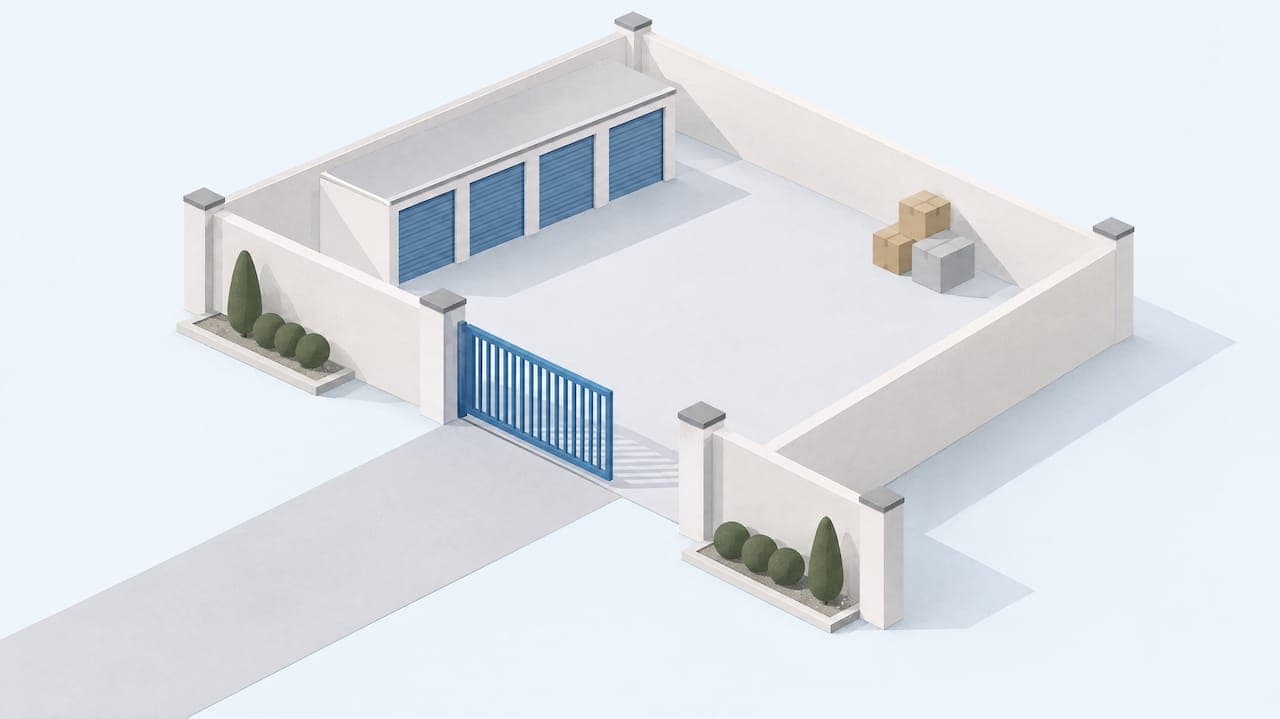
A gated storage facility limits who can drive onto the property, so only renters and staff reach the unit doors. That cuts down casual foot and vehicle traffic. It is not a complete security system, and it works best alongside cameras, lighting, a well-run office and a good lock on your own unit. This guide explains what a gate adds, what to check next to it, and how to pick the right unit size when you rent in South San Antonio.
TL;DR
- A gate controls vehicle entry. It deters opportunists but does not replace cameras, lighting or a solid lock.
- Ask about the whole package: video surveillance, gate operation, lighting, fencing, and how you get in after hours.
- At Inline Storage in South San Antonio, you get gated entry, video surveillance, drive-up access and a 24-hour kiosk, with Touchless Rentals™ for online renting.
- Size matters as much as security: 5x5 for a closet, 10x10 for a one-bedroom, 10x30 for a full household.
- A storage unit is for belongings only. It cannot be used as a residence.
Table of Contents
- What "gated" actually means
- The real benefits of a gated storage facility
- What a gate does not do
- Security features worth checking next to the gate
- Our perspective: security is a system, not a gate
- Choosing the right unit size
- What storage costs
- How to tour a gated facility in five steps
- Rules to know before you rent
- Renting with Inline Storage
- FAQ
- Sources
What "gated" actually means
The word covers a range of setups. At the simple end, there is a swing or sliding gate at the entrance that is closed outside business hours. At the other end, an electronic gate opens only when a renter enters a code at a keypad, and the fence runs the full perimeter of the property.
When you search for a gated facility, you are usually asking three things:
- Can a stranger drive in and walk the rows?
- If someone does get in, will there be a record?
- Can I get to my things when I need them, without waiting for an office to open?
A gate answers the first question. Cameras answer the second. The third depends on how access is set up, which is why a facility with a gate and a 24-hour kiosk is a different proposition from one with a gate and a locked office.
The real benefits of a gated storage facility
It filters who is on the property
Most storage theft is a crime of opportunity. Someone sees an open lot, an unlocked door or a unit with a weak latch, and acts. A gated entrance removes the easiest version of that: a person with no reason to be there simply driving in. For a business owner keeping inventory in a unit, or a family storing furniture during a renovation, that first layer matters.
It makes cameras more useful
Video surveillance is much more valuable when there is one controlled way in and out. If every vehicle passes through the same point, footage of who came and went is easier to review. Cameras without a gate record what happened. A gate with cameras narrows down who could have been there.

It keeps the property calmer
Fewer unrelated visitors means fewer people cutting through, loitering or dumping trash. Tenants notice this in daily use: quieter aisles, cleaner corners and less to worry about when you visit after work.
It supports vehicle storage
Gates matter most for RVs, trailers and boats, which are high-value and easy to see from the road. If you are weighing outdoor parking for a vehicle, a fenced, gated lot with cameras is a sensible baseline. We cover our options on the RV storage and boat storage pages.
What a gate does not do
Being honest about limits will help you more than any brochure line.
- It does not stop someone who is already a tenant. Anyone with gate access can reach the aisles, which is why your own lock matters.
- It can be followed through. A car trailing another through an open gate is a known weak point at any facility with automated entry. Cameras and tenant awareness cover that gap.
- It does not protect against weather. A gate does nothing for humidity, heat or moisture. For that, you need a different feature: climate control.
- It does not insure your belongings. Check your renter's or homeowner's policy, or ask what tenant protection options are offered at move-in.
Security features worth checking next to the gate
Use this list when you tour any facility, ours included.
| Feature | Why it matters | What to ask |
|---|---|---|
| Video surveillance | Creates a record and deters theft | Which areas do cameras cover? Do they include the gate and aisles? |
| Gated entry | Controls vehicle access | Is it electronic? Is the fence continuous? |
| Lighting | Makes evening visits safer | Are the driveways and unit rows lit? |
| Drive-up access | Lets you load next to the door, out of the aisle | Are all units drive-up or only some? |
| After-hours access | Matters if you work days | Is there a kiosk or staffed office when you arrive? |
| Open parking | Room to park a vehicle or trailer | Is it separate from the unit rows? |
| ADA storage spaces | Step-free, easy access | Which units are accessible? |
At Inline Storage, the facility in South San Antonio has gated entry, video surveillance, drive-up access, open parking, ADA storage spaces and a 24-hour contactless kiosk. If accessibility is a priority, our guide to five checks for accessible storage units walks through what to look for.
Our perspective: security is a system, not a gate
We get asked about the gate more than almost any other feature, and we understand why. It is the first thing you see and the easiest to picture. But when we think about what makes customers comfortable leaving their belongings with us, the gate is one piece.
Here is how we think about it:
- Layers beat any single feature. Gated entry, video surveillance and a lock you choose yourself each cover a different gap.
- Convenience is part of safety. A kiosk open around the clock means you do not have to rush a move-in or wait on someone to unlock the office. Fewer rushed decisions lead to fewer mistakes, like leaving a unit unlatched.
- Fewer touchpoints help. With Touchless Rentals™, you can rent a unit online with minimal physical interaction, which suits people who want a quick, low-contact process.
- Match the unit to the stuff. Security is wasted if your things are damaged by heat. In South Texas, climate-controlled storage is worth a look for electronics, documents, photographs and wood furniture.
- Stay flexible. Our leases are month-to-month, so you are not locked into a long commitment while you work out how much space you need.
If we had to give one piece of advice: visit, look at the gate, then look at everything else. A facility that is confident in its setup will show you around.
— Ian
Choosing the right unit size
Once you are happy with security, size is the next decision, and it is where most people either overpay or run out of room. U-Haul's size guide groups units into small (up to 50 sq. ft., typically lockers and 5x5), medium (51 to 150 sq. ft., including 5x15 and 10x10) and larger units, with 10x30 at 300 sq. ft. as the largest size at many facilities, roughly a 1.5-car garage.
Here is how we match sizes to the situations we hear about most.

Lockers and 5x5: the closet
Good for seasonal clothing, boxes, a small piece of furniture or a bike. Our post on what fits in a 5x5 shows how many boxes it takes, and our bicycle storage guide covers whether a bike fits.
5x10: the small apartment
A mattress, a few boxes, a desk and some small furniture. If you are downsizing or living in a small apartment, see our small apartment storage guide and the 5x10 units.
10x10 and 10x15: a one- to two-bedroom move
The 10x10 is the common choice for a one-bedroom home's furniture. A 10x15 gives you more depth and room for appliances. Our post on ceiling height, packing and contactless booking for a 10x15 explains how to use the vertical space. Comparing 10x10 and 10x20? Read our furniture storage guide.
10x20 and 10x30: a full household or a business
The 10x20 suits a two- to three-bedroom home or a small business with pallets or shelving. The 10x30 is the largest size, and U-Haul notes it can hold the contents of a fully furnished four-bedroom house. If you are planning one, our 10x30 guide explains how to load it so you can still reach things.
Why drive-up helps
When you are moving furniture, a unit you can pull up to beats carrying boxes through hallways. Our drive-up storage guide covers which sizes work for a one- or two-bedroom move.
What storage costs
Prices depend on size, location and features, so use national numbers only as a sanity check. As of September 2026, TractIQ reports a national average street rate of $1.41 per square foot per month and an average web rate of $1.17, with the average 10x10 around $120 a month, though it ranges from roughly $62 in Oklahoma to $253 in Hawaii.
Two things to understand about those figures:
- Web rates and street rates differ. Web rates are usually lower and can include move-in specials. Street rates are higher and steadier.
- Climate control costs more. One 2026 guide puts the premium at about $17 a month over a standard unit, which can be a fair price for sensitive items.
At Inline Storage, pricing starts from $65 a month, and the exact rate depends on the unit. For students, our summer storage guide explains how to choose quickly.
How to tour a gated facility in five steps
- Drive the perimeter first. Look for a continuous fence, no gaps and no overgrown corners.
- Watch the gate work. Does it close behind each vehicle? Is it damaged or propped open?
- Look up. Find the cameras and check that they cover the gate and aisles. Check lighting too.
- Test access. Ask how you would get in on a Sunday evening, and what happens if you forget your code.
- Read the lease. Check the term, notice period, fees, insurance requirements and lien terms before signing.
Rules to know before you rent
You may wonder whether you can spend time in your unit, or live in it. The answer is no. Iowa's self-service storage statute is one example of state law covering storage facilities, and leases generally limit use to storing personal property. Rules differ from state to state, so for Texas, read your own rental agreement and ask the manager.
Also know what happens if you stop paying. Virginia's Self-Service Storage Act illustrates how these laws work: an owner can deny access to a unit in default and may eventually sell the contents to satisfy the lien. Texas has its own statute and notice process, so if you think you may be late on rent, call the office early rather than hoping it goes away.
Renting with Inline Storage
If you are near South San Antonio, we make it simple to get started. Choose a unit on our self-storage page, reserve it online with Touchless Rentals™, and move in whenever suits you. You get gated entry, video surveillance, drive-up access and month-to-month terms. If you are not sure which size you need, our month-to-month guide explains how short-term renting works, or you can start at inlinestorage.com.
FAQ
Is a gated storage facility safer than an open one?
Usually, yes, because a gate limits who can drive onto the property. It is still only one layer. Look for cameras, lighting, a fence and a decent lock on your unit too.
Do I still need a lock if the facility is gated?
Yes. Anyone who has gate access can walk the aisles, so your lock is the last barrier between your belongings and everyone else. Choose a sturdy one and use it every time.
Can I hang out in a storage unit?
No. Leases limit units to storing personal property, and state laws, such as Iowa's, treat residential use as off limits. Ask your facility manager about any questions on what is allowed.
What is the biggest storage unit you can rent?
At many facilities, 10x30, which is 300 square feet, according to U-Haul. Sizes vary by location, so check what is available near you.
Can I pay for a storage unit a year in advance?
Some facilities allow prepayment, but policies vary. We rent month-to-month, so ask us about payment options when you reserve.
Sources
- TractIQ self-storage market data
- U-Haul 10x30 storage unit information
- Easy Storage Search 2026 self-storage guide
- Iowa Code Chapter 578A, self-service storage facilities
- Code of Virginia, Virginia Self-Service Storage Act