
If you have a car and live within driving distance, rent a small self-storage unit near campus. If you're going home across the country or flying, book a pickup-and-store service instead. If your load is light, just take it home. Either way, do two things this week: build a quick inventory of what needs storing, and reserve your space now, before move-out week prices climb.
TL;DR:
- Students living near campus with access to a vehicle should rent a self-storage unit or use on-campus storage to save money, while those flying home benefit from pickup-and-store services.
- The most common storage unit size for solo students is 5x5, which accommodates a dorm room's belongings, but larger options like 5x10 or 10x10 are better for shared spaces or multiple roommates.
- Booking storage two to three weeks before move-out minimizes costs and availability issues, especially during peak late April to early May deadlines.
- Climate-controlled units are recommended for electronics, furniture, and delicate items, but basic storage is sufficient for bedding and household items.
- Never store irreplaceable items like passports, medications, or jewelry; always prepare, inventory, and label boxes, and photograph contents for a smooth move-out process.
Table of Contents
- What Are Your Student Summer Storage Options?
- Access, Cost, and Security: How the Options Really Compare
- How to Estimate Your Total Storage Cost and Pick a Unit Size
- Packing Rules: What to Store, What to Take Home, and How to Prep It
- When to Book: Your Move-Out Timeline
- Choosing a Provider: The Short Checklist Before You Book
- Why Inline Storage Fits Student Needs
- End-of-Summer Retrieval: Avoiding Surprise Fees
- A Quick Note on Paying for Convenience
- Reserve Your Unit With Inline Storage Before Move-Out Week
- Sources
- FAQ
What Are Your Student Summer Storage Options?
Most students choose between five setups, and each one fits a different situation.
- Take it home: Free and simple if you have a car or family nearby to help haul boxes. Not realistic for international students or anyone flying home.
- On-campus storage programs: Some universities offer summer storage in dorms or nearby warehouses, often at a flat seasonal rate. Convenient, but space is limited and fills up fast.
- Self-storage units: You rent a unit near campus or home, load it yourself, and get a key or access code. Cheapest per month if you have a vehicle and don't mind the drive.
- Portable storage containers: A company drops a container at your door, you pack it, then they haul it to a facility. Useful when you have too much to carry but no truck.
- Pickup-and-store (full-service): Movers pack your stuff, store it, and deliver it back in the fall. Costs more but solves the no-car, long-distance problem completely.
Distance and access needs decide this more than anything else. A student staying in-state with a car should almost never pay full-service prices.
Access, Cost, and Security: How the Options Really Compare
The real differences show up in four places: how often you can get to your stuff, what you pay, who does the lifting, and how secure the space is.
- Access frequency: Self-storage and on-campus units let you visit anytime during posted hours. Pickup-and-store and containers usually lock your items away until a scheduled delivery date.
- Cost range: Self-storage tends to run cheapest per month since you're only paying for space. Full-service pickup bundles in labor and transport, so it costs more but saves you the drive.
- Who does the work: You load and unload self-storage and containers yourself. Full-service crews handle the packing, hauling, and unloading.
- Security and climate control: Commercial self-storage facilities typically offer gated access, video surveillance, and optional climate control. On-campus programs vary widely in security standards from school to school.
A 5x5 unit holds roughly one dorm room's worth of belongings. Step up to a 5x10 and you've got room for two students' items or a small bedroom's worth of furniture. Full-service pricing usually bundles a flat rate per item or per cubic foot, which can beat monthly rent for a short three-month stretch but loses that advantage over a full year.
How to Estimate Your Total Storage Cost and Pick a Unit Size
Run the numbers before you commit to anything. The standard formula is straightforward: monthly rent times the number of months, plus one-time move costs, packing supplies, and any optional protection or insurance.
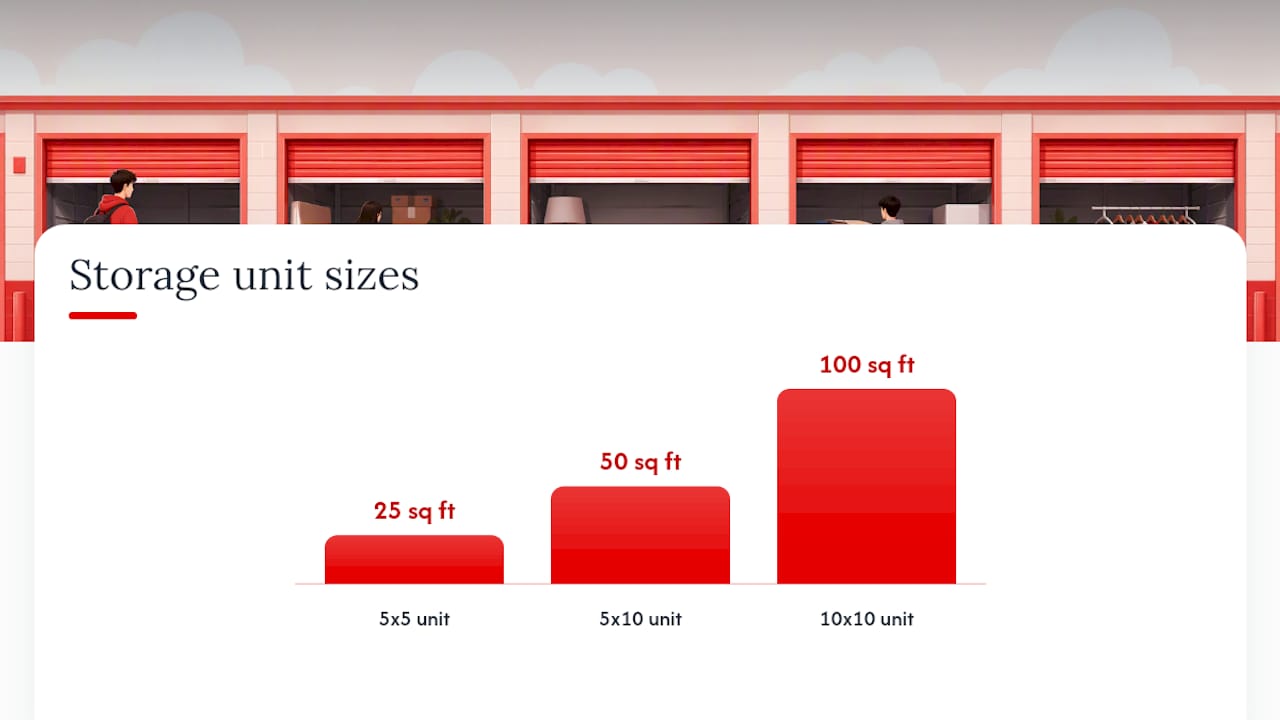
Unit sizes break down like this:
- 5x5 (about 25 square feet): Fits a single dorm room's worth of belongings, mini-fridge, bins, bedding, and a bike. This is the default pick for most solo students.
- 5x10 (about 50 square feet): Covers two students' dorm items or a small off-campus bedroom, including a mattress leaned on its side and a few pieces of furniture.
- 10x10 (about 100 square feet): Holds a full studio or shared apartment's worth of stuff. Splitting a 10x10 among three or four roommates usually costs less per person than everyone renting separate 5x5 units.
Three quick scenarios to run through the formula yourself:
- A solo student storing dorm items for three months in a 5x5, plus a $20 lock and $15 in tape and boxes.
- Four roommates splitting a 10x10 for three months, dividing rent evenly and each covering their own packing supplies.
- A long-distance student paying a flat full-service rate for pickup, three months of storage, and fall delivery, with no driving involved.
Add optional protection insurance to any of these if your items include electronics or furniture worth replacing.
Packing Rules: What to Store, What to Take Home, and How to Prep It
Before you pack a single box, sort everything using the Keep, Store, Donate method: keep what you need this summer, store what you'll need again in the fall, and donate or sell the rest. It cuts both time and cost once you actually pack.
Some items should never go into storage. Take these home instead: passports, medications, laptops, jewelry, and anything irreplaceable.
For everything else:
- Use plastic bins instead of cardboard for anything staying in storage more than a few weeks. They hold up better against moisture and pests.
- Cover mattresses in a plastic mattress cover before storing them on their side.
- Skip vacuum bags for anything with structure, like pillows or stuffed items you want to keep their shape. They work well for clothes and bedding you won't need until fall.
- Label every box by room and priority, and photograph the contents before sealing it so you're not guessing what's inside come August.
Pro Tip: Unplug your mini-fridge, defrost it, and let it air out for at least 24 hours before it goes into storage. A damp fridge grows mold fast, and that mold can spread to whatever's stored next to it.
When to Book: Your Move-Out Timeline
Reserve storage two to three weeks before move-out, and aim for April if your campus market gets tight in May. Waiting until finals week means competing with hundreds of other students for the same units and trucks.
- Three to four weeks out: Build your inventory and sort items using Keep, Store, Donate.
- Two to three weeks out: Book your unit or pickup service and measure large items against unit dimensions.
- One week out: Gather boxes, bins, and packing tape.
- Move-out day: Confirm your pickup window or drive over and load in.
Students going home nearby have flexibility. Long-distance and international students don't, so book earlier to lock in a slot before flights and finals collide.
Choosing a Provider: The Short Checklist Before You Book
Run any option through five filters: fit, cost, convenience, security, and flexibility.
- Fit: Does the unit size actually match your inventory, or are you guessing?
- Total cost: Have you added move fees, supplies, and insurance to the monthly rate, not just the sticker price?
- Convenience: Do you need drive-up access, or does a pickup service make more sense given your schedule?
- Security: Does the facility have gated entry, cameras, and clear access hours?
- Flexibility: Can you go month-to-month, or are you locked into a long-term lease you don't need?
Before signing anything, ask directly: Where exactly is the facility located relative to campus? What's covered under their insurance or protection plan? What are the access hours, and is there a hard deadline for fall pickup? A provider that can't answer these clearly is a red flag, not a minor inconvenience.
Why Inline Storage Fits Student Needs
Inline Storage offers Touchless Rentals™ for contactless booking, a full range of unit sizes, climate-controlled options, drive-up access, gated entry, and video surveillance. For students without a car or with unpredictable finals schedules, contactless booking and month-to-month leases remove two of the biggest summer storage headaches.
End-of-Summer Retrieval: Avoiding Surprise Fees
Getting your stuff back out should take less planning than moving it in, but only if you handle a few things before move-in week.
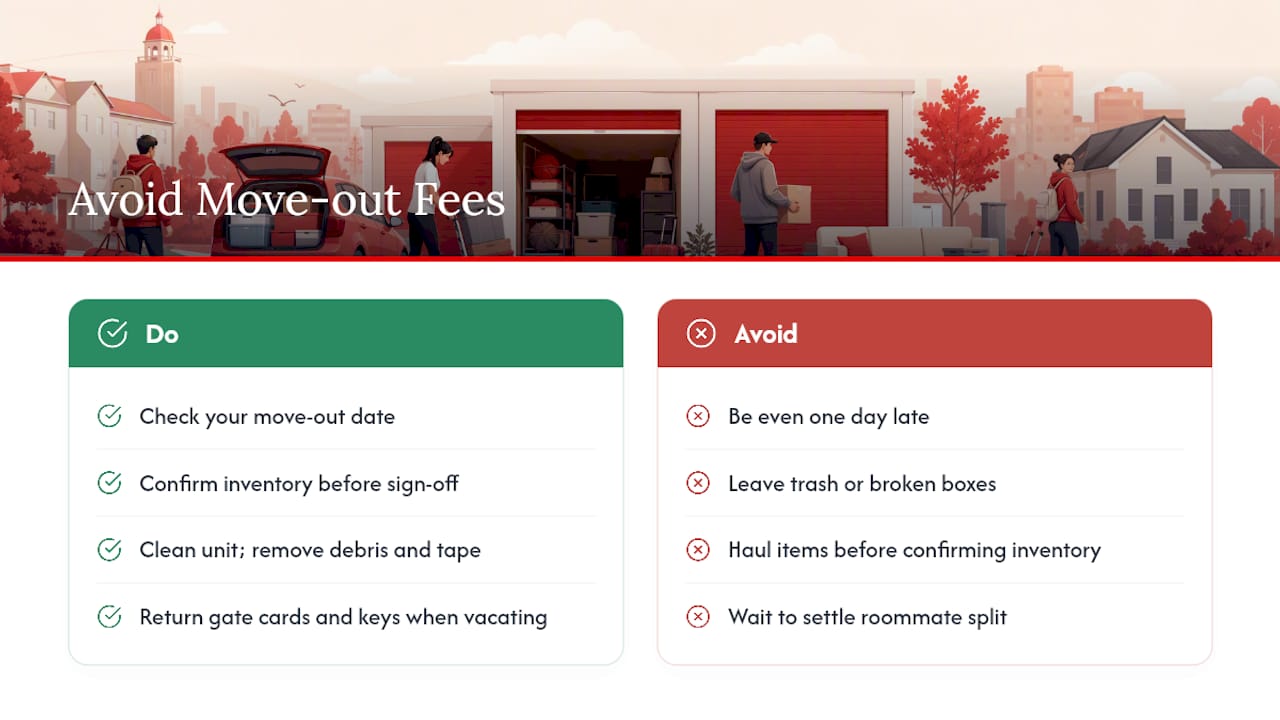
Start by checking your contract's move-out deadline. Most facilities charge a full extra month if you're even a day past your scheduled end date, so mark that date somewhere you'll actually see it. Walk through your digital inventory photos and confirm nothing's missing or damaged before you sign off, since disputes are much harder to resolve after you've already hauled everything away.
Clean out the unit completely, including sweeping out packing debris and removing any tape residue from walls or doors. Facilities often charge cleaning fees for units left with trash, broken boxes, or leftover furniture nobody wanted. If you shared a unit with roommates, settle who's taking what before pickup day, not during it. A labeled, owner-by-owner inventory prevents the awkward parking-lot argument over whose lamp is whose.
Return any access devices, gate cards, or keys on the day you vacate. Late returns sometimes trigger a fee even after you've technically moved everything out. Take final photos of the empty unit as proof of its condition, the same way you photographed it going in. If you paid for insurance or protection coverage, confirm whether it's prorated or refundable for unused months. And if you're switching to a smaller unit for a partial-year lease, ask about transferring your existing rental instead of closing it out and rebooking, which can save you a second move-in fee entirely.
A Quick Note on Paying for Convenience
Paying more for pickup service makes sense when finals, flights, and move-out overlap. If your summer is that tight, the extra cost buys back hours you don't have.
Pro Tip: Photograph every box, label the side facing out, and pack a small "essentials" bag you keep with you, not in storage.
— Ian
Reserve Your Unit With Inline Storage Before Move-Out Week
Inline Storage gives students a nearby, contactless way to handle summer storage without waiting in line or coordinating a facility visit around finals. Book through Touchless Rentals™ from your phone, pick from a full range of unit sizes starting around $65, and choose climate control if you're storing electronics or furniture that can't handle heat swings.
Every unit comes with gated entry, video surveillance, and drive-up access, so you're not hauling boxes through a maze of hallways. Leases run month-to-month, which matters if you're not sure exactly when you'll be back for your things. Reserve your self-storage unit online now, before move-out week fills the closest units to campus.
Sources
- College Move-Out and Summer Storage: A Parent's Guide (2026)
- Storage tips for college students: summer storage costs, packing, and unit size
- How to prepare your mini-fridge for storage
- Crates: College Students
FAQ
What size storage unit does a college student need?
Most solo students fit their dorm room into a 5x5 unit, which holds a mini-fridge, bins, bedding, and a bike. Roommates sharing furniture usually need a 5x10 or, split three or four ways, a 10x10.
How far in advance should I book student summer storage?
Book two to three weeks before move-out, and go earlier in April if your campus market gets competitive in May. Waiting until finals week risks paying more for whatever space is left.
How much does student summer storage cost?
Cost depends on unit size, location, and how many months you need it, calculated as monthly rent times months, plus move costs, supplies, and optional insurance. Inline Storage lists unit sizes starting around $65 a month, with current pricing available on its site.
Is climate-controlled storage worth it for students?
It's worth it for wood furniture, musical instruments, electronics, and paper records that can warp or degrade in heat and humidity. Basic bedding and inexpensive housewares generally do fine in a standard unit without the added monthly cost.
What items should I never put in storage?
Keep passports, medications, laptops, jewelry, and anything irreplaceable with you instead of in a unit. Most facilities also prohibit flammable materials, perishable food, and hazardous chemicals, so check your contract's restricted-items list before you pack.