
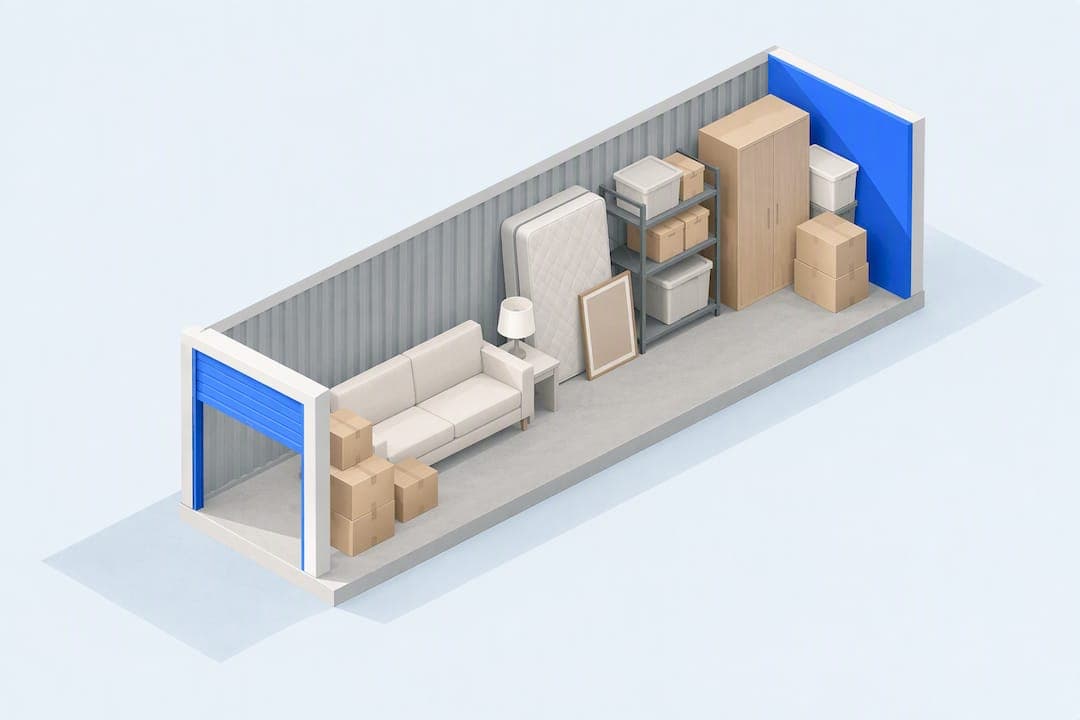
A 10x30 storage unit measures 10 feet by 30 feet and at a typical 8 foot ceiling, offers about 2,400 cubic feet of space. That footprint commonly holds a four-bedroom household, a vehicle plus boxes, or palletized business inventory. Before booking, confirm the roll-up door opening and exact ceiling height with the facility, since both vary and affect what you can actually move inside.
TL;DR:
- Confirm that the door opening and ceiling height match your largest items, as these dimensions vary and limit what can be stored inside.
- Understand that a 10x30 unit at eight feet high offers about 2,400 cubic feet of space, suitable for a four-bedroom household or a vehicle plus boxes.
- Consider splitting into two 10x15 units for better access and flexibility if frequent retrieval or separation of contents is desired.
- Use effective organization strategies, such as reserving the front for accessible items and stacking with shelving or pallets to maximize space.
- Be aware that cost varies by location, with a typical median rent around $246 monthly, and compare benefits of one large unit versus two smaller units based on access needs.
Table of Contents
- How big is a 10x30 unit in square feet and cubic feet?
- What fits in a 10x30 unit: furniture, vehicles, and pallets
- How to load and organize a long, narrow 10x30 unit
- Choosing a moving truck and checking door clearance
- What does a 10x30 unit cost, and is one big unit better than two smaller ones?
- Depth versus width: a practical take on long storage units
- Reserving a 10x30 unit with Inline Storage and confirming it fits
- FAQ
- Sources
How big is a 10x30 unit in square feet and cubic feet?
The math behind a 10x30 unit is straightforward: 10 feet times 30 feet gives you 300 square feet of floor space. Multiply that by an 8 foot ceiling and you get roughly 2,400 cubic feet of usable volume. Some facilities offer taller units, in the 10 to 12 foot range, which pushes usable cubic feet higher and gives you more room to stack boxes or furniture without crowding the floor.
A 10x30 unit at an 8 foot ceiling holds about 2,400 cubic feet, though actual usable space depends on how efficiently you stack and how much aisle room you leave for access.
Two details matter more than the headline numbers:
- The roll-up door opening is often narrower than the interior width, which limits the size of items you can wheel or drive inside.
- Ceiling height listed by a facility is an average, and your actual unit may run a few inches shorter or taller.
Before you commit to a unit, measure your largest items (a sofa, a mattress, a vehicle's width) and call the facility to confirm both the door opening and the ceiling height for that specific unit.
What fits in a 10x30 unit: furniture, vehicles, and pallets
Most fit calculators and facility guides agree that a 10x30 unit comfortably holds the furniture and appliances from a four-bedroom home, including beds, a couch, a dining set, a refrigerator, and dozens of boxes. Larger homes with oversized furniture or extensive garage contents may need to leave a few bulky items behind or add a smaller secondary unit.

The same footprint works well for vehicle storage. A 30 foot depth comfortably fits a car, pickup truck, or small RV with several feet left over for boxes and totes, as long as the drive-up access and door width match the vehicle's dimensions.
For business or inventory use, pallet math helps size up capacity. A standard 48 by 40 inch pallet occupies about 13 square feet, so a 300 square foot floor could theoretically hold around 22 pallets if you used every inch. In practice, you will fit fewer once you account for:
- A center aisle for forklift or hand-truck access.
- Stacking height limits based on pallet weight and product fragility.
- Clearance near the door for loading and unloading.
For household boxes, a loose rule of thumb is that a well-packed 10x30 holds several hundred standard moving boxes when stacked to a reasonable height, but that number drops fast if you need a walkway down the middle rather than packing wall to wall.
How to load and organize a long, narrow 10x30 unit
A 10 foot wide, 30 foot deep unit rewards planning more than brute-force stacking. Organize it in zones and you will avoid digging through everything to find one box.
- Reserve the front third for items you need often, such as seasonal gear, tools, or business inventory you restock from regularly.
- Use the back two-thirds for long-term storage: furniture, archived records, or items you won't touch for months.
- Skip a full center aisle if your unit is only 10 feet wide and you're storing bulky furniture on both sides; instead, leave a narrow path just wide enough to walk and plan vertical access from the front.
- Distribute weight evenly, keep heavy or rigid items low, and use shelving or sturdy pallets to protect boxes from moisture on the floor.
- Leave 20 to 30% more space than your initial estimate suggests, since real-world stacking is rarely as tight as a calculator assumes.
Pro Tip: Photograph each wall of stacked boxes as you fill the unit, and keep a simple labeled inventory list so you never have to unload the back to find one item.
Choosing a moving truck and checking door clearance
Matching your moving truck to a 10x30 unit avoids a frustrating second trip. Most movers use a 16 to 26 foot box truck for a load this size, with the larger end of that range suited to full four-bedroom households.
- Load the longest and bulkiest items first so they land at the back of the unit, matching the 30 foot depth.
- Save frequently accessed boxes for last so they come off the truck first and land near the unit's front third.
- Confirm the facility's roll-up door width and height, along with drive-up clearance, before loading day so oversized furniture or a trailer hitch doesn't get stuck at the entrance.
What does a 10x30 unit cost, and is one big unit better than two smaller ones?
Pricing for a 10x30 unit varies by location, but one tracked dataset puts the national median rent at roughly $246.30 per month. Indoor, climate-controlled, or higher-demand locations tend to push that figure up, while basic drive-up units in less competitive markets often run lower.
An alternative worth weighing is splitting the same floor area into two 10x15 units instead of one 10x30. The combined square footage is identical, but two separate doors mean:
- Easier access to items stored near the back, since you're never digging through 30 feet of depth for one box.
- A natural way to separate household goods from business inventory without mixing contents in one aisle.
- More flexibility if your storage needs shrink, since you can give up one unit instead of renegotiating a single large lease.
Decide based on how often you'll need to retrieve items, how mixed your inventory is, and whether your budget favors one larger payment or two smaller ones.
Depth versus width: a practical take on long storage units
A 10x30 unit's biggest advantage, its depth, is also its biggest planning challenge. Width gives you an aisle; depth without width just gives you more to unload. My rule of thumb: treat the front third as your working zone and everything past that as archive space you touch rarely. Combine that with a labeled inventory and a few photos, and a unit that looks intimidating on paper becomes easy to manage in practice.
Before you book, always verify the actual door opening, ceiling height, and drive-up clearance with the facility, since published averages can differ from the unit you're assigned. If you have questions about sizing your specific load, most facilities are glad to walk through it with you.
— Ian
Reserving a 10x30 unit with Inline Storage and confirming it fits
We offer 10x30 units as part of our 10x20 & 10x30 Units lineup, built for households and businesses that need the depth and volume this size provides. Some facilities offer touchless rental systems to allow reservations and move-ins with minimal in-person contact, and units may be located on properties with video surveillance and 24-hour kiosks for after-hours access.

Before you load, we recommend calling ahead or checking unit specs on our South San Antonio storage page to confirm ceiling height and roll-up door width for your assigned unit. If you're storing a vehicle alongside household goods, our RV storage options are worth comparing for drive-up clearance.
| Feature | What it means for a 10x30 renter |
|---|---|
| Touchless Rentals™ | Reserve and access your unit with minimal in-person interaction |
| Drive-up access | Load directly from your vehicle without a long carry |
| Video surveillance | Monitored grounds for added security |
| 24-hour kiosk | Self-service account and access support outside office hours |
Check availability and reserve your unit directly through Inline Storage to lock in a 10x30 that fits your move-in timeline.
FAQ
How much can fit in a 10x30 storage unit?
A 10x30 unit typically holds the furniture and appliances from a four-bedroom home, or a vehicle plus several dozen boxes. Business users can expect room for roughly 15 to 20 pallets once you account for an access aisle and stacking limits.
How big is 10x30?
A 10x30 unit measures 10 feet wide by 30 feet long, totaling 300 square feet. At a typical 8 foot ceiling, that works out to about 2,400 cubic feet of usable space.
How big is a 12x30 storage unit?
A 12x30 unit is wider than a 10x30, and the extra width mainly helps by making room for a center aisle, which is harder to fit in a 10 foot wide unit when storing bulky items on both sides.
Is a 10 by 10 storage unit big enough?
A 10x10 unit covers a smaller floor area than a 10x30, and suits a one to two-bedroom apartment or a small vehicle's worth of boxes. For a four-bedroom household or vehicle storage, a 10x30 or larger unit is the better match.
Should I rent one 10x30 or two 10x15 units instead?
Both options offer the same total floor area, but two 10x15 units often improve access since each has its own door and shorter depth to dig through. A single 10x30 can still work well if most of your stored items are long-term and rarely retrieved.
Sources
- 10x30 Storage Units — What Fits & What They Cost | Storage by Price
- What Fits in a 10x30 Storage Unit? Fit Calculator | ItemFits
- Storage