
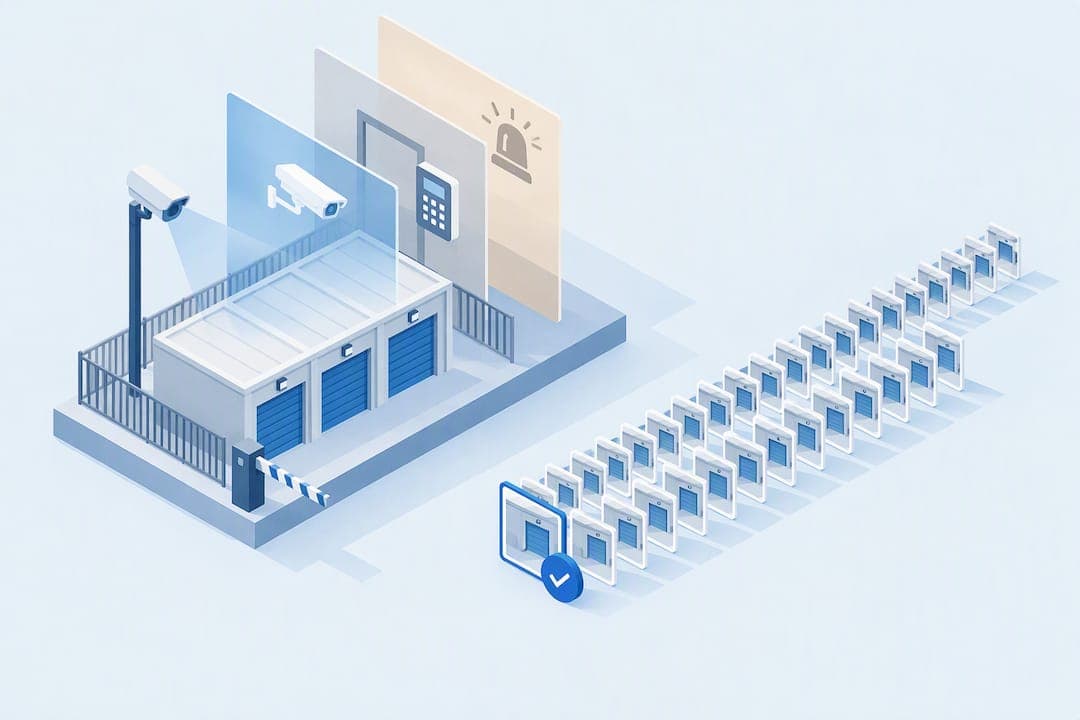
Yes, storage units can be safe, but safety depends on the facility's security features and how you pack and insure your belongings. Before signing a lease, confirm the facility has recorded video surveillance, gated or electronic access control, and climate control if you're storing anything sensitive to heat or moisture. Walk the property, ask for proof of insurance options, and get the retention policy in writing.
TL;DR:
- Facilities with layered security systems, including video surveillance, individual gate codes, and unit alarms, report up to 75% fewer theft incidents.
- Climate control and humidity monitoring are essential to prevent mold and moisture damage, especially in non-climate-controlled units in humid regions.
- Inspect the storage unit for water stains, pests, and structural issues, and verify camera footage retention and response times before signing a lease.
- Storing hazardous items like flammable liquids, explosives, or chemicals in standard units poses serious safety risks and often requires specialized facilities.
- Most property-based security measures are passive; maximizing safety relies on renter practices such as using documented inventories, elevating boxes, and insuring belongings.
Table of Contents
- What Are the Biggest Risks to Items in Storage?
- What Security Features Should a Safe Facility Have?
- How Do You Inspect a Unit and Pack It Safely?
- What Should You Never Store in a Standard Unit?
- Does Your Insurance Actually Cover a Storage Unit?
- How Inline Storage's Features Address These Risks
- The Checklist Matters More Than the Price Tag
- Reserve a Unit Built Around These Safety Checks
- FAQ
- Sources
What Are the Biggest Risks to Items in Storage?
Most storage problems fall into five categories: theft, water damage, fire, pests, and natural disasters. Knowing how each one actually happens helps you judge whether a facility and your own packing choices are up to the job.
Theft remains the risk people worry about most, and for good reason. Self-storage facilities can attract break-ins partly because of what security researchers call the "hotel rule": units are anonymous, so a thief doesn't know whether they're cutting into an empty locker or one full of electronics. Facilities that invest in integrated security stacks report large drops in theft incidents, and the gap between well-protected and poorly protected sites is widening as more operators upgrade their systems, according to a self-storage security market report.
According to industry data, facilities using modern security stacks, combining surveillance, access control, and unit alarms, report 65% to 75% fewer theft incidents and 40% to 50% faster response times than facilities relying on a single measure like a perimeter fence or basic padlocks, per the same security systems market research. That gap is the clearest evidence that layered security, not any single feature, is what actually deters break-ins.

Water and mold are the quieter threat. The EPA recommends keeping indoor relative humidity between 30% and 50%, and strictly below 60%, to prevent mold growth. A non-climate-controlled unit in a humid region can swing well past that range for weeks at a time, especially after rain or a temperature change that causes condensation on walls and floors.
Fire risk in storage units usually traces back to a handful of causes: faulty wiring in older buildings, overloaded power strips brought in by renters, or stored chemicals reacting with heat. Densely packed boxes and furniture mean fire spreads fast once it starts, with little airflow to slow it.
Pests leave evidence before they cause visible damage: droppings, chewed cardboard corners, or a musty smell near baseboards. Rodents and insects target paper, textiles, and wood first, which makes books, clothing, and furniture especially vulnerable in units that aren't sealed well.
Natural disasters are harder to control but not impossible to plan around. Before renting, check:
- Whether the facility sits in a flood zone or low-lying area prone to standing water
- Whether units are elevated above ground level or built on a raised slab
- How the facility handled past severe weather events, if staff will share that history
- Whether the roof and drainage systems have had recent maintenance
What Security Features Should a Safe Facility Have?
A facility that takes security seriously will have measures you can actually verify, not just a sign out front. Ask specific questions rather than accepting a general "we have cameras" answer.
Video surveillance matters most when it covers entry points, hallways, and the unit rows themselves, with enough resolution to identify a face or license plate at night. Insurers increasingly require that footage be retained for at least 30 days, since that window is often the difference between a usable police report and a dead end, according to market research on storage security systems.
Access control is the second pillar. A facility where every renter gets an individual gate code, logged by time and date, is far more accountable than one using a single shared code for the whole property. Some operators now pair that with staff patrols or remote monitoring rather than relying on cameras alone.
- Video coverage: cameras at gates, hallways, and unit rows with at least 30 days of stored footage
- Access control: individual gate codes tied to your account, not a shared code
- Unit-level protection: smart locks or unit alarms that flag tampering, plus high-security doors
- Lighting and fencing: well-lit rows and a secured perimeter that discourages loitering
- Operational practices: written incident logs, staff trained on police reporting procedures
Unit-level smart locks that report door status and tamper events reduce the success rate of cut-and-run thefts, since many break-ins exploit weak hasps or poorly placed padlocks rather than the lock itself, as industry reporting on self-storage crime has noted. Operators increasingly treat visible security investment as a form of brand protection, and that investment is a reasonable signal of facility quality, per Janus International's analysis of self-storage vulnerabilities.
Pro Tip: Ask the front desk for the exact camera retention period in writing, not just a verbal "we keep footage." A facility that hedges on this question usually hasn't thought it through.
How Do You Inspect a Unit and Pack It Safely?
A short walkthrough before you sign anything tells you more than any brochure. Follow this order on your visit:
- Approach the property and note whether the gate requires a code for every vehicle or stays propped open.
- Check camera placement at the entrance, hallways, and near your specific unit row.
- Test the lighting by visiting toward evening if you can, since poor lighting at night is a common gap.
- Inspect the unit interior for water stains, gaps under the door, or a musty smell before you sign.
- Look for pest evidence: droppings, chew marks, or nests in corners and along baseboards.
While you're there, ask staff how long camera footage is retained, how quickly they respond to a triggered alarm, what hours you can access your unit, and whether they require proof of insurance as part of the lease.
Once you're packing, elevate boxes on pallets or shelving rather than placing them directly on concrete, which sweats moisture; for more detailed advice, see these storage tips and packing guidance. Use silica packets or a small dehumidifier in non-climate-controlled units, and cover fabrics with breathable fabric covers instead of airtight plastic, which traps condensation. Leave clearance near the ceiling and away from any sprinkler heads, and avoid stacking boxes so tightly that airflow stops entirely.

Pro Tip: A standard padlock on a weak hasp is often the easiest point of entry. Pair a hardened disc lock with a unit alarm if your facility offers one, rather than relying on the lock alone.
What Should You Never Store in a Standard Unit?
Some items create risk no amount of security can offset, because the danger comes from the item itself, not from who might break in.
- Flammable liquids, fuel, propane, or other compressed gases, which raise fire and explosion risk
- Perishable food or live plants, which attract pests and spoil quickly without climate control
- Fireworks or other explosives, which are illegal to store in most general-purpose units
- Unsecured hazardous chemicals, which can react dangerously with heat, humidity, or each other
Storing hazardous chemicals in a general-purpose unit is unsafe because proper storage requires segregating incompatible materials, specialized cabinets, and labeling that standard units don't provide, according to chemical storage guidance from Mississippi State University's environmental health office. If you have a regulated item that genuinely needs storage, a licensed specialty facility designed for that material is the only safe option.
Does Your Insurance Actually Cover a Storage Unit?
Most facilities offer limited liability coverage, which usually falls far short of replacing a unit full of furniture, electronics, or sentimental items after a fire or theft. That gap is exactly why renters often need their own coverage, either through a homeowner or renter's policy rider or a standalone storage insurance plan.
- Call your current homeowner or renter insurer before you rent to ask if storage units are already covered under your policy
- Choose replacement cost coverage over actual cash value when you can, since ACV pays only the depreciated value of older items
- Photograph every box's contents before sealing it, and keep receipts or serial numbers for higher-value items
- Store a digital copy of your inventory somewhere other than the unit itself, so you're not locked out of your own records
A documented inventory with timestamped photos is often the single factor that determines whether a claim gets paid in full, since insurers need proof of what was actually inside a unit, not just an estimate after the fact.
How Inline Storage's Features Address These Risks
Our facility in South San Antonio is built around the same checks this guide covers. Touchless Rentals™ let you reserve and access a unit with minimal foot traffic through the office, which cuts down on unnecessary people wandering the property. We pair that with video surveillance, gated access, and drive-up units, so footage exists if an incident ever needs investigating, and a 24-hour kiosk keeps access logged around the clock. Climate-controlled storage is available for renters storing anything sensitive to humidity swings.
The Checklist Matters More Than the Price Tag
The biggest mistake renters make is choosing a facility on price alone and treating security features as a bonus rather than the actual product. A cheap unit with no camera retention policy and a shared gate code isn't a deal, it's a gamble with your own belongings.
Conventional advice tends to stop at "look for cameras and a gate," which is true but incomplete. The feature that actually predicts outcomes is whether those systems are paired together: a camera with no retention policy is nearly useless after the fact, and a gate code shared among fifty renters defeats its own purpose.
If you only do one thing differently after reading this, make it the inventory. Simple renter habits, elevating boxes, monitoring humidity, documenting contents with photos, often reduce your actual risk more than paying extra for a flashier facility without changing how you pack.
— Ian
Reserve a Unit Built Around These Safety Checks
Everything covered above, recorded surveillance, gated access, individual codes, and climate control, is already part of how we operate in South San Antonio. We built Touchless Rentals™ so you can reserve a unit, pick up your gate code, and move in without waiting on a staffed office, while still getting the security features that actually matter: cameras, gated entry, and a 24-hour kiosk.

- Browse available self-storage units and sizes with current prices listed on the pricing page.
- Check RV storage or boat storage options if you're storing a vehicle
Reserve online in a few minutes and skip the office visit entirely.
FAQ
What are the risks of using a storage unit?
The main risks are theft, water damage or mold, fire, pest infestation, and, depending on location, flooding or other natural disasters. Facilities with layered security measures and renters who pack with moisture and pest prevention in mind face substantially lower risk on every one of these fronts.
How common is theft in storage units?
Theft rates vary widely by facility, but industry data shows facilities with integrated security systems, cameras, access control, and unit alarms together, report 65% to 75% fewer theft incidents than facilities using only a single measure like a fence. A facility's visible security investment is a reasonable indicator of how seriously it treats this risk, according to Janus International.
Will my stuff be safe in a storage unit?
Your belongings are generally safe when the facility has recorded surveillance, individual access codes, and good lighting, and when you pack items off the floor with humidity control. Adding your own documented inventory and insurance coverage closes the remaining gap that facility security alone can't cover.
Do storage units have cameras inside of them?
Most standard storage units don't have cameras inside the individual unit itself, for the same privacy reasons hotel rooms don't. Coverage instead focuses on gates, hallways, and unit rows, which is why confirming camera placement and footage retention during your facility visit matters more than assuming an interior camera exists.
Are indoor storage units safer than outdoor drive-up units?
Indoor units typically offer more consistent temperature and humidity control, which helps protect items sensitive to heat or moisture, while drive-up units trade some of that climate stability for easier loading access. Neither type is inherently safer from theft, since that depends more on the facility's overall security systems than on indoor versus outdoor unit placement.
Sources
- EPA — Mold course: chapter 2
- Self-Storage Security Systems Market Research Report 2034 — MarketIntelo