
For most furniture, rent a climate-controlled self-storage unit sized to your actual inventory; a standard unit only makes sense for short stays under a month with durable, nonperishable items. Wood, leather, pianos, artwork, and electronics need climate control to avoid warping and mold. A one-bedroom household typically needs a unit around the size of a 10x10, while a three-bedroom generally requires a unit close to the size of a 10x20. Start by walking through your home with a notepad, flag anything humidity-sensitive, then reserve your unit before moving day.
TL;DR:
- Climate-controlled units are essential for long-term storage of wood, leather, electronics, pianos, and artwork to prevent warping and mold.
- A typical three-bedroom home's furniture requires a 10x20 unit, while a one- or two-bedroom can usually fit into a 10x10 or 10x15 space.
- Proper wrapping with breathable blankets, disassembling furniture, and leaving space between pieces reduces damage risks during storage.
- Overestimating by 10-20% when sizing your unit prevents overpacking and makes loading and retrieval more manageable.
- Bookings can be completed entirely online with contactless systems, but checking facility safety, climate specs, and insurance options beforehand is advised.
Table of Contents
- Choosing the Right Furniture Storage Unit Size
- How to Prepare Furniture for Storage
- How Do You Estimate the Right Unit Size?
- What Is Climate Control and Which Furniture Needs It?
- Security, Insurance, and What Drives the Price
- Packing Materials Checklist for Furniture Storage
- Inventory, Labeling, and Retrieval Planning
- Choosing a Reputable Storage Facility
- Understanding Rental Agreements for Furniture Storage
- Loading and Unloading Furniture Safely
- Pest Control and Prevention in Storage Units
- Maximizing Furniture Storage Space Efficiently
- Prohibited Items and Safety Rules in Storage Units
- When to Hire Pros vs. Handle It Yourself
- Book Furniture Storage Online Without the Hassle
- Sources
- FAQ
Choosing the Right Furniture Storage Unit Size
The size mistake happens in both directions. Renters underestimate how much a sectional sofa and a dining set actually take up, or they overpay for a 10x20 when a 10x10 would have worked fine.
Here's what each size realistically holds, based on standard sizing benchmarks:
- 5x5: A closet's worth of boxes, a nightstand, or seasonal decor. Think dorm room overflow.
- 5x10: A studio apartment, including a mattress, small dresser, and a few boxes.
- 10x10: Roughly a bedroom's footprint. Fits a one to two bedroom apartment when packed efficiently, including a sofa, bed frame, and appliances.
- 10x15: A two to three bedroom home with moderate furniture, including a dining set.
- 10x20: About the size of a one car garage. Commonly holds a three to four bedroom house's furniture, including large appliances and a sectional.
- 10x30: Full house loads, vehicles, or business inventory that needs serious square footage.
Drive-up units save you labor because you park directly at the door and skip the hallway shuffle. They work well for heavy furniture and frequent access. Interior units, especially climate-controlled ones, protect against dust and temperature swings but usually mean navigating a hallway with a dolly.
Choose climate control any time you're storing for more than a few weeks or holding onto anything made of solid wood, leather, or particleboard with veneer. A short move gap with patio furniture and plastic totes doesn't need it. A six-month renovation with your grandmother's dresser absolutely does.
How to Prepare Furniture for Storage
Damage in storage rarely comes from theft. It comes from moisture, pressure points, and sloppy wrapping. A little prep work up front saves you from unwrapping a warped dresser six months later.
- Clean and dry everything completely. Any residual moisture trapped under a cover turns into mold within weeks, even in a decent unit. Wipe down wood, vacuum upholstery, and let everything air out before you wrap it.
- Disassemble what you can. Bed frames, table legs, and shelving units take up far less space broken down. Bag every screw and bracket, then tape the bag directly to the matching piece so nothing gets lost.
- Wrap wood and upholstery in furniture blankets, not tight plastic. Shrink wrap traps humidity against wood and can cause discoloration or mildew. Breathable moving blankets protect corners and surfaces while letting air circulate, a point U-Haul's storage guidance makes explicitly.
- Box glass and framed items separately. Use mirror boxes and tape an X across any exposed glass so it holds together if it does crack in transit.
- Leave breathing room between pieces. Don't jam furniture flush against unit walls. A couple inches of air gap on all sides limits condensation buildup.
Pro Tip: Stand mattresses and couch cushions on their sides instead of stacking anything on top of them. Weight left on upholstery for months compresses the padding permanently.
How Do You Estimate the Right Unit Size?
Start with your biggest items, not your smallest ones. A couch, a mattress, and a dining table set the floor for what size you need; boxes just fill in the gaps around them.
Walk through each room and count boxes you expect to pack, then add 10 to 20% on top of that estimate. You'll always end up with more than you think, and a unit that's too tight makes loading miserable and retrieval worse. Cross-reference your item list against the size examples above rather than guessing.
Once you know your size, plan the layout before you start loading:
- Leave a walking aisle down the center so you can reach the back without unloading everything.
- Stack boxes by weight, heaviest on the bottom, and keep uniform box sizes together for stable stacks.
- Use vertical space with freestanding shelving units for smaller, fragile boxes instead of piling them on furniture.
- Store recently used seasonal items or anything you'll need mid-lease closest to the door.
This approach mirrors what moving and storage sizing guides recommend for anyone trying to avoid a second trip to rent more space midway through a move.
What Is Climate Control and Which Furniture Needs It?
Climate control keeps a unit's temperature and humidity within a stable range instead of letting it swing with the weather outside. That stability is what prevents warping, corrosion, mold growth, and delamination on furniture that reacts to moisture and heat, according to American Van Lines' guidance on multi-month relocations.
Items that need it: solid wood furniture, leather sofas and chairs, pianos and string instruments, framed artwork, electronics, and archival documents or photos.
Items that usually don't: metal patio furniture, plastic storage bins, tools, and other durable goods being stored for a few weeks at most.
Even a short two to four week hold can turn risky during extreme summer or winter months, since attics and metal units swing far more in temperature than a climate-controlled space does, per American Van Lines.
If you're storing anything for longer than a season, or the item cost real money to buy, pay for climate control. It's cheap insurance against a much more expensive replacement.
Security, Insurance, and What Drives the Price
Before you sign anything, walk the facility and check for gated access, video surveillance covering the actual unit rows (not just the entrance), individual keypad entry, on-site management hours, and adequate lighting after dark.
On the insurance side, most facilities offer a basic valuation option, but it usually caps reimbursement per item far below replacement cost. Third-party renters insurance or Full Value Protection through a moving company covers more, so photograph and log the condition of high-value pieces before they go into storage.
Pricing swings on a few clear factors:
- Unit size and whether it's climate-controlled (expect a premium for the latter).
- Facility location, since urban units cost more than ones outside city centers.
- Lease length and access frequency, since some facilities discount longer terms.
- Move-in promotions, which can meaningfully cut your first month or two.
Packing Materials Checklist for Furniture Storage
The materials you use matter almost as much as the prep work itself. Cheap or wrong materials undo careful wrapping fast.
Buy or request these:
- Furniture blankets for every wood and upholstered piece
- Mattress bags sized to your exact mattress dimensions
- Mirror and picture boxes for anything framed or glass
- Bubble wrap for lamps, decor, and small breakables
- Packing tape, plus a marker for labeling
- Desiccant packs to absorb ambient moisture inside boxes and cabinets
These line up with the core supply list U-Haul recommends for anyone storing furniture in self-storage rather than a garage or basement.
For anything unusually valuable or awkward, ask about specialty options. Custom crating protects irregular antiques, piano boards make moving an upright or grand safer for the movers and the instrument, and palletizing heavy items keeps them off a potentially damp floor.
Pro Tip: Never shrink-wrap leather directly. Sealed plastic traps humidity against the material and causes it to crack or grow mildew. Use a breathable cotton cover instead.

Inventory, Labeling, and Retrieval Planning
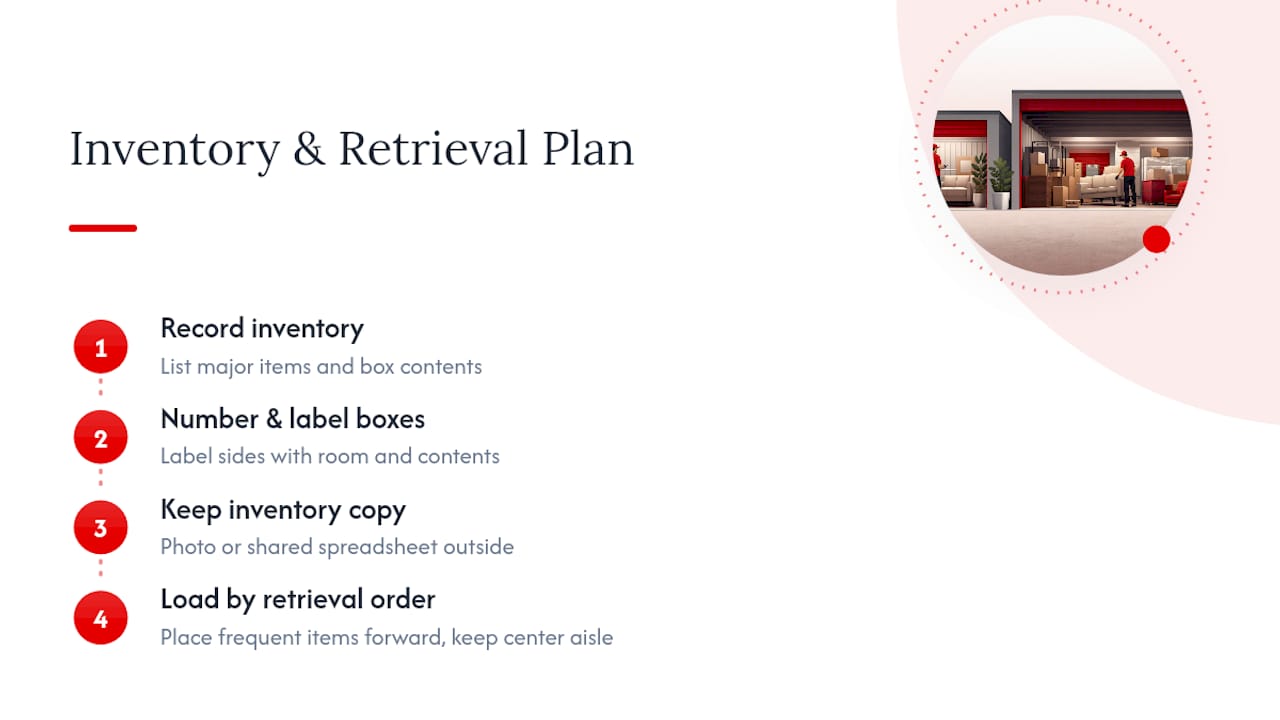
An inventory list turns a storage unit from a black box into something you can actually manage. Before anything goes in, write down every major item and every box's general contents, then number each box and match that number on your list.
Label boxes on the side, not just the top, so you can read them while they're stacked. Include the room name and a one-line contents summary for each. For furniture, a strip of masking tape with a note (dining chairs, set of 4) saves you from unwrapping blankets just to figure out what's underneath.
Keep a copy of your inventory outside the unit. A photo of the list on your phone works, or a shared spreadsheet if a family or business is coordinating access. If you're storing for months, note the date items went in, since that helps you flag anything that's overdue for a check-in.
Plan retrieval order at the same time you plan your layout. If you know you'll need holiday decorations before you need the guest bedroom furniture, load accordingly. Digging through a packed 10x20 for one box because it ended up buried in the back defeats the purpose of labeling in the first place.
Choosing a Reputable Storage Facility
Start with the basics: is the facility clean, well-lit, and free of any musty smell when you walk the halls? A smell of mildew in the hallway is a preview of what your furniture will encounter inside.
Questions worth asking directly:
- What's the actual temperature and humidity range in your climate-controlled units, not just the marketing description?
- Who has access to the property after hours, and is there staff on-site or only cameras?
- What's your policy if a pipe leaks or pests get into a unit?
- Are there hidden fees for administrative costs, locks, or late payments?
Red flags: a facility that won't let you view the actual unit before signing, vague answers about climate control specs, no visible cameras despite claims of "24/7 surveillance," and reviews mentioning pest problems or unresponsive management.
A facility with drive-up access, gated entry, and a straightforward online booking process usually signals a business that's invested in making storage easy rather than an afterthought bolted onto a warehouse.
Understanding Rental Agreements for Furniture Storage
Read the lease before you load a single box. Most self-storage agreements run month-to-month, which gives you flexibility if your renovation timeline slips or your move gets pushed back, but confirm that explicitly since some facilities lock you into longer minimum terms.
Pay attention to the insurance clause specifically. Many contracts require you to carry some form of coverage, either through the facility's own plan or your own renters or homeowners policy extended to cover off-site storage. Check what the facility's liability actually covers if something goes wrong on their end, like a roof leak or break-in, versus what falls entirely on you.
Look for the rate increase language too. A low move-in rate that jumps significantly after a few months is standard in this industry, but you should know the terms going in rather than getting surprised by a bill increase. Also confirm the notice period required to move out, since some contracts require 30 days written notice before vacating.
Finally, check what happens with unpaid balances. Facilities typically have the right to place a lien on stored contents after a set number of missed payments, which can mean losing access to or ownership of your furniture. Set a payment reminder so this never becomes a real risk.
Loading and Unloading Furniture Safely
Bad loading technique causes more furniture damage than a bad unit ever will. Rushing a couch through a doorway or dragging a dresser across concrete scuffs and cracks things that survived the actual move just fine.
Use a furniture dolly for anything heavy and a hand truck for stacked boxes. For couches and mattresses, two people minimum, lifting with legs rather than backs, and moving pieces vertically through doorways when they're too wide to pass flat.
Moving straps distribute weight across your shoulders and back, making it realistic for two people to carry a dresser or wardrobe that would otherwise require four. If you're loading a truck before storage, load heaviest and largest items first, against the truck's walls, then fill gaps with boxes so nothing shifts in transit.
Inside the unit itself, set furniture down gently rather than dropping corners onto concrete. A furniture pad or old moving blanket laid down first protects legs and bases from scratches against the unit floor. Take your time on the final placement, since rearranging a fully loaded 10x15 later is far harder than getting it right the first time.
Pest Control and Prevention in Storage Units
Pests get into units through gaps most people never think to check: cardboard boxes, food residue on furniture, and cracks around doors. Cardboard is genuinely one of the worst materials for long-term storage because it's an ideal nesting material and food source for insects.
Switch to plastic bins for anything staying longer than a couple months, especially in units near ground level. Wipe down furniture completely before storage, since even faint food or drink residue on a couch cushion can attract pests over time.
Ask the facility directly about their pest control program, including how often they treat common areas and whether individual units get periodic inspection. A facility that can't answer this clearly is worth reconsidering.
Inside your own unit, a few sachets of cedar blocks or moth repellent near upholstered furniture deters some insects without introducing chemicals that could stain fabric. Avoid storing any food items entirely, even sealed ones, and check your unit every few weeks if you're storing for the long haul.
Maximizing Furniture Storage Space Efficiently
Vertical space is the most wasted resource in a typical storage unit. Most renters fill the floor and stop, leaving feet of empty air above eye level.
Stand mattresses on their sides using a mattress rack or against the wall with support underneath. Stack chairs seat-to-seat where possible. Disassemble bed frames and table legs rather than storing them fully built, since flat pieces stack far more efficiently than assembled furniture ever will.
Use dressers and cabinets as extra storage rather than empty boxes. Fill drawers with linens, off-season clothing, or small breakables wrapped in towels, which also cushions the drawer contents during any shifting. Nest smaller furniture inside larger pieces where dimensions allow, like stacking nightstands or side tables inside an open bookshelf frame.
Save the center aisle for access, but treat every other cubic foot as usable space, including the area above waist height along the walls.
Prohibited Items and Safety Rules in Storage Units
Every reputable facility bans a similar list of items, and it's worth confirming before move-in day rather than discovering a rule at the loading dock. Flammable materials top the list: gasoline, propane tanks, paint thinner, and fireworks are standard exclusions across the industry.
Perishable food and anything that attracts pests is typically prohibited outright, along with hazardous chemicals, weapons and ammunition in many states, and living plants or animals. Illegal items obviously fall outside any facility's terms.
Fire code also usually restricts how close items can be stacked to sprinkler heads and ceiling lines, so leave clearance at the top of your unit rather than packing floor to ceiling. Facilities enforce these rules for insurance and safety compliance, and violating them can mean losing your lease with little notice.
When in doubt about a specific item, ask facility staff directly rather than assuming it's fine.
When to Hire Pros vs. Handle It Yourself
Hire a full-service mover with integrated storage for long-distance relocations, high-value antiques, pianos, or any situation with multiple pickups and deliveries. Trained crews pad-wrap correctly and maintain chain-of-custody in ways that reduce handling risk, something integrated moving-and-storage providers are built around.
DIY storage works fine for short holds, standard furniture, and tighter budgets, provided you actually follow a real prep checklist instead of tossing pieces in bare.
— Ian
Book Furniture Storage Online Without the Hassle
The facility offers an online rental system to simplify the unit booking process. The Touchless Rentals™ system lets you pick a unit, sign, and get your access code entirely online.
Every South San Antonio location backs that convenience with real security: video surveillance, gated entry, drive-up access for the units where labor matters most, and a 24-hour kiosk if you need to check in outside normal hours. Climate-controlled units are available for the wood, leather, and electronics that need it, and if you've got a trailer or boat sitting in the driveway, RV and boat storage is on-site too.
Pricing varies by unit size and features; current rates and terms are available on the Inline Storage website. Before you book, finish your inventory walk-through, settle on your target move-in date, and note whether you'll need frequent access or just a long-term hold. Then reserve your unit online and get your access details without ever standing in a line.
Sources
For further reading on the technical claims above: U-Haul on climate control, SelfStorage.com's sizing guide, and U-Haul's furniture prep guide.
FAQ
Do I Need Climate Control for Short-Term Furniture Storage?
Not always. A stay of a few weeks with durable items like patio furniture or tools is usually fine in a standard unit, according to U-Haul. Wood, leather, and electronics are the exception even for short holds during extreme weather months.
What Size Storage Unit Do I Need for a Three-Bedroom House?
A 10x20 unit typically fits a three to four bedroom household's furniture, including large appliances and sectionals, based on standard sizing benchmarks. A 10x10 to 10x15 range works for smaller one to two bedroom homes.
How Much Does Furniture Storage Cost at Inline Storage?
Inline Storage's unit pricing varies by size and whether the unit is climate-controlled. Current rates and available promotions are listed on the Inline Storage site.
Can I Wrap Furniture in Plastic for Storage?
Avoid tight plastic wrap directly on wood or leather, since it traps moisture and causes mold or cracking. Use breathable furniture blankets or covers instead, a point U-Haul emphasizes for anyone storing wood or upholstered pieces.
How Do I Book a Storage Unit Without Visiting in Person?
Inline Storage's Touchless Rentals™ system lets you select a unit, complete paperwork, and get access codes entirely online. A 24-hour kiosk is also available on-site if you need in-person support at any hour.