
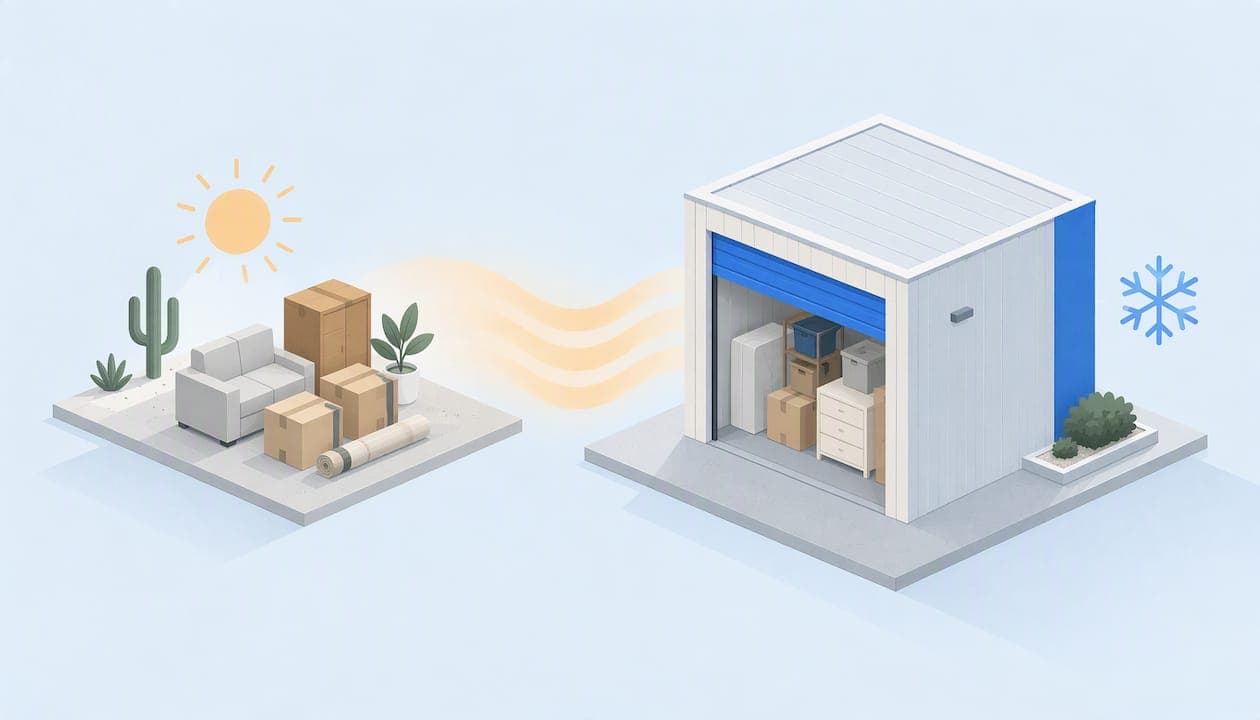
If you are storing wood furniture, leather, electronics, photographs, important papers, artwork, instruments or anything you would hate to replace, you need climate-controlled storage in San Antonio. The same goes for anything that stays in a unit for more than a few weeks through a Texas summer. Sturdy, cheap-to-replace items like plastic bins, metal tools and patio gear usually do fine in a standard drive-up unit. Below, we sort your belongings into those two groups and explain what "climate controlled" does and does not mean. We also cover how to decide for your own move.
TL;DR
- Choose climate-controlled storage for wood and leather furniture, mattresses, electronics, photos, documents, art, instruments, collectibles and anything sentimental or costly to replace.
- San Antonio's July average high is about 95°F, and a closed metal-door unit can run hotter than the air outside. Humidity is the second threat, and it works year-round.
- Standard units suit short stays and rugged items: tools, plastic totes, outdoor gear, basic kitchenware.
- "Climate controlled" is not a standard. Ask the facility what it controls, how it measures it and whether the unit is inside a building.
- Duration matters: the longer your items stay, the more a climate-controlled unit pays off.
Table of Contents
- What does "climate controlled" actually mean?
- How hot do storage units get in South Texas?
- Which items need climate-controlled storage?
- What can stay in a standard unit?
- When to use climate-controlled storage: a quick decision guide
- Climate control for RVs, boats and vehicles
- What to ask before you rent a climate-controlled unit
- Rent a climate-controlled unit in South San Antonio
- FAQ
- Sources
What does "climate controlled" actually mean?
A climate-controlled unit sits inside a building whose air is conditioned, so the space stays out of the temperature swings you get outdoors. The term is used loosely across the industry. Indoor storage with no heating or cooling system is not climate controlled, and controlling temperature alone does not control humidity, as industry commentary points out.
There is also no single rule for how it is done. The Self Storage Association notes there is no industry consensus on climate control, and that designs should reflect regional weather, building construction and local codes. In practice, interior hallway buildings suit full climate-control systems well. Outdoor roll-up-door units are harder to condition efficiently because heat escapes through the doors, so humidity control is often the better fit there.
What this means for you: do not assume a specific number such as 72°F. Treat the range a facility maintains as something to ask about, not a guarantee printed on the word "climate." Our own guide on asking for humidity logs before paying extra walks through the questions worth asking.

How hot do storage units get in South Texas?
Hot enough to matter. San Antonio averages a July high of 95°F, with 29 days at 90°F or above, and a handful of days in the triple digits. Those are air temperatures measured in the shade. A closed metal-skinned unit with no airflow sits in direct sun and traps heat, so the inside can run well above the forecast. How much depends on several things:
- Sun exposure. A door facing west takes afternoon sun for hours. A unit in the middle of a building does not.
- Construction. Metal roofs and doors absorb heat. Insulated, sealed buildings buffer it.
- Airflow. A packed unit with no gap between boxes and walls holds hot, damp air.
- Time of year. Heat peaks from June through September, but a unit left shut through that stretch has no way to release it.
- Humidity. The Gulf influence on South Texas means moisture is in the air long after the heat breaks.
Winter is milder, so freezing is rarely the problem in San Antonio. The risk here runs the other way: long hot spells and sticky air. That is why most Texas storage advice centers on heat and humidity rather than cold.
Which items need climate-controlled storage?
The guiding idea is simple. Materials that swell, shrink, warp, melt, corrode or grow mold respond badly to heat and humidity. Here is how common household items sort out.
| Item | Main risk | Our recommendation |
|---|---|---|
| Wood furniture (dressers, tables, antiques) | Warping, cracked veneer, loose joints | Climate controlled |
| Leather sofas and chairs | Mildew, stiffening, sticky surface | Climate controlled |
| Upholstered furniture and mattresses | Mold and musty odor | Climate controlled |
| TVs, computers, game consoles, audio gear | Heat stress, condensation, corrosion | Climate controlled |
| Photos, albums, documents, books | Curling, sticking, mold, fading | Climate controlled |
| Paintings, prints, framed art | Warping, mold, cracked finish | Climate controlled |
| Musical instruments | Cracked wood, loose glue, pitch drift | Climate controlled |
| Collectibles, resin and plastic figures | Softening, warping, paint damage | Climate controlled |
| Clothing, linens, wedding dress | Mildew, yellowing | Climate controlled |
| Appliances | Rust, seals going bad | Climate controlled for long stays |
| Plastic totes, metal tools, patio furniture | Little | Standard unit is fine |
| Canned goods, basic cookware | Little | Standard unit is fine |
Wood, leather and upholstery
Solid wood takes on and releases moisture as conditions change. Over a Texas summer that cycle can open joints and crack finishes on a family dresser or dining table. Leather and fabric hold moisture and are prone to mildew when the air stays damp. If a piece matters to you, it belongs in a climate-controlled unit. For sizing furniture, see our comparison of 10x10 and 10x20 units for furniture storage.
Electronics and appliances
Heat shortens the life of electronics, and moving a device between very hot and cooler air invites condensation. One caution that surprises people: cold is not a fix for media. The National Archives says electronic and magnetic media are low-sensitivity holdings, and cold storage does not extend their life and may damage them. The aim is stable, moderate conditions, not as cold as possible.
Photographs, paper and keepsakes
The Library of Congress recommends keeping photographs and paper below 70°F and at 30% to 50% relative humidity. A closed standard unit in a San Antonio summer cannot meet that. If your storage holds family albums, tax records, diplomas or a child's artwork, this is the strongest reason to upgrade.
Instruments, art and collectibles
Guitars, violins, pianos and brass all react to swings in heat and moisture. Wood cracks, glue lets go and finishes cloud. Our guide to storing musical instruments covers which size to pick. Heavy collectibles have their own issues, since weight and softening materials work together. This guide to storing heavy statues and collectibles shows how to support and cushion large figures, and pairing that with a climate-controlled space is the safest route for resin and plastic pieces.

What can stay in a standard unit?
A standard drive-up unit is a good value for belongings that shrug off heat. Think plastic storage totes with sealed lids, metal shelving, hand tools, lawn equipment, patio furniture, bicycles, camping gear and basic kitchenware. If you are a homeowner clearing out a garage, our piece on storing lawn equipment without building a shed shows what that looks like in practice.
Standard units also make sense for short stays. If you are moving between homes over a few weeks, rugged items face little risk. Pack well anyway. Leave a little space between boxes and walls, avoid sealing damp items in plastic, and keep cardboard off the floor. Our five steps for packing a unit to avoid mold cover this in detail.
When to use climate-controlled storage: a quick decision guide
Three questions settle most cases.
- What is in the load? If even one category from the table matters to you, a climate-controlled unit protects it. Many people split the load: valuables in a smaller climate-controlled unit, tools and outdoor items in a standard one.
- How long will it stay? A few weeks in March is different from six months across a Texas summer. Plan for the hottest stretch your items will face, not the day you drop them off.
- How replaceable is it? If you could rebuy it next week for little money, standard storage is fine. If it is an heirloom, a signed print or the only copy of your records, don't gamble.
Here is how that plays out for the people we hear from most:
- Relocating or between homes: furniture, mattresses and electronics ride out a long gap better in a climate-controlled unit.
- College students at summer break: the summer is exactly the hot window. Electronics, mini-fridges with soft seals, bedding and books benefit.
- Small business owners: paper records, inventory with adhesives, fabrics, cosmetics, electronics and printed goods are all heat- and moisture-sensitive.
- Families renovating: furniture sitting out of the house for months should be protected, especially upholstery and wood pieces.
- New homeowners: a short overlap usually works in a standard unit, unless boxes of keepsakes or wood furniture are in the load.
Our perspective
We have watched the same pattern at our facility: people pick a unit by price, then realize the box of photos or the leather chair they brought is the one thing they cannot replace. Our advice is to decide by what is inside, not by the size alone. If it holds wood, leather, paper, electronics or keepsakes, we recommend a climate-controlled unit, and we offer them alongside our standard drive-up units so you can split a load without going to two facilities.
We also believe in being straightforward about what the term means. Ask any facility, including us, how its climate-controlled units work and what conditions you can expect. Our approach is built around options: a range of sizes from lockers and 5x5 units up to 10x30, month-to-month leases, gated access, video surveillance and Touchless Rentals™, so the unit fits your load and your schedule.
Ian
Climate control for RVs, boats and vehicles
A vehicle is a different case. RVs and boats are built to live outdoors, and many owners choose covered or open parking for them. Still, interiors, upholstery, electronics and cushions suffer in long summer heat, so it helps to remove sensitive items and store them in a climate-controlled unit. Our guide to outdoor, covered and indoor vehicle storage and our note on what to know before renting outdoor vehicle storage help you weigh the choices.
What to ask before you rent a climate-controlled unit
Since the term is loosely used, a few direct questions go a long way:
- Is the unit inside a conditioned building, or is it an outdoor unit with a vent?
- Does it control temperature, humidity or both?
- What range does the facility aim for, and can you see how it tracks it?
- Is access from an interior hallway or a drive-up door? Interior hallways are better at holding conditions.
- What size fits your load? Leave room for airflow rather than packing wall to wall.
For sizing help on a one- or two-bedroom move, see our guide to drive-up storage sizes from 5x5 to 10x30. If you are in a small apartment, our note on picking a 5x5 or 5x10 will keep the footprint small and the lease flexible.
Rent a climate-controlled unit in South San Antonio
If your load includes anything from the "climate controlled" column above, we can help you match it to a unit. We offer climate-controlled storage along with lockers, 5x5, 5x10, 10x10, 10x15, 10x20 and 10x30 units at our South San Antonio location. You can browse our units and sizes and rent online with Touchless Rentals™, or use our 24/7 contactless kiosk.

Current pricing and availability are on each unit page, so you can see what fits before you commit.
FAQ
Do I really need climate-controlled storage in San Antonio?
If you are storing wood or leather furniture, electronics, photos, documents, art or instruments, yes, especially for more than a few weeks in summer. San Antonio's July average high is around 95°F, and humidity is a concern too. For tools, plastic totes and outdoor gear, a standard unit is usually enough.
How hot do storage units get?
A closed, non-climate-controlled unit can run hotter than the outside air, because metal walls and doors absorb sun and trap heat. The exact number depends on sun exposure, construction and airflow. With San Antonio's summer highs in the mid-90s on average, plan for a hot interior from June through September.
What temperature range does a climate-controlled unit keep?
There is no single industry standard, and designs vary by facility. Ask the facility what range it aims to hold and whether it controls humidity as well as temperature. Do not assume a fixed number unless it is stated in writing.
Can I split my belongings between two types of units?
Yes, and many customers do. Put sensitive items in a smaller climate-controlled unit and rugged items such as tools and outdoor gear in a standard unit. That keeps the protection where it matters and trims the overall cost.
Sources
- Library of Congress: Preserve Your Papers
- National Archives: Temperature, Relative Humidity and Air Quality supplement
- Self Storage Association: Climate Control 101
- StorageOwnerAdvisor: Climate Control vs. Non-Climate Storage
- Current Results: San Antonio weather in July