
Pack a storage unit by building a stable back wall out of large furniture, installing shelving along the sides, stacking uniform boxes floor to ceiling with heavy ones low, leaving a clear aisle from door to back, and protecting everything from moisture with elevation and desiccants. Photograph and label as you load. If you'll visit often, plan for access; if this is long-term storage, prioritize climate control and moisture protection over speed.
TL;DR:
- Use uniform, sturdy boxes and elevate items off concrete with pallets or sheeting to prevent moisture damage in long-term storage environments.
- Prioritize climate control for electronics, paper documents, and leather goods, especially if storing for six months or more, to avoid mold and irreversible deterioration.
- Pack large furniture against the back wall, install shelving early, and leave a clear aisle to facilitate access and efficient stacking.
- Label boxes on the side facing the aisle, photograph each container before sealing, and keep a simple inventory for quick retrieval and insurance documentation.
- Avoid storing perishable foods, flammable chemicals, hazardous materials, or live plants, and always verify specific facility restrictions before packing.
Table of Contents
- Planning and Supplies Before You Pack a Storage Unit
- How Should You Map and Load a Storage Unit?
- How Do You Pack Different Item Types for Storage?
- Does Humidity Really Damage Stored Belongings?
- What's the Best System for Labeling and Tracking Boxes?
- What Items Are Off-Limits in a Storage Unit?
- Packing a Storage Unit Checklist and Sample Loading Plan
- Why Facility Features Change How You Pack
- An Insider's Take on Packing Smart
- Get Your Storage Unit Ready With Inline Storage
- Sources
- FAQ
Planning and Supplies Before You Pack a Storage Unit
Decide upfront whether this is short-term storage (weeks to a few months, frequent access) or long-term storage (six months or more, rare visits). That single decision changes almost everything else: box choice, aisle width, even whether you need climate control.
Measure your unit before you show up with a truck. Sketch a rough layout on paper: back wall, two side zones, and a center or side aisle. Ten minutes with a tape measure saves an hour of shuffling boxes later.
Gather these supplies before moving day:
- Uniform sturdy boxes (same one or two sizes for stable stacking)
- Clear plastic bins for anything moisture-sensitive or long-term
- Freestanding shelving units
- Wood pallets or plastic sheeting to keep boxes off concrete
- Mattress bags and moving blankets
- Bubble wrap, packing paper, and strong tape
- A permanent marker and a dolly
- Silica gel desiccant packs
How Should You Map and Load a Storage Unit?
Walk the empty unit first and pick your aisle, either straight down the center or along one side, and mark the zones mentally before a single box goes in. Everything after that decision follows a set order.
- Place large furniture and disassembled frames against the back wall first. This becomes your foundation.
- Install shelving units along the side walls before you bring in a single box.
- Stack boxes in tight, uniform columns, heaviest on the bottom, lightest and most fragile on top or on shelves.
- Use shelving to keep breakables off the floor and to add usable vertical space you'd otherwise waste.
- Leave a walkable aisle from the door straight to the back wall.
The trick most people miss: load your moving van in reverse order. Whatever needs to go against the back wall of the unit should be the last thing loaded into the van, so it comes out first and walks straight to the back.
Pro Tip: Number your columns as you build them (Column 1, Column 2, and so on) and note the number on your inventory sheet. It turns "where did I put the lamp" into a 30-second answer instead of a 20-minute unpacking job.
How Do You Pack Different Item Types for Storage?
Different items fail in different ways, so treat each category on its own terms rather than boxing everything the same way.
- Furniture: Disassemble beds, tables, and shelving where you can. Wrap pieces in breathable moving blankets rather than plastic, which traps condensation. Stuff drawers with soft linens to save box space, and tape hardware bags directly to the matching piece so nothing goes missing.
- Electronics: Back up anything important before you unplug it. Remove batteries so they don't corrode, coil cords separately and label them, and pack devices in sealed bins. If storage is long-term, a climate-controlled unit matters far more here than almost anywhere else.
- Clothing and textiles: Vacuum-sealed bags work fine for short-term storage, but for long-term storage, breathable garment bags or bins with a silica packet tossed in beat airtight plastic, which can trap moisture against fabric.
- Books and paper: Pack flat, not standing on end, in small or medium boxes. A big box of hardcovers is heavy enough to warp spines and hard enough to injure your back. Split heavy collections across several smaller boxes instead.
- Fragile items: Double-wrap in paper and bubble wrap, mark "this side up" clearly, and place on a shelf rather than the floor of a stack.
Does Humidity Really Damage Stored Belongings?
Yes, and the threshold is well documented. Relative humidity above roughly 60% is what triggers mold growth and irreversible damage to paper, cloth, and leather. It's not usually a single humid week that ruins a box of photos or books. It's the swelling and shrinking that happens every time temperature and moisture swing back and forth, which preservation experts point to as the real driver of warping and cracked finishes.
The 60% Threshold: Once relative humidity climbs past 60%, organic materials become vulnerable to mold and staining that often can't be reversed.
If you're storing electronics, paper archives, leather, or anything for the long haul, a climate-controlled unit is worth the extra cost. In a standard unit, elevate boxes on pallets or plastic sheeting to keep them off the concrete, leave breathing room between stacks, skip plastic wrap on fabric, and drop silica packets into bins holding electronics or books.
What's the Best System for Labeling and Tracking Boxes?
Label every box on the side that will face the aisle once it's stacked. A label on top is useless once three more boxes go on top of it.
- Write the room name and three key contents on each box, then number it sequentially.
- Keep a simple inventory, even a basic spreadsheet, mapping box number to contents to general location.
- Take photos or a short video of the unit once it's loaded, before you shut the door.
- Group similar items together and reserve a front "access zone" for things you'll actually need before the unit is full again, like seasonal decorations or tools.
Pro Tip: Photograph the inside of each box before you seal it, not just the label. If a claim or a memory lapse ever comes up, that photo does more work than any written description, and it doubles as documentation for insurance purposes.
What Items Are Off-Limits in a Storage Unit?
Facilities restrict certain items for safety and liability, and the list is fairly consistent across the industry:
- Perishable food or anything that attracts pests
- Flammable materials like gasoline, propane, or solvents
- Hazardous chemicals and compressed gas
- Live plants or animals
Always check your specific facility's rules, since exact restrictions vary. On the safety side, use a dolly for anything heavy, get a second person for awkward furniture, distribute weight evenly across the floor, and never stack so high the column risks toppling. Keep aisles clear and unblocked, since fire codes govern minimum aisle widths and stacking limits in commercial storage settings for good reason.
Packing a Storage Unit Checklist and Sample Loading Plan
Before moving day, confirm these basics: unit measurements, full supply list, box numbers assigned, photos of high-value items, and whether you have drive-up or interior access, since that affects how much you can carry versus roll in on a cart.
On loading day, follow this sequence:
- Build the back wall with your largest furniture pieces.
- Set up shelving along both side walls.
- Stack boxes by category, heaviest and least-needed on the bottom.
- Place fragile items on higher shelves, never under heavier boxes.
- Confirm a clear walking aisle remains from the door to the back.
Remember the reverse-loading rule from the van: whatever needs to land in the back of the unit gets loaded into the van last, so it comes off first.
Why Facility Features Change How You Pack
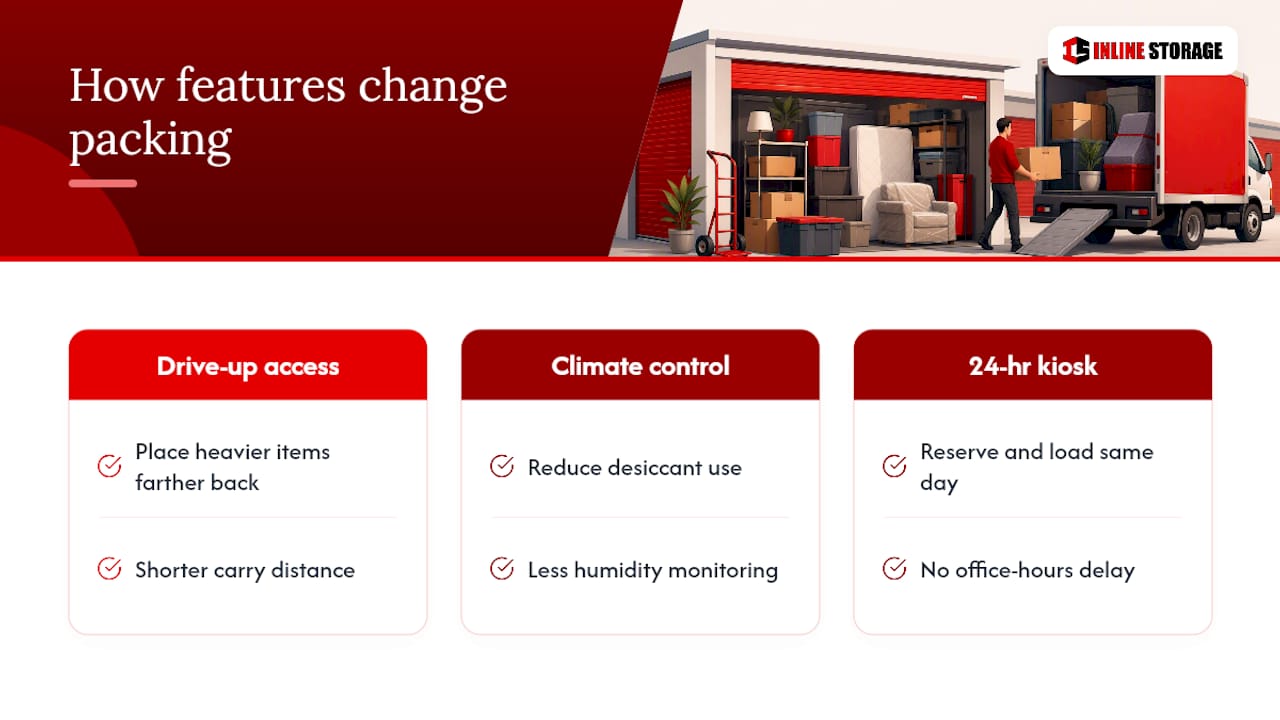
Inline Storage in South San Antonio is a useful example of how a facility's features actually shape your packing decisions, not just your rental paperwork. Drive-up access shortens the carry distance from vehicle to unit, which means you can reasonably place heavier items farther back without exhausting yourself hauling them across a lot. Climate-controlled units cut down how much you need to lean on desiccants and constant humidity monitoring. And a 24-hour kiosk with Touchless Rentals™ means you can reserve a unit and start loading the same day, without waiting on an office to open.
An Insider's Take on Packing Smart
Uniform box sizes and a photo inventory are worth more than any fancy organizing system. A single bedroom takes about an hour to pack; a full house usually eats a full day. Past that, hiring movers pays for itself in your back.
— Ian
Get Your Storage Unit Ready With Inline Storage
Everything covered above, the back wall strategy, the shelving, the climate protection, works best when the facility itself cooperates. Inline Storage is built around exactly that: drive-up access that shortens your carry distance so heavier furniture doesn't wear you out, climate-controlled units for anything sensitive to humidity swings, and Touchless Rentals™ that let you reserve and access a unit through the 24-hour kiosk without waiting in a line or scheduling an office visit.
If you're ready to put this packing plan into action, here's where to start:
- Check available unit sizes against your furniture list and box count
- Add climate control if you're storing electronics, books, or anything long-term
- Ask about RV storage if you're clearing out a driveway along with the garage
Reserve your unit today and start loading with a plan instead of a guess.
Sources
For deeper reading on the preservation and packing guidance covered here: University of Illinois Preservation on humidity thresholds, Smithsonian collection care guidance on temperature stability, Click Storage on loading order, Extra Space on bin selection, and U-Haul on inventory systems. For protecting walls and surfaces during a move, Wendell Barco Plastering has practical prep guidance worth a look.
- Preserving books in your home library – University of Illinois Preservation
- Handling of collections in storage — Smithsonian / UNESCO guidance
- How to pack a storage unit like a pro — Click Storage
- Expert tips on how to pack a self-storage unit — U-Haul
FAQ
What's the best way to pack a storage unit for long-term use?
Prioritize climate control, elevate everything off the concrete floor, and use clear plastic bins instead of cardboard, since plastic resists moisture and pests far better over time. Build your back wall with furniture, add shelving, and leave an aisle for access.
How do you stack boxes in a storage unit without them collapsing?
Use uniform box sizes so columns stack evenly, with the heaviest boxes on the bottom and lighter or fragile ones on top or on shelving. Mixed box sizes create wobble points that lead to toppled stacks over time.
Should I use a climate-controlled unit for everything?
Not necessarily. It matters most for electronics, paper, leather, and anything you're storing long-term, since relative humidity above 60% drives mold growth in organic materials. For furniture and household goods in short-term storage, a standard unit with elevation and desiccants is often enough.
How much does a storage unit cost at Inline Storage?
Current pricing and available sizes are listed on the Inline Storage site, since rates vary by unit size and features like climate control. Reserving through Touchless Rentals™ lets you see exact availability before committing.
What items can't I store in a self-storage unit?
Most facilities prohibit perishable food, flammable materials like gasoline or propane, hazardous chemicals, and live plants or animals. Always confirm the specific list with your facility, since restrictions can vary slightly between providers.