
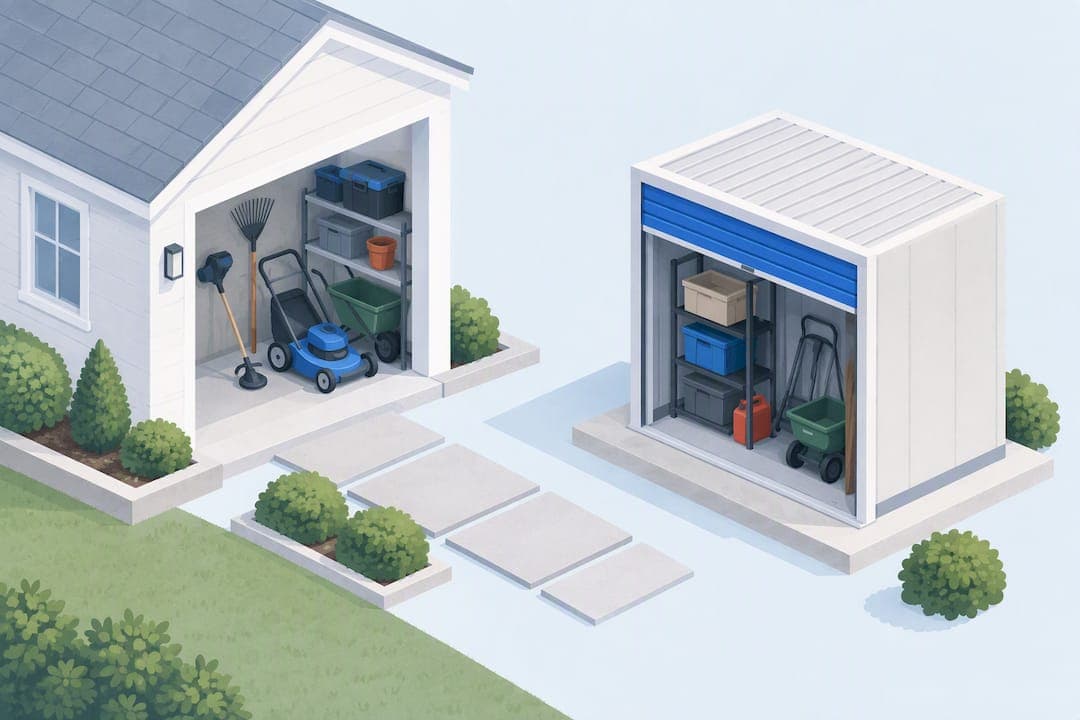
Store push mowers, riding mowers, and battery-powered equipment in a covered, dry space, and keep fuel and flammables in approved containers away from living areas. Lithium-ion batteries do best in a climate-controlled spot at partial charge. If your garage or shed can't offer dry, secure, temperature-stable space for everything you own, renting a storage unit solves the gap without forcing a tool collection to live outdoors.
TL;DR:
- Climate-controlled storage is essential for batteries and electronics, especially during extreme heat, to prevent capacity loss and damage.
- A garage suits multiple machines with regular access, while resin or plastic sheds are best in humid climates if ventilated properly.
- Using approved fuel containers, stabilizing fuel, and storing batteries at partial charge within moderate temperatures are critical safety and maintenance steps.
- DIY options like ceiling hooks, pallet platforms, and wall-mounted rails help optimize small shed or garage space efficiently.
- For temporary needs or overflow, self-storage units with drive-up access and climate control provide a secure, flexible alternative.
Table of Contents
- Covered storage options: garage, shed types, deck boxes, pergolas, and self-storage.
- Storing lawn mowers: push, riding, electric, and robotic models
- Organizing small tools and accessories with rails, pegboards, and charging stations
- Fuel and battery safety: approved containers and storage best practices
- DIY and space-saving solutions for tight garages and sheds
- How to choose the right storage: a checklist and quick scenarios
- Pest and moisture control in storage areas
- Security measures for stored equipment
- Planning and preparing storage space layout for efficient access and workflow
- Publisher perspective: when renting a unit beats improving home storage
- Inline Storage: secure, climate-controlled space when home storage runs out
- FAQ
- Sources
Covered storage options: garage, shed types, deck boxes, pergolas, and self-storage.
The right home for your mower and tools depends on how much gear you have and how much protection it needs. A garage offers the best all-around protection: insulation, security, and enough room for a riding mower or a full tool collection, but it competes with cars and household overflow for space.
Resin and plastic sheds resist rust and rot, and they're lighter to install than wood, but they can trap humidity if ventilation is poor, which invites corrosion on metal blades and fasteners. Metal sheds hold up structurally and deter pests, though they can sweat condensation in temperature swings unless you add vents. Wood sheds breathe better and look better in a yard, but they need periodic sealing or staining to keep moisture out.
For smaller yards, a deck box or storage bench handles hand tools, cushions, and small accessories without the footprint of a shed. A covered deck or pergola can shelter a mower short-term, but it won't protect against driving rain or theft the way a locked structure does.
- A garage suits homeowners with multiple machines and daily access needs.
- A resin or plastic shed works well in humid climates if it has vents or louvers.
- A metal shed resists pests and fire but needs ventilation to avoid condensation.
- A wood shed offers better airflow but requires more upkeep over time.
- A deck box or bench fits small yards with modest tool collections.
When a growing equipment list outpaces available covered space, climate-controlled storage protects engines, batteries, and electronics the way a shed often can't during extreme heat or cold. Dry, covered environments that avoid direct exposure to rain, snow, and heavy humidity matter for both gas and battery equipment, according to Lowe's guidance on sheds and outdoor storage.
Storing lawn mowers: push, riding, electric, and robotic models
Every mower type needs a slightly different pre-storage routine, but the goals are the same: remove debris, protect fuel systems or batteries, and position the machine so it's easy to retrieve later.
- Scrape and hose off grass clippings from the deck, wheels, and undercarriage, then let the mower dry fully before storing it.
- Check and top off engine oil on gas mowers, and wipe down metal surfaces with a light coat of oil to prevent rust.
- For gas mowers going into storage longer than a month, either add a fuel stabilizer to a nearly full tank or run the engine until the tank is dry, since untreated ethanol-blend fuel causes carburetor varnish over time.
- For electric and robotic mowers, remove the battery and store it separately at a partial charge rather than leaving it in the deck.
- Position mowers with handles folded and wheels aligned so they take up the least floor space along a wall or in a corner.
A short pre-storage checklist covering cleaning, fuel handling, and lubrication is one of the simplest ways to prevent the carburetor varnish and dead batteries that cause spring start failures, according to winterization guidance from The Lawn Almanac. Riding mowers and zero-turn models need the same fuel and battery steps, plus a tire check since flat spots can develop if a machine sits on the same spot for months.
Pro Tip: Keep the owner's manual or a photo of it on your phone so you know the exact oil type and battery charge target for your specific model before storage season hits.
Organizing small tools and accessories with rails, pegboards, and charging stations
Hand tools and accessories eat up floor space fast unless you get them onto a wall. Wall-mounted rail systems and pegboards keep rakes, shovels, trimmers, and hoses visible and off the ground, which also makes it easier to spot a tool that needs sharpening or repair.
- Mount a metal rail system along a garage or shed wall to hang long-handled tools by their heads, keeping handles at a consistent height.
- Use a pegboard with hooks sized to your tools for anything you reach for weekly, like pruners or hand trowels.
- Store consumables such as fertilizer, grass seed, and pesticide in labeled bins or resealable bags to prevent spills and pests.
- Set up a dedicated charging shelf for battery-powered tools, away from fuel storage and with enough airflow to prevent heat buildup.
Commercial rail systems make this easier to execute well. A DEWALT 48-inch metal rail system supports heavy loads per lineal foot, which is enough for a full wall of rakes, trimmers, and extension cords without sagging or pulling loose from the wall. Pair a rail system with a battery rail or charger mount, and you get a single wall that handles both long-handled tools and the chargers for your cordless lineup, rather than scattering cords across a workbench.
Fuel and battery safety: approved containers and storage best practices
Fuel and batteries cause more storage-related damage and injury than any other part of lawn equipment care, so the rules here aren't optional.
- Use only UL-listed or ASTM-approved gasoline containers, never improvised jugs or containers not rated for fuel.
- Store gas cans in a ventilated, locked location away from ignition sources and direct sunlight.
- Inspect cans regularly for cracks, loose caps, or corrosion, and replace any that show damage.
- Add fuel stabilizer to a nearly full tank for long-term storage, or run the engine dry if you'd rather skip stabilizer entirely.
- Keep lithium-ion batteries at roughly 40 to 60 percent charge and in moderate temperatures rather than full charge or extreme heat.
Use only UL-listed gasoline safety containers, follow strict handling and storage practices, and inspect and replace damaged cans regularly.
Lithium-ion batteries for mowers and trimmers hold up best at a partial charge and within a moderate temperature range, generally between about 40°F and 80°F, since full charge or temperature extremes accelerate capacity loss and can cause permanent cell damage. A climate-controlled space with a dedicated charging shelf protects battery investment far better than a hot garage wall or an unheated shed in winter.
DIY and space-saving solutions for tight garages and sheds
You don't need a contractor to free up floor space. A handful of straightforward builds handle most of what a typical yard crew needs.
- Install ceiling hooks rated for the weight of what you're hanging, such as a bike or a folded wheelbarrow, and always check the hook's weight limit against the item before loading it overhead.
- Build a simple pallet platform to keep equipment off a damp garage or shed floor, then cover gear with a tarp secured at the corners with bungee cords or weighted clips so wind can't lift it.
- Build a quick rack from 2x4 lumber or PVC pipe to hold rakes, shovels, and trimmers vertically against a wall, sized to the specific tools you own.
- Repurpose five-gallon buckets with cut holes as tool caddies for smaller hand tools that otherwise end up in a pile.
DIY rack and organizer projects, including pegboards, PVC holders, and repurposed buckets, remain some of the most effective low-cost ways to get tools off the floor, according to Family Handyman's roundup of yard tool storage tips. Keep ceiling storage limited to lightweight items. A mower or heavy power tool belongs on the ground or on a rated rack, not hanging overhead.
How to choose the right storage: a checklist and quick scenarios
Matching your gear to the right storage setup starts with an honest inventory. Walk your garage, shed, and yard and list every machine, tool, and consumable you need to house, then flag anything sensitive to temperature or humidity, like batteries, fuel, or seed.
- List every piece of equipment and mark which items need climate control, like batteries and electronics.
- Estimate how often you need access: daily tools belong near the door, seasonal gear can go in back or off-site.
- Set a budget that accounts for both one-time builds (racks, pegboards) and recurring costs (a storage unit rental).
- Measure your largest items, such as a riding mower or a trailer, against your available covered space before assuming it fits.
Three common scenarios cover most homeowners. A small yard with a push mower and basic hand tools usually needs nothing more than a resin shed or a corner of the garage with a pegboard. A multi-machine owner with a riding mower, a trimmer, a blower, and battery tools benefits from a rail system plus a dedicated charging shelf to keep everything organized and accessible. A homeowner mid-move, mid-renovation, or storing a riding mower for an off-season stretch often finds that a self-storage unit solves the space and climate problem faster than building new shed capacity.
Pest and moisture control in storage areas
Moisture and pests ruin stored equipment just as often as neglect does. Rodents chew through fuel lines and wiring insulation, and damp conditions rust blades, corrode electrical contacts, and warp wood handles.

Seal gaps around doors and foundation lines in sheds and garages, since even a small opening lets mice and insects in over a winter. Add desiccant packs or a small dehumidifier in enclosed storage spaces to pull humidity away from metal and electronics, particularly in basements or below-grade areas. Keep vents or louvers clear in metal and plastic sheds so air can circulate instead of trapping condensation against tool surfaces. Store consumables like grass seed and fertilizer in sealed containers, since open bags attract rodents faster than almost anything else in a shed. A quick seasonal check, lifting stored tarps and bins to look for droppings or nesting material, catches problems before they spread to your mower's wiring harness or upholstery on a riding model.
Security measures for stored equipment
A mower or a set of power tools represents a real investment, and sheds and garages are common theft targets, especially detached structures out of view from the house. Start with a quality padlock rated for outdoor use on any shed door, and consider a hasp reinforced with bolts rather than screws, which pry out easily.
A motion-activated light near a shed or garage entrance deters opportunistic theft more than almost any other low-cost step. For higher-value collections, a simple alarm sensor on the door or a battery-powered camera aimed at the entrance adds a layer of monitoring you can check from a phone. Facilities built for vehicle and equipment storage typically go further, with gated entry and continuous video surveillance covering the property rather than a single door. If your yard structure can't offer that level of coverage, an off-site unit with gated access and round-the-clock surveillance closes the gap for higher-value machines like a riding mower or a trailer.

Planning and preparing storage space layout for efficient access and workflow
A well-organized shed or garage saves time every single weekend, not just during seasonal changeovers. Start by placing the tools you reach for most, trimmers, hand pruners, gloves, nearest the door, and push seasonal or rarely used items like snow equipment toward the back or on overhead racks.
Group by task rather than by tool type: keep mowing gear (mower, bag, fuel can) in one zone, and planting gear (trowels, seed, gloves) in another, so you're not crossing the space to assemble what you need. Leave a clear walking path down the center of a garage or shed rather than lining both walls floor to ceiling, since a blocked path is the main reason people give up on organization systems within a season. Reassess the layout twice a year, once before mowing season starts and once before winter storage, since gear and priorities shift as equipment ages or gets replaced.

Publisher perspective: when renting a unit beats improving home storage
Most homeowners can solve lawn equipment storage with a shed, a rail system, and some fuel discipline. But a few situations change the math: a move, a renovation that temporarily claims the garage, or an off-season stretch where a riding mower, trailer, or boat simply doesn't fit anywhere dry and secure at home.
That's the gap self-storage fills. Units with Touchless Rentals™ for contactless sign-up, sizes starting at $65, video surveillance, and drive-up access handle the overflow without asking you to build a bigger shed for a problem that might last three months. For riding mowers, trailers, or boats specifically, a dedicated RV and boat storage option solves a fit problem no home shed was built to handle.
— Ian
Inline Storage: secure, climate-controlled space when home storage runs out
When a renovation, a move, or an off-season stretch leaves your riding mower, trailer, or tool collection without a dry home, Inline Storage gives you room without the shed project.

- Touchless Rentals™ let you reserve and manage a unit online with minimal in-person contact.
- Unit sizes range from compact lockers to large 10x30 spaces, plus dedicated RV and boat storage.
- Drive-up access and video surveillance keep retrieval easy and equipment monitored.
- Climate-controlled options protect batteries and electronics from Texas heat swings.
If your gear has outgrown your garage, check unit availability at Inline Storage and get it under cover this week.
FAQ
What is the best storage for lawn mowers?
A dry, covered space like a garage, shed, or climate-controlled unit protects mowers best, since moisture causes rust and humidity degrades batteries. For gas mowers, pair covered storage with fuel stabilizer or an emptied tank; for battery models, store the battery separately at a partial charge in a moderate temperature.
What is the best outdoor storage option for a lawn mower?
A resin, metal, or wood shed with good ventilation works well outdoors, as long as it keeps rain and snow off the mower and includes a lock. If the shed can't maintain stable temperatures for a battery-powered model, a climate-controlled storage unit is a better fit for that machine.
What are some creative ways to store a lawn mower?
Pallet platforms keep mowers off wet garage floors, while wall-mounted rail systems free floor space for other equipment nearby. A covered pergola or deck box works for short-term storage, but a locked shed or unit offers better security for longer stretches.
What is the best storage box for garden tools?
A weatherproof deck box or storage bench suits small yards with hand tools, cushions, and accessories that don't need a full shed. For larger tool collections, a wall-mounted rail or pegboard system, such as a DEWALT rail setup, organizes more gear than a single box can hold.
How long can gasoline sit in a mower before it goes bad?
Untreated ethanol-blend gasoline can start forming varnish in a carburetor within about a month of sitting unused. Adding a fuel stabilizer to a nearly full tank, or running the tank dry before storage, prevents this common cause of spring start failures.
Sources
- Sheds & outdoor storage | Lowe's
- Fire Prevention 52: Gas Cans — National Park Service
- How to store lithium batteries — SpareFoot