
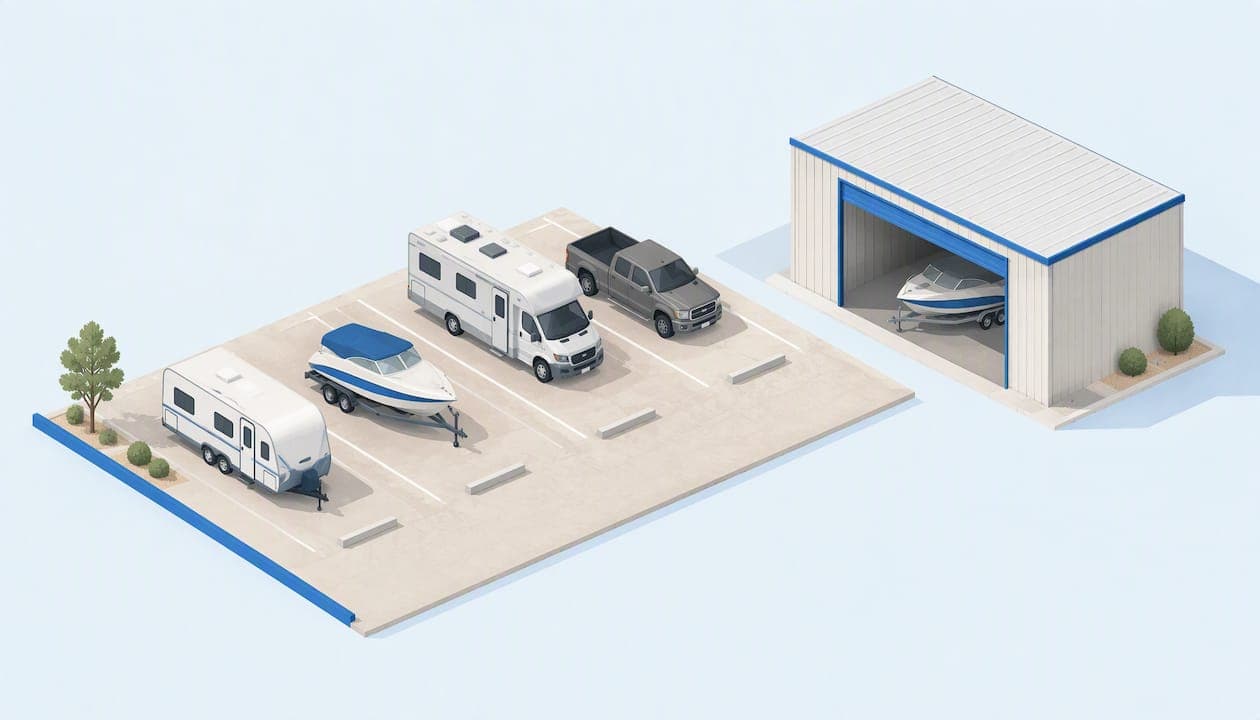
Outdoor vehicle storage means paying to park a car, truck, RV, boat or trailer in an open-air space at a storage facility instead of in an enclosed unit. It costs less than indoor storage and suits vehicles built to live outside. It also asks more of you: you prep the vehicle yourself, and you need to read the lease closely, especially the words "open parking." This guide covers what you get, what to ask, and how to leave a vehicle for weeks or months without coming back to a dead battery or flat tires.
TL;DR
- Outdoor (uncovered) storage is open parking at a gated facility. It is the budget option for cars, RVs, boats and trailers.
- "Open parking" often means a right to park in a designated area, not a stall with your name on it. Ask whether your space is reserved before you sign.
- A vehicle that sits more than two weeks needs prep: battery, tires, fuel, cleaning and pest control.
- Check insurance and registration rules for a stored vehicle with your insurer and your state DMV before you cancel anything.
- Our South San Antonio facility offers open parking, RV storage and boat storage with gated entry, video surveillance and a 24-hour kiosk.
Table of Contents
- What outdoor vehicle storage actually is
- What "open parking" means in a lease
- Outdoor, covered or enclosed: how to choose
- Who uses outdoor vehicle storage
- How to prepare a vehicle for outdoor storage
- Insurance, registration and the law
- Security: what to look for
- Our perspective: match the space to the vehicle, not the budget
- Renting outdoor and vehicle storage at Inline Storage
- A quick checklist before you sign
- FAQ
- Sources
What outdoor vehicle storage actually is
Picture a paved or gravel lot, fenced, with a gate and cameras. You drive in, park in your area, lock up and leave. There is no roof and no walls. Some people call this uncovered storage, open storage or open parking. They all describe the same thing: the vehicle stays exposed to sun, rain and wind, and you pay a lower rent than for a unit with a door.

It is a different product from a drive-up unit, where your vehicle sits inside a roll-up-door space. If your car is going into a 10x20 or 10x30 unit, you are buying enclosed storage. We cover that distinction further down, and our guide on storing a car in a storage unit goes through the checks before you tow anything in.
What fits outdoors
Outdoor storage works best for vehicles that are already designed to be outside or are too big for a unit:
- RVs and motorhomes. Most are longer and taller than any standard unit.
- Boats on trailers. Hulls and trailers are made for weather, though the prep still matters.
- Utility and cargo trailers. A good use for a small business with seasonal equipment.
- A second or spare car, truck or work van. Fine outdoors if it is a daily-use vehicle that you just need parked somewhere else.
A classic car, a convertible with a soft top or a low-mileage collector vehicle is a different case. Those belong under a roof, ideally in an enclosed or climate-controlled space.
What "open parking" means in a lease
The phrase causes most of the confusion we see. In leases and facility agreements, open parking generally refers to designated parking areas you may use at any time when they are not reserved for someone else. That is not the same as an assigned stall. A legal definitions site also notes the term usually describes a non-exclusive right to park in an area rather than a specific space, with the wording varying by contract.
What that means for you in practice:
- Ask if the space is assigned. If you want to find your RV in the same spot every month, get that in writing.
- Ask what the area covers. Is it one row, a lot or the whole property?
- Ask who else can use it. Other renters, or only you?
- Ask what happens if the vehicle is moved. Can you take it out for a weekend trip and return to the same place?
A good facility answers these in plain words. If you get a vague answer, keep asking before you pay a deposit.
Outdoor, covered or enclosed: how to choose
| Option | Best for | Trade-off |
|---|---|---|
| Outdoor (open parking) | RVs, boats, trailers, daily-use vehicles | Exposed to weather and sun, so you do more prep |
| Enclosed drive-up unit | Cars, motorcycles, small trailers, valuable vehicles | Costs more and is limited by unit size |
| Climate-controlled unit | Classic cars, vehicles with delicate interiors, items stored with them | Typically the highest rent and the smallest vehicle size range |
Three questions settle it quickly.
Will it fit? Measure your vehicle bumper to bumper, including any hitch, ladder or bike rack, and measure the height. A 10x20 unit gives you 20 feet of length, and our 10x30 units give more, but a typical Class A motorhome or a boat on a trailer will not go inside either one.
How long will it sit? For a few weeks, outdoor storage is fine for almost anything with a working battery and sound tires. For many months, the case for a roof gets stronger.
How much is it worth to you? Sun fades paint and cracks dashboards and rubber seals. If the vehicle's condition affects its value, pay for cover.
Who uses outdoor vehicle storage
The people who rent open parking tend to fall into a few groups:
- New homeowners and renters. Your driveway is narrow, the HOA bars RVs, or the lease says no trailers. Moving the vehicle off site solves it.
- Families renovating. A garage full of construction materials cannot also hold the second car.
- Small business owners. Seasonal trailers, work vans and equipment need a safe place between jobs.
- College students. A car left behind for the summer does not need to sit on the street near campus.
- Boat and RV owners. Many neighborhoods restrict them, and the off-season is long.
If you are storing a motorcycle, the rules differ because a bike can often go into a small enclosed unit. We lay out the rules for motorcycle storage units separately.
How to prepare a vehicle for outdoor storage
A vehicle left unused for a long time can suffer from tire damage, battery damage, wiper decay, corrosion and electrical problems. A federal fleet guide flags more than 14 days of inactivity as the point where preparation matters. Outdoors, with sun and humidity, it matters more.
Here is the sequence we recommend, roughly a week before drop-off.
Cars and trucks
- Wash and wax. Remove bird droppings, tree sap and road salt or grime. A coat of wax gives the paint some protection from the sun.
- Clean the interior. Take out food, wrappers and anything that attracts pests. Do not leave papers or valuables inside.
- Fill the tank and add fuel stabilizer. A full tank leaves less room for moisture. Run the engine a few minutes so the stabilized fuel reaches the system.
- Handle the battery. Use a battery tender if the facility's rules and your setup allow it, or disconnect the battery for a long stay. Ask the facility first.
- Inflate the tires. Slightly higher pressure helps prevent flat spots. Check the pressure again when you visit.
- Release the parking brake. Use wheel chocks instead, so the brake pads do not stick.
- Use a breathable cover. A fitted, breathable car cover keeps off dust and some UV. Avoid plastic tarps, which trap moisture.
- Block pests. Rodents chew wiring in parked vehicles. Peppermint sachets or ultrasonic deterrents are common, and so is sealing the exhaust tip and air intake as your owner's manual allows.
RVs and boats
RVs and boats need everything above plus a few extras: drain and winterize water lines as the manufacturer advises, empty holding tanks, prop the refrigerator door open, remove perishables, and cover or seal vents. For boats, flush the engine, drain the bilge and cover the hull and trailer. Check trailer tires and bearings before you move it.

If you want a checklist to print, a vehicle storage prep checklist lays out timing for cars, RVs and boats.
Visit it
Stored does not mean forgotten. Plan to look in every month or two. Start the engine, check tire pressure, look for leaks and confirm the cover is still in place. A quick visit catches small problems before they get expensive. Our storage access hours guide explains weekend and after-hours access options so you can plan your visits.
Insurance, registration and the law
Talk to your insurance agent before you store. Some policies let you drop collision coverage while keeping comprehensive coverage, which covers theft, vandalism and weather. Others require continuous coverage if you have a loan or lease. We cannot tell you which applies to you, and the answer depends on your insurer and state.
Registration rules vary by state. Some states let you suspend or cancel insurance only after you notify the motor vehicle agency. West Virginia's DMV, for example, requires seasonally used vehicles to be insured for the time they are used and tells owners to take specific steps before storing. That is one state's rule, not a national one. Nevada's DMV publishes a vehicle storage guide with its own procedures. If you live in Texas, check with the Texas Department of Motor Vehicles and your insurer before you change coverage. Do not cancel anything on the strength of a general article, ours included.
One more Texas note: the state licenses businesses that store or park at least 10 vehicles a year under Chapter 2303 of the Occupations Code. That chapter mainly governs towing-related vehicle storage facilities. A voluntary rental agreement like a self-storage lease is governed by the contract you sign, so read it.
Security: what to look for
Open-air storage is only as safe as the facility around it. Look for:
- Gated entry with a code or credential unique to you.
- Video surveillance that covers the parking area, not just the office.
- Lighting you can see at night.
- A fence around the full perimeter.
- Clear access hours, and a way to get in on your schedule.
- Camera footage you can ask about. Our renter checklist on storage safety shows what to verify, including how long footage is kept.
Also, never store anything valuable inside a vehicle in an open lot. Remove electronics, tools, documents and anything you would hate to lose.
Our perspective: match the space to the vehicle, not the budget
We run a self-storage facility in South San Antonio, and the most common mistake we see is picking a space by price alone. Open parking is a good deal for an RV or a boat. It is the right call for a trailer. It is a so-so call for a car you love, and the savings are small next to a sun-cracked dashboard or a faded roof.
Our advice is simple. If the vehicle was built to sit outside, store it outside and spend your time on prep. If it was built to be garaged, put it in a unit with a door. If you are not sure, tell us what you are storing and for how long, and we will tell you honestly which of our options fits, even when that is the smaller rental.
The second most common mistake is signing without asking what the space includes. Ask about access hours, ask whether you keep the same spot, and ask how the gate works. Those answers matter more than a few dollars a month.
— Ian
Renting outdoor and vehicle storage at Inline Storage
Our South San Antonio facility offers open parking along with gated entry, video surveillance, drive-up access and a 24-hour kiosk. For larger vehicles, see our dedicated pages for RV storage and boat storage. If your vehicle fits indoors, our 10x20 units and 10x15 units are enclosed drive-up options, and we also offer climate-controlled storage.
You can rent through Touchless Rentals™, which lets you complete the process online with minimal in-person contact, or use our 24/7 contactless kiosk. Leases are month to month. Start from our self-storage home page to see what is available and reserve.
A quick checklist before you sign
- Measured length, width and height of the vehicle, with accessories.
- Confirmed in writing whether the space is assigned or shared.
- Asked about gate hours and how you get in.
- Confirmed what the facility allows: battery tenders, covers, minor maintenance and trailers.
- Called your insurer and checked your state's registration rules.
- Planned a monthly visit.
- Taken photos of the vehicle at drop-off, all sides, with the odometer.
If you need a space that is easy to reach for people with mobility needs, see our guide to accessible storage units. And if the vehicle is a part of a bigger move, our guide to drive-up storage sizes helps you plan the rest of your belongings.
FAQ
Is outdoor vehicle storage safe?
It can be, if the facility has gated entry, video surveillance and good lighting. No open-air lot offers the protection of a locked unit, so remove valuables from the vehicle and keep it locked. Ask the facility how long it keeps camera footage.
What does open parking mean?
It usually means a right to park in a designated area, not a reserved stall with your name on it. Contracts differ, so ask whether your space is assigned and get the answer in writing.
Can I store a car outside for several months?
Yes, if you prepare it. Fill the tank and add stabilizer, protect the battery, inflate the tires, clean it inside and out, use a breathable cover and guard against rodents. Visit every month or two, and for a vehicle you value highly, consider an enclosed unit.
Do I need insurance on a stored vehicle?
Often yes, and lenders usually require it. Rules vary by state and by insurer, so call your agent and your state motor vehicle agency before you cancel or reduce coverage.
Can I store an RV or boat at Inline Storage?
Yes. We offer RV storage and boat storage in South San Antonio. Check the pages for current availability and details.
Sources
- Open parking definition and meaning, GenieAI
- Open parking definition, Law Insider
- Guide to Your GSA Fleet Vehicle
- Vehicle Storage Prep Checklists, StowHelp
- Nevada DMV, Vehicle Storage Guide
- Texas Occupations Code, Chapter 2303