
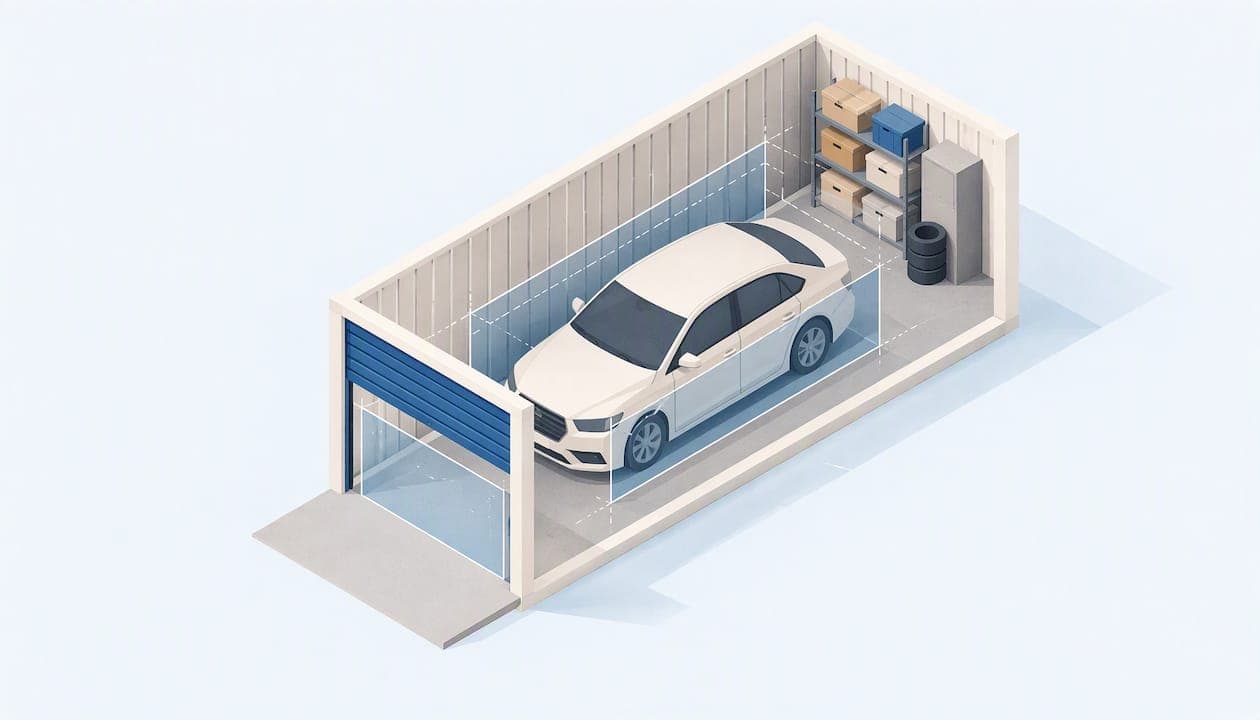
A 10x20 storage unit is 10 feet wide and 20 feet deep, about the footprint of a one-car garage, and it holds most sedans, crossovers and smaller SUVs. Whether your car actually fits comes down to three things: the vehicle's measured length and width, the height and width of the unit's door, and whether the facility accepts vehicles at all. This guide walks through each check, shows what else fits beside the car, and explains when an outdoor parking space is the smarter choice.
TL;DR
- A 10x20 is 200 square feet, roughly 1,600 cubic feet with an 8-foot ceiling, and it commonly suits sedans, crossovers and smaller SUVs.
- Measure the car, then measure the door opening and the drive aisle. The door, not the floor, is usually what stops a tall vehicle.
- Ask the facility about registration, insurance, operability, leaks and fuel level before you sign. Policies differ by facility.
- A car in a 10x20 leaves only a narrow strip for other items, so plan shelving along the walls or the front, not a full household.
- Larger trucks, lifted vehicles, RVs and boats usually belong in a wider unit or a dedicated vehicle space.
Table of Contents
- How big a 10x20 storage unit really is
- Does a car fit in a 10x20 storage unit?
- The measurements to take before you rent
- What to ask the facility before storing a car
- What else fits in a 10x20 with a car
- What fits in a 10x20 without a car
- Preparing the car for storage
- Climate control, security and access
- When a parking space beats a 10x20 unit
- Our perspective
- Rent a 10x20 in South San Antonio
- FAQ
- Sources
How big a 10x20 storage unit really is
The label is the floor plan: 10 feet across, 20 feet deep, 200 square feet in total. Most facilities build these units with an 8-foot ceiling, which gives about 1,600 cubic feet of space, although some sites offer taller ceilings. Door height is nearly always a bit lower than the ceiling, and that lost few inches is what matters for vehicles.
It helps to picture it. A standard one-car garage is close to the same footprint. Inside a 10x20 you could park a car and still walk around it, or you could fill the unit with the contents of a three- to four-bedroom home. It is the largest size many people need, and it sits between the smaller sizes and the 10x30. If you want to compare, our guide to the 10x30 unit size shows what the next step up adds.
| Measurement | 10x20 unit |
|---|---|
| Width | 10 ft |
| Depth | 20 ft |
| Floor area | 200 sq ft |
| Typical ceiling | 8 ft (some sites higher) |
| Typical volume | About 1,600 cu ft |
These are the nominal numbers. Walls, door tracks and corrugated panels take a little room, so the usable space is slightly smaller than the label suggests.
Does a car fit in a 10x20 storage unit?
Usually yes. ConsumerAffairs reports that a 10x20 commonly suits sedans, crossovers and smaller SUVs, while larger trucks, commercial vehicles and boats may be restricted. That last part matters: facility acceptance is not universal. Layout, local fire codes and insurance requirements all affect whether a given site lets you park a car in a unit.
So the honest answer has two halves:
- Physically: a typical car leaves a few feet of length to spare in a 20-foot-deep unit, and it is well under the 10-foot width.
- Administratively: the facility has to allow it, and the rental agreement has to cover it.
A full-size pickup or a long three-row SUV is where the physical answer gets tight. Those vehicles can be close to the 20-foot depth once you count the door track and a little walking room, and they are often taller than a standard door.
The measurements to take before you rent
Do this at home with a tape measure, before you reserve anything. It takes ten minutes and prevents the most common storage mistake: renting a unit the car cannot enter.

Length and width of the vehicle
Measure bumper to bumper for length. For width, measure the widest point including the mirrors, because mirrors are the part that scrapes. Many owners fold mirrors in, but check that they actually fold on your model. You want to be able to open at least the driver's door a little once the car is inside, or you will be climbing out through a gap.
A practical target: your car's length should leave at least 2 to 3 feet of the 20-foot depth free, and the width plus mirrors should leave comfortable space on both sides of a 10-foot floor. Squeezing the car to the wall leaves no room for a cover, a battery tender or boxes.
Height, including roof racks
Measure to the highest point: the roof, the antenna, a roof rack or a cargo box. Compare it with the door opening, not the ceiling. Door height varies by facility, and a unit that fits a sedan will not always fit a lifted truck. Ask the office for the actual opening height of the unit you are being offered.
The door opening and the drive aisle
The door of a 10x20 is typically narrower than 10 feet, since it sits inside the frame. Ask for its width and height. Then look at the drive aisle in front of the unit. To drive straight in you need enough room in the aisle to line up the car, and tight aisles make a 20-foot turning swing much harder. Drive-up units with wide aisles are far easier than interior units reached through hallways and elevators, which in most cases cannot take a vehicle at all.
A quick fit test
| Check | What to compare | Margin to aim for |
|---|---|---|
| Length | Bumper to bumper vs. 20 ft depth | 2 to 3 ft spare |
| Width | Body plus mirrors vs. door width | Several inches each side |
| Height | Roof, rack or antenna vs. door opening | A few inches clear |
| Approach | Aisle width in front of the door | Room to line up straight |
If any row fails, ask about a different unit or a vehicle space rather than hoping it works.
What to ask the facility before storing a car
The same ConsumerAffairs piece lists the questions worth asking, and they are the ones that decide whether a lease is approved. Confirm that the facility accepts the vehicle, then ask about:
- Registration: many sites want current registration on file.
- Insurance: whether your auto policy has to stay active, and whether the facility requires its own coverage on the contents.
- Operability: some sites require a car that starts and rolls, not a project vehicle.
- Leaks and fuel: fluid leaks are commonly prohibited, and there may be a limit on how much fuel can be in the tank.
- Tires and blocks: whether flat tires are acceptable and whether vehicles on blocks are allowed.
The pattern ConsumerAffairs describes is that requirements vary by facility, so get the rules in writing or in the lease. Our own checklist, five checks before you tow your car, covers the same ground in more detail for U.S. renters.
Also call your auto insurer. A stored car may still need comprehensive coverage even if you drop collision, and your policy terms decide that, not the storage lease.
What else fits in a 10x20 with a car
A car takes a lot of the floor. A sedan occupies roughly a 6-by-16-foot rectangle, which leaves a strip on each side and a short stretch at the back. That is room for supplies, not for a house.
Good candidates for the leftover space:
- Wall-mounted or freestanding shelving with plastic totes
- A set of seasonal tires stacked on a rack. Our tire storage guide explains why to keep them off bare concrete
- Tool chests, a battery tender, a car cover and jack stands
- Bicycles hung on the wall, a few folded chairs or a small table
- Business inventory in sealed boxes along the back wall, as long as the lease allows it
What will not work is a full living room set plus a car. If you need to store both furniture and a vehicle, count the furniture first. Our comparison of 10x10 versus 10x20 for furniture helps you size that part, and many people end up renting a unit for the car and a second smaller one for the contents.
Leave a walkway
Stack items so you can still reach the car's door and the hood. A narrow walkway on one side is worth more than a few extra boxes. It also keeps cardboard away from the car's paint and lets air move around the vehicle.
What fits in a 10x20 without a car
If you are only reading this to size a unit for household or business storage, the picture changes. Empty of a vehicle, a 10x20 can hold the contents of a three- to four-bedroom home: a sofa, a dining set, mattresses, dressers, appliances and a few hundred boxes if you stack to the ceiling and plan aisles. For a renovation, that is the common choice, because you can move everything out of a whole floor at once.
For small businesses, it works as a stockroom: shelving units down both walls, pallets or tote stacks in the middle and a central path to the back. The key is to keep an aisle, so you do not have to unload the front to reach the back.
Preparing the car for storage
A few steps protect the car, and they cost little.
- Wash and dry it. Dirt, bird droppings and road grime eat at paint over weeks. Dry the car fully before covering it.
- Handle fuel and fluids. Follow the facility's fuel rule. Many owners fill the tank and add a stabilizer for longer stays, but check your owner's manual.
- Protect the battery. Disconnect it or connect a maintainer, if the site allows it. Ask first.
- Keep pests out. Seal the exhaust opening with a rag only if you can remember to remove it, and keep food out of the cabin.
- Use a breathable cover. It keeps dust off without trapping moisture.
- Skip the parking brake on long stays. Pads can stick over time. Use wheel chocks.
If the vehicle is a classic or a collector car, the stakes are higher and so is the care. This overview of classic car storage options gives a broader view of how owners protect that kind of investment.
Climate control, security and access
San Antonio summers are hot and humid, and heat is hard on rubber, leather and fluids. A climate-controlled unit moderates that, which is worth considering for a valuable car or one that will sit for months. A standard drive-up unit is cheaper and works for most daily drivers stored short term.
Security matters just as much. Look for gated access, good lighting and cameras you can trust. Our renter checklist on storage safety explains what to verify, including how long footage is kept.
When a parking space beats a 10x20 unit
A unit is not always the answer. A parking space is often better if:
- The vehicle is too tall, too wide or too long for the door
- You are storing an RV, a trailer or a boat
- You want to take the car out often and do not want to maneuver into a tight unit
- The facility's rules do not allow vehicles inside units
Our guides on outdoor vehicle storage and outdoor, covered or indoor options lay out the trade-offs. At our South San Antonio location, we also offer RV storage and boat storage for vehicles that do not belong in a unit.
Our perspective
Most people who call us about a 10x20 for a car have measured the length and forgotten the door. We would rather you spend ten minutes with a tape measure than a weekend backing out of the wrong unit. So we tell renters to bring three numbers: the car's length, its width with mirrors, and its height with anything on the roof. Then we match those to a unit.

We also think a 10x20 is a sensible size for a car and a small amount of gear, and a poor size for a car and a household. If you find yourself needing both, rent two units. It is usually easier than building a tower of boxes around a vehicle you need to start.
Our facility is built around convenience: drive-up access, gated entry, video surveillance and a 24-hour kiosk. Our Touchless Rentals™ system lets you reserve and rent online without a visit to the office, and our leases are month-to-month, which suits a car you may only store for a season. Tell us what you are storing when you reserve, and we will confirm what suits the vehicle.
— Ian
Rent a 10x20 in South San Antonio
If your numbers work, you can look at our 10x20 storage units in San Antonio and rent online. You can also use our 24/7 contactless kiosk to complete the rental on your own schedule. If you are not sure the car fits, look at the 10x15 or the 10x30 pages to compare sizes, or start at our self-storage units overview.

Current unit pricing and availability are on the unit page, since they change with demand.
FAQ
Can a car fit in a 10x20 storage unit?
Usually yes, if it is a sedan, crossover or smaller SUV. Check the door height and width as well as the 20-foot depth, because the door is the usual limit. Ask the facility whether it allows vehicles in units at all.
Can I park a pickup truck in a 10x20?
It is possible with a short-bed or compact truck, but full-size trucks can be close to the unit's depth and taller than the door. Measure the truck and ask for the door's opening height. A vehicle parking space may be a better fit.
How much room is left for other items with a car inside?
Not much floor space: a narrow strip along each side and a small area at the back. Use shelving and wall hooks for totes, tires and tools, and keep a path to the driver's door.
Do I need insurance and registration to store a car?
Often, yes. Many facilities ask for current registration and proof of insurance, and requirements vary by site. Ask before you rent, and check with your auto insurer about the coverage you should keep on a stored car.
Is a 10x20 big enough for household items instead of a car?
Yes. It can hold the contents of a three- to four-bedroom home when packed with aisles, which makes it a common choice for moves and renovations.