
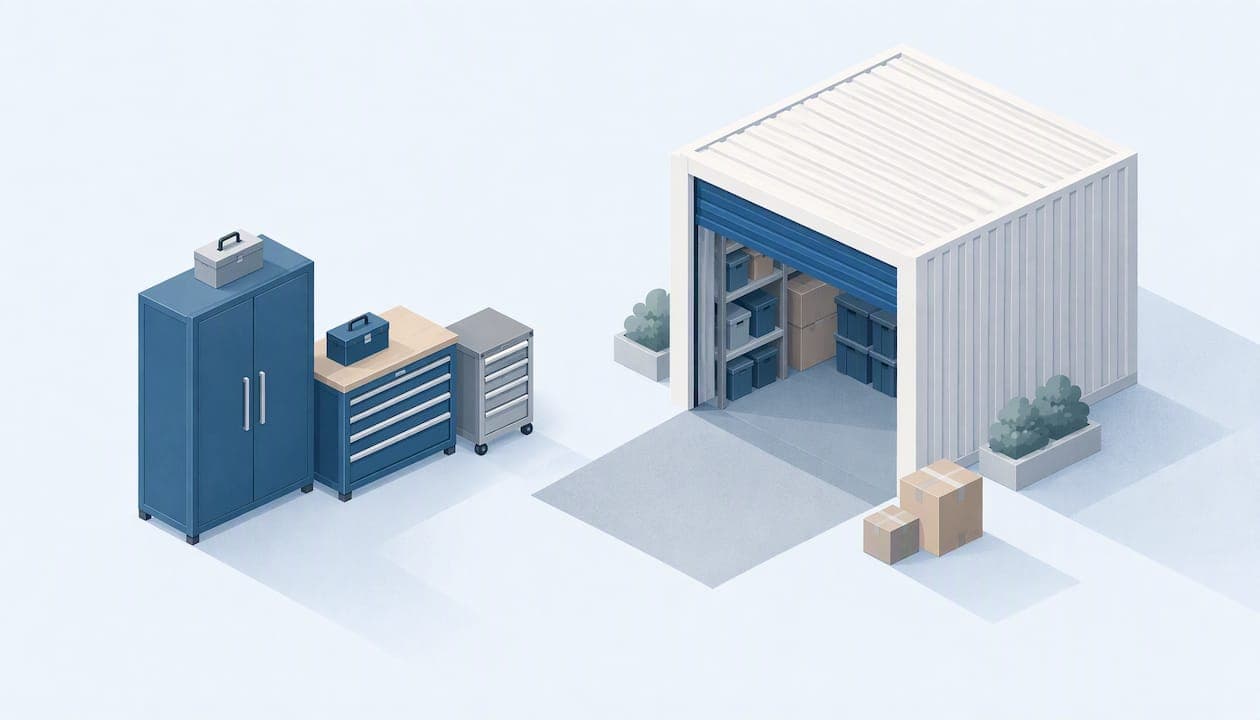
A tool storage unit can mean two things: a piece of furniture that holds your tools, such as a chest, roller cabinet, or tool bag, or a rented space where the whole collection lives. Most people need the first. If your garage is shrinking, you are renovating, or you run a trade out of a truck, you may need both. This guide covers the types, how to size and organize them, what to compare before you buy, and when it makes sense to move tools into a self-storage unit.
TL;DR
- Tool storage ranges from portable tool carts to stationary cabinets, so match the type to how often you move your tools.
- A cabinet is the floor-standing base on casters. A chest usually sits on top of it, and the two are not interchangeable terms.
- Steel, ball-bearing drawer slides, lockable drawers, and lockable casters are the features worth paying for.
- When the cabinet no longer fits the garage, or tools have to be out of the house during a project, a drive-up storage unit is the next step.
- Group tools by use, keep heavy items low, and label everything, whether they sit in a box or a rented unit.
Table of Contents
- What counts as a tool storage unit
- The main types, side by side
- How to choose the size and layout
- What to compare before you buy
- Building your own tool cabinet
- How to organize a big tool box
- When a cabinet is not enough: a storage unit for tools
- Rent a tool storage unit in South San Antonio
- Packing tools for storage
- Our perspective
- FAQ
- Sources
What counts as a tool storage unit
The phrase covers a wide range. Harbor Freight's buying guide lists mechanics carts, full-bank service carts, roller cabinets, top chests, and work center hutches with pegboards. Lowe's takes an even broader view, including portable tool boxes, cabinets and chests, rolling and stackable systems, tool bags, truck tool boxes, pegboards, workbenches, and garage cabinets.
In practice you can sort it by one question: does the storage stay put, or does it travel with you?
- Stays put: roller cabinets, side cabinets, wall pegboards, garage cabinets, workbenches with drawers.
- Travels: tool bags, portable boxes, stackable modular cases, truck boxes.
- Both: wheeled systems that live in the shop and roll out to the driveway or the job.
There is also a third category that rarely shows up in a tool aisle: a separate space for the tools you do not need at home every day. We come back to that below.
The main types, side by side
| Type | Best for | Watch out for |
|---|---|---|
| Tool bag | Hand tools and larger tools like drills, saws, and hammers on the move | Limited protection and no built-in lock |
| Plastic portable box | Light carrying, occasional use | Less durable than steel |
| Steel portable box | Heavier tools, rougher handling | Weight when full |
| Top chest | Stacking on a cabinet or sitting on a bench | Needs a base or a sturdy surface |
| Roller cabinet | A main shop collection that needs to move | Footprint in a small garage |
| Modular or stackable system | Mixed small parts and deep tools | Cost grows as you add modules |
| Pegboard or wall system | Everyday tools within sight | No security, and dust collects |
The portable rows come from Lowe's guide, which says plastic tool boxes are lightweight, steel boxes offer greater durability, and tool bags suit both hand tools and larger tools. The cabinet and chest rows follow Harbor Freight's descriptions of roller cabinets, top chests, and work center hutches.
Chest versus cabinet
Shoppers mix these up all the time. CRAFTSMAN's support FAQ makes the distinction plainly: cabinets sit on casters, while chests generally sit on top of cabinets to form a combination. Think of the cabinet as the base that carries capacity and mobility, and the chest as an upper module. Stacking one on the other adds organized storage without taking up more floor.

Professional metal systems follow the same logic. SinoTools describes top boxes, roller cabinets, combination boxes, side cabinets, and pit boxes, and notes that a top box may stand alone or sit on a roller cabinet.
What about a Dutch tool chest?
This is a different animal. A Dutch tool chest is a woodworker's build, and Lost Art Press calls it a beginner project that goes together with dimensional pine. It is a stationary shop chest for hand tools, not a rolling steel cabinet and not something designed for transport. If you like building furniture, a shop-built chest is a satisfying route, but it solves a different problem than a roller cabinet.
How to choose the size and layout
Start with the tools, not the product page. Tony Carrick's advice, in a Popular Mechanics pegboard roundup, is to lay your tools out on the floor in the arrangement you plan to use, then measure the area. It works for cabinets as well as pegboards. You will see right away how much is small precision gear and how much is bulky power tools.
Then work through four checks.
- Inventory by size. Separate hand tools, power tools with cases, long items like levels and saws, and loose hardware. Each group wants a different drawer depth.
- Think vertically. Harbor Freight notes that setups often combine units, such as a top chest stacked over a rolling cabinet, to use vertical space for everything from small instruments to bulky power tools.
- Match the workbench. Standard workbench height of 34 to 36 inches suits people between 5 feet 8 inches and 6 feet tall. A chest on top of a cabinet should land you near that working height, not above it.
- Leave working room. The same guide says a 24-inch deep bench is the most common prefabricated size, and a 30-inch depth leaves space to store items along the back while keeping 18 inches of workspace at the front. Measure the aisle you need to open drawers fully, too.
Home Depot describes the appeal of modular systems as bringing tools, accessories, and small parts together while keeping the workspace open and making the collection easier to move. That matters when you may relocate in a year or two.
What to compare before you buy
Materials and finish
Steel is prized for strength and durability, according to Harbor Freight, and powder coating helps resist rust, corrosion, scratching, and outside elements. Lowe's describes heavy-duty welded-steel cabinets as very durable, plastic boxes as lightweight, and aluminum truck boxes as rust resistant. If your tools live in a hot, humid Texas garage, finish quality is worth paying for.
Drawers and slides
Ball-bearing slides give smooth operation and typically handle heavier loads. Test a drawer loaded, not empty, if you can. A full drawer of sockets and wrenches is heavy, and cheap slides are where cabinets fail first.
Mobility
Roller cabinets come with wheels. Look for lockable casters so the cabinet does not creep when you pull a heavy drawer. Wheeled portable boxes ease transport, and removable trays and inserts add flexibility.
Security
Lockable drawers and lids are the baseline. Lowe's also points to latches that secure modular cases and sealed truck-box lids that help keep out moisture and dirt. A lock on a cabinet only deters casual theft, though. Which brings up the main limit of any cabinet: it is only as safe as the building around it.
Building your own tool cabinet
If you own a table saw and want a custom fit, a shop-built cabinet is realistic. A one-sheet plywood cabinet build for home-shop tools shows how far a single sheet and basic equipment can go, and it is a good model for a wall cabinet or a small base unit. Size the carcass to your drawer depth and the heaviest tool it will hold. Pair it with a steel top chest if you want real drawer slides without building them.

How to organize a big tool box
A big box turns into a junk drawer quickly. Bob Vila's approach is practical: take inventory, group tools by use, keep frequently used tools accessible, and store heavy tools and batteries low with lighter tools above. He also recommends labeling locations and subdividing large drawers with organizers or homemade dividers.
A few habits that make it stick:
- Zone by job. Plumbing, electrical, and carpentry each get a drawer, so you grab one drawer and go.
- Split containers when it helps. A small kit for daily repairs beats digging through the full chest.
- Line the drawers. Harbor Freight says toolbox liners protect tools and drawers and stop tools sliding around.
- Put a label on the front, not inside. If you have to open the drawer to learn what is in it, the label has failed.
When a cabinet is not enough: a storage unit for tools
Some situations outgrow even a good cabinet. These are the ones we hear about most.
- Renovations. Tools and equipment need to be out of the way, but you do not want to haul them home each night.
- Moves. You are between homes and the garage is gone, or the new place has no workshop space yet.
- Small trades. A contractor or handyman needs a secure place for ladders, compressors, and stock that does not fit the truck. Our guide on renting versus buying storage for contractors walks through the tradeoffs.
- Seasonal or hobby gear. Lawn equipment, pressure washers, and big power tools take space you want for cars. See our note on storing lawn equipment without building a new shed.
- Students and apartment dwellers. No garage at all, but a full set of tools you will need again.
Which unit size fits tools
A full tool collection takes less room than most people expect. A roller cabinet, a top chest, a workbench, and a few totes fit a modest space. Here is a starting point, which you should confirm by measuring your own gear:
| Your situation | Unit to look at |
|---|---|
| A few tool bags, a toolbox, and some cases | A 5x5 unit or a storage locker |
| A cabinet and chest, plus power tools and boxes | A 5x10 unit |
| A full shop with bench, cabinets, and lawn gear | A 10x10 or 10x15 unit |
| Contractor stock, ladders, and larger equipment | A 10x20 or 10x30 unit |
If you run a small business, our piece on what a 5x10 can hold for inventory shows how to think about shelving and aisle space, which applies equally to tool stock.
Why drive-up access matters for tools
Tools are heavy. Carrying a roller cabinet up an elevator or down a long hallway is a bad afternoon. Drive-up access lets you back the truck to the door and roll the cabinet straight in. Our South San Antonio facility offers drive-up access, gated entry, and video surveillance, so the security that a drawer lock cannot provide comes from the property itself.
Do tools need climate control?
Steel tools rust when moisture sits on them for weeks. Powder coating on cabinets helps, but bare tool surfaces, sandpaper, glues, finishes, and battery packs are more sensitive. South San Antonio summers are hot and humid enough that a climate-controlled unit is worth considering for precision tools, hand-tool collections, and anything with batteries. For packing methods that cut down on moisture, read our guide on packing a storage unit to avoid mold.
Rent a tool storage unit in South San Antonio
Inline Storage offers month-to-month leases, a range of unit sizes from lockers and 5x5s up to 10x30s, and climate-controlled options. You can rent through our Touchless Rentals™ system online, or use the 24/7 contactless kiosk, so you never have to wait for office hours to start moving in. Browse the available unit sizes or start from our self-storage page to reserve a unit. If you also keep a trailer, camper, or truck, ask about our RV storage and boat storage.
Packing tools for storage
Whether the destination is a garage corner or a rented unit, the steps are the same.
- Clean and dry every tool. Wipe off dirt and moisture before anything goes into a drawer or tote.
- Empty fuel and remove batteries from power equipment. Store batteries low and in a cabinet, as Bob Vila suggests when storing heavy tools and batteries low.
- Lock casters on rolling cabinets once they are in place, so they stay put.
- Put heavy items on the bottom and keep items you reach for most near the door.
- Leave an aisle. Plan a walkway down the middle so you never have to unstack to reach the one box you need.
- Label every box on two sides, and keep an inventory list on your phone.
Want more help with layout? Our guide to packing for drive-up access covers aisle planning in more detail.
Our perspective
We see tools come through our South San Antonio doors for the same few reasons: a renovation, a move, a business that outgrew its truck. The pattern is consistent. People buy the best cabinet they can afford, and it is a good call, but the cabinet is not the part that fails. Space fails first. The garage fills with boxes, the bench disappears, and the cabinet gets pushed into a corner where nobody can open the drawers.
Our advice is to keep what you use every week close, in a cabinet you can reach, and to move the rest out. A small unit on a month-to-month lease costs less than the project you cannot finish because the garage is a mess. We built the drive-up layout and the touchless rental process around that kind of customer, someone who wants to rent in minutes, load a truck, and get back to work. Match the unit to the tools, not the other way around, and do not be afraid to start small and size up later.
— Ian
FAQ
What is the difference between a tool chest and a tool cabinet?
A cabinet is the floor-standing unit, usually on casters. A chest is a smaller box that generally sits on top of the cabinet, as CRAFTSMAN explains. Together they form a combination that adds drawer space without adding floor space.
How do I organize a big tool box?
Take inventory, group tools by use, and keep frequent tools within reach. Store heavy tools and batteries at the bottom and lighter ones above. Label each spot and divide large drawers with organizers, as Bob Vila recommends.
Is steel always better than plastic for tool storage?
Steel offers more durability and suits heavy tools and workshop cabinets. Plastic is lighter, which is useful for carrying a basic kit, according to Lowe's guide. Choose by how you use the box: steel for heavy daily use, plastic for light portable work.
Can I keep my tools in a self-storage unit?
Yes. Tools, cabinets, workbenches, and equipment are common in storage units. Clean and dry everything first, drain fuel, and consider climate control for precision tools and batteries. At Inline Storage you can choose from several unit sizes and rent online with Touchless Rentals™.
Sources
- Tool Storage Buying Guide, Harbor Freight
- Tool storage buying guide, Lowe's
- Tool Box Types: Chests, Cabinets, and Other Organizers, SinoTools
- How to Choose the Right Workbench Size for Your Workshop
- Build Your Modular Tool Storage System, The Home Depot
- The 5 Best Pegboard Accessories, Popular Mechanics
- How to Organize a Tool Box Like a Pro, Bob Vila
- Storage frequently asked questions, CRAFTSMAN
- Tools Needed to Make the Dutch Tool Chest, Lost Art Press