
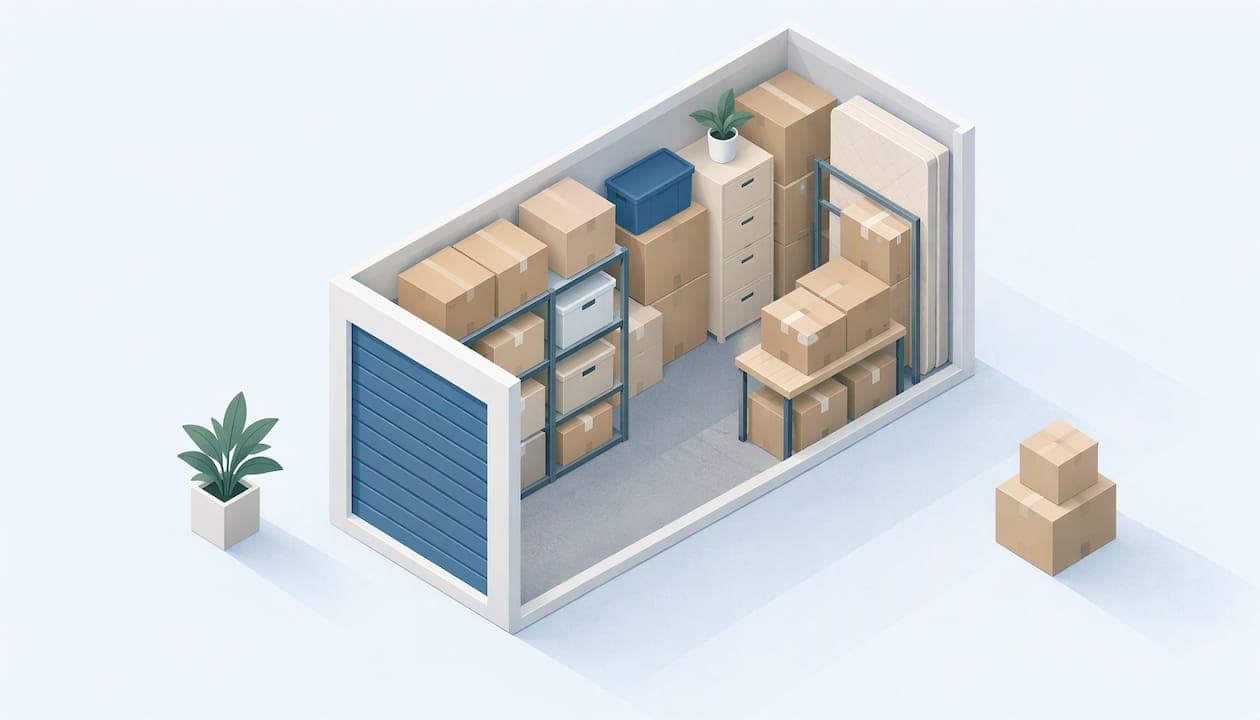
A self-storage unit sized for business stock is a practical, scalable choice for many small businesses. Several factors decide whether it works, including unit size, security, climate control, lease terms, and insurance. We offer storage options at Inline Storage, from Touchless Rentals™ to climate-controlled units and video surveillance. Calculate your volume first, then reserve the smallest unit that leaves room to grow.
TL;DR:
- Measure cartons using their outer dimensions, plan shelving and a clear aisle, then add a 10–25% growth buffer before choosing a unit.
- Choose climate control for goods sensitive to heat or humidity, including cosmetics, paper, electronics, and food; use drive up access for frequent heavy loads.
- Ask your insurer whether stored stock is covered and get its limit in writing; security, climate control, and lease rules can affect coverage.
- Compare rent, move in fees, and insurance over the same period, using the post promotion rate to calculate each facility’s effective monthly cost.
Table of Contents
- What fits in a 5x5 through 10x30 unit?
- Which security, access, and insurance details protect your stock?
- What does an inventory storage unit really cost?
- How do you choose the right unit for your inventory?
- How should you pack, shelve, and lay out stored stock?
- How do receiving, fulfillment, and seasonal peaks work?
- What about RV and boat storage for your business?
- How do touchless rentals work, and why do they help?
- How can promotions lower your storage costs?
- Why off-site storage suits small businesses
- Check availability for your inventory with Inline Storage
- FAQ
- Sources
What fits in a 5x5 through 10x30 unit?
Match your stock to a footprint before you compare prices. These are rough planning ranges, not guarantees, so measure your own cartons before you commit.
- 5x5: Best for a few dozen small cartons, samples, or a single shelving bay. Think accessories, supplements, or paperwork archives.
- 5x10: Fits a full wall of shelving plus a narrow walkway. A good fit for a growing online seller with a few hundred SKUs in small boxes.
- 10x10: Holds several shelving runs or a couple of pallets with a pick aisle. This is the common starting point for retailers carrying bulky goods.
- 10x15 and 10x20: Room for multiple pallets, a packing table, and staging space for carrier pickups.
- 10x30: Works like a small warehouse bay for furniture, equipment, or high-volume seasonal stock.
A simple rule of thumb: count your cartons, stack them no higher than you can safely reach, and picture the floor area they cover. Then add room for a walkway, because stock you cannot reach is stock you cannot sell. If you ship from the unit, pick a size where one person can walk the full length without moving anything.
Choose climate control for anything sensitive to heat or humidity, such as cosmetics, paper goods, electronics, or food-grade items. Choose drive-up access when you load heavy cartons or pallets often. Our guide to drive-up storage sizes shows how each size looks in practice.
Which security, access, and insurance details protect your stock?
Your inventory is cash sitting on a shelf, so the facility should treat it that way. Look for these features first:
- Gated entry with individual access codes
- Video surveillance covering driveways and unit rows
- Good lighting and on-site monitoring
- A lease that spells out rules for prohibited items
Insurers care about the same things. A self-storage insurance application asks operators about security, climate control, vehicle storage, and written lease rules, which tells you what coverage decisions hinge on. Operators are also putting money into security, communications, and automation tools, according to the 2026 industry outlook.
On your side, call your business insurer and ask whether your policy covers stock kept off premises, and what the limit is. If it does not, arrange dedicated coverage. Our article on getting your off-premises limit in writing walks through that call.
Pro Tip: Photograph your stock and save a dated inventory list in the cloud regularly, so a claim never depends on memory.
If a unit ever holds both personal and business items, record the business-use percentage. Tax deductions apply only to the qualifying business portion.
What does an inventory storage unit really cost?
Budget for the whole move-in, not just the sticker rent. Typical cost components include:
- Base monthly rent, which rises with unit size and with climate control
- Deposits or administrative fees at move-in
- Optional tenant insurance or your own business coverage
- Possible fees for late payment or after-hours access, depending on the facility
Most self-storage leases run month to month, billed automatically. That flexibility is the main financial advantage over a long warehouse contract, because you can resize when your stock changes. Promotions can lower early months, but the rent you pay after the promotion ends is the number that matters.
To compare offers fairly, add up the rent, move-in fees, and insurance over the same period, then calculate the average monthly cost. That effective monthly cost shows which facility is cheaper in practice. The exact price for a South San Antonio unit depends on size and features, so check availability for current pricing.
Also look at how the facility is billed. A lease that renews automatically is convenient, but confirm how much notice you must give before moving out so you are not paying for space you stopped using.
How do you choose the right unit for your inventory?
Work through the math step by step:
- Count your volume. Total the cartons or pallets you hold today, using the real outer dimensions, not the product size.
- Plan the footprint. Decide whether you will use shelving or floor stacking, and measure the floor area each takes.
- Add working space. Leave an aisle wide enough to walk, plus room to open a carton and pack an order.
- Add growth. Build in a buffer of 10–25% so a busy quarter does not force a rushed move.
Then evaluate the facility itself. Check whether it offers climate control, drive-up or interior units, ground-level loading, convenient gate hours, strong security, and a short drive to your carriers. Our business storage units checklist covers the reservation side of this step by step.
One decision comes up often: one large unit or two small ones? A single large unit is easier to organize, and you only unlock one door. Two smaller units can cost less per month and let you drop one when demand slows, but you will spend more time walking between them. If you ship daily, choose one larger unit. If your stock is seasonal, two units give you an easy way to scale down.
How should you pack, shelve, and lay out stored stock?
A tidy unit protects your goods and saves labor every time you pick an order.
- Use freestanding industrial shelving where possible, and keep heavy cartons on the bottom shelves.
- Stack boxes uniformly so a column cannot topple, and never block the unit door.
- Label every carton on two sides with SKU, quantity, and date received.
- Keep a clear aisle so you never have to move stock to reach stock.
- Use moisture absorbers and a climate-controlled unit for anything that warps, rusts, or molds.
- Rotate stock first in, first out, and keep food, textiles, and paper goods in sealed plastic bins to deter pests.
Our guide to packing a storage unit goes deeper on moisture and airflow.
A good layout also depends on a system that tells you where everything lives. A partner article on building an inventory system is written for artists, but its tracking ideas adapt well to any small business.
Pro Tip: Number your shelves and aisles like a grid, then record each SKU's location so a new helper can find stock on day one.

How do receiving, fulfillment, and seasonal peaks work?
A storage unit slots into an e-commerce or retail routine in a few ways.
- Ship to your business address, then transfer. You inspect every delivery before it goes in the unit, which catches damage early, but you handle the stock twice.
- Ship directly to the unit. This saves a step. The tradeoff is that someone must be present to accept deliveries, and carrier access depends on facility rules.
- Stage for carriers. Keep outbound cartons near the door with labels printed, so pickups take minutes.
- Scale for the season. Rent a larger unit for your peak, add a second short-term unit, or swap down when the season ends.
Seasonal peaks are a common reason businesses turn to self-storage, since a unit lets you match your footprint to demand instead of paying for a year-round warehouse. Plan your pick-and-pack area near the door, and put your fastest-moving SKUs at waist height.
What about RV and boat storage for your business?
Some businesses store vehicles, not boxes. A food truck, a trailer, a work van, or a dealership's boat inventory all need secure parking with different features than a standard unit.
We offer both RV storage and boat storage at our South San Antonio location. Vehicle spaces are a different product from interior units, so ask about these details before you reserve:
- Dimensions: Measure length, width, and height, including hitches, ladders, and roof equipment, and compare them with the space.
- Covered or open parking: Open parking costs less, while covered or enclosed spaces shield paint and seals from sun and weather.
- Gate access: Confirm gate hours and whether your rig can turn comfortably.
- Prohibited items: Leases usually restrict fuel, hazardous materials, and operating vehicles on site. Insurance applications ask operators about indoor and outdoor vehicle storage and hazardous items, so read this part of your lease.
- Prep before storing: Clean the vehicle, empty tanks as the lease requires, and disconnect or maintain the battery.
If your business stores both stock and a vehicle, one provider means one account and one set of gate codes. Ask about both when you check availability.
How do touchless rentals work, and why do they help?
Touchless rental lets you rent a storage unit online with minimal physical interaction. We built our Touchless Rentals™ process around that idea, with a 24/7 contactless kiosk on site for customers who prefer to finish in person.
For a small business owner, the advantages are practical:
- Speed: You can reserve between supplier calls, at night, or on a weekend, without driving to an office first.
- Fewer handoffs: You deal with the process on your own schedule, so a delivery or a customer call does not derail it.
- Clear records: Your lease and payment details are saved electronically, which helps when your accountant asks for documentation.
- Accessibility: Digital steps can reduce barriers for customers who find counters or paperwork difficult. Our accessible storage units checklist lists things to check.
Operators across the industry are investing in automation and communications tools, per the Storable outlook, so expect touchless options to keep spreading. When you compare facilities, ask whether you can complete the full rental online and how you get access afterward.
How can promotions lower your storage costs?
Promotional offers can trim your first months of rent, and they are worth asking about. Common patterns include a discount on the first month, reduced administrative fees, or a special rate on certain unit sizes. Offers change, so confirm the current terms before you reserve.
Use a simple checklist so a promotion helps you instead of confusing you:
- Ask what the rent becomes when the promotion ends.
- Confirm whether the offer applies to the unit size and type you need, including climate control.
- Check whether the discount requires a minimum stay.
- Add insurance and fees to the same period, then compare your effective monthly cost across providers.
The best way to save on inventory storage is usually the quiet one: rent the right size. A unit that is one size too large costs more every month, while one that is too small forces a second rental. Re-measure your stock regularly. If you have plenty of unused space, downsizing may save more than any promotion. We are happy to confirm current offers when you check unit availability, so ask before you commit.
Why off-site storage suits small businesses
Most small businesses cannot predict next year's volume, which is exactly why long warehouse commitments scare me. A month-to-month unit lets you test a product line, ride out a slow season, and grow when orders prove it is time. What you pay is a monthly rent, and what you keep is the freedom to change your mind. The features matter just as much: a gated site, cameras, a climate-controlled option, and a rental process that works at 10 PM. That mix is what we built our Touchless Rentals™, unit sizes, and security around.
— Ian
Check availability for your inventory with Inline Storage
If you have measured your stock and picked a size, the next step is to check availability. We offer the unit sizes covered in this article, climate-controlled storage, video surveillance, gated entry, drive-up access, and Touchless Rentals™ at our South San Antonio location, so you can skip the counter and keep your day moving.

Start with the size you calculated: a unit for small cartons, a unit for pallets and an aisle, or a unit for a packing table and staging space. Not sure? Browse all of our self-storage units and compare, then add the growth buffer from the checklist above. Pricing depends on the unit size and features. Check availability for current pricing. Check availability online and reserve your unit.
FAQ
How big of a storage unit does a small business need?
It depends on your carton count, shelving plan, and aisle space. Measure your stock before you reserve so you pay for the space you will actually use.
Do I need a climate-controlled unit for inventory?
Choose climate control for goods that react to heat or humidity, such as cosmetics, paper, electronics, and food-grade items. Sturdy, sealed goods like hardware often do fine in a standard unit. Insurers also track climate control as an underwriting detail, per the self-storage application.
Does my business insurance cover inventory in a storage unit?
Not always. Many business policies limit coverage for stock kept off premises, so call your insurer and get the limit confirmed in writing. If your policy falls short, arrange dedicated coverage before you move stock in.
Can I deduct my storage unit as a business expense?
Only the portion used for qualifying business activity is deductible, so record the business-use percentage if a unit holds mixed items. For inventory treatment, review IRS Publication 334 or ask your tax professional.
Sources
- Publication 334 (2025), Tax Guide for Small Business | Internal Revenue Service
- Self-Storage Application
- Storable Releases 2026 Self-Storage Industry Outlook