
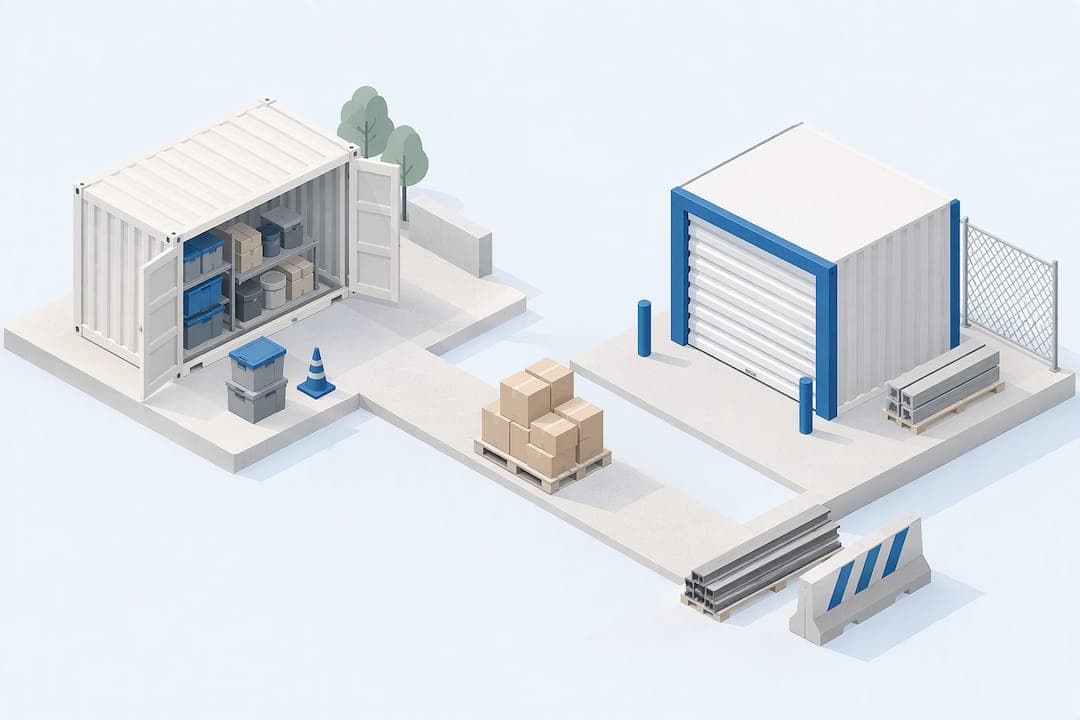
For most contractors, a secured drive-up self-storage unit or a gated vehicle yard gives the best mix of access, security, and compliance, and facilities like Inline Storage show what that setup looks like in practice. The right choice comes down to two things: how often you need to reach your gear, and how well the arrangement helps you meet OSHA storage and fire-safety limits without slowing you down. Below, you will find the format options, the questions worth asking a provider, and a setup plan that keeps a unit safe and efficient.
TL;DR:
- Drive-up units are ideal for daily access to tools and small equipment, especially when loading and unloading trucks directly at the door.
- Fenced yards or parking lots are necessary for storing trailers, heavy equipment, or vehicles that cannot fit inside standard units.
- OSHA storage rules require securing stacked materials, avoiding overloads, and confirming load ratings to prevent hazards and comply with safety standards.
- Leasing offers flexibility with month-to-month agreements and should include clear security features, access hours, and insurance requirements.
- Inline Storage provides contractors with drive-up access, round-the-clock kiosks, and RV parking, combining convenience with safety features suitable for heavy and sensitive gear.
Table of Contents
- Contractor storage options: formats and when each fits
- How to choose the right storage arrangement
- Safety and compliance: OSHA rules and what you must not store
- Practical setup: organizing a contractor storage unit for speed and safety
- What to expect in a storage rental agreement
- Questions worth asking before you rent a unit
- Common red flags when choosing storage for a contracting business
- Setting up contractor storage: a step-by-step start
- What contractors get wrong about storage
- How Inline Storage meets contractors' needs
- Sources
- FAQ
Contractor storage options: formats and when each fits
Not every job needs the same storage setup. A framing crew cycling through lumber and nail guns has different needs than an electrician storing spools of wire and panel boxes for months at a time.
Drive-up and drive-in self-storage units work well when you need frequent hands-on access to hand tools, power tools, and small equipment. You can pull a truck right to the door, load or unload quickly, and skip the elevator or long hallway walk that indoor units require.
Portable storage containers suit short-term project staging or a business move, since the container can sit on-site or at a yard and then relocate with the job. Jobsite chests and toolbox systems, like the steel jobsite storage chest models built with arc-welded seams and pry-resistant locks, handle the daily mobility problem: they bolt into a truck bed or trailer and keep tools secure between stops.
Fenced yards and RV or vehicle parking solve a different problem entirely: trailers, work trucks, skid steers, and other heavy equipment that will not fit in a standard unit need to open, secured space with enough clearance to maneuver.
A quick way to narrow the field:
- Access frequency: daily access favors drive-up units; monthly access can work with a standard indoor unit.
- Vehicle or trailer storage: anything with wheels usually needs a fenced yard or dedicated RV/vehicle parking, not a unit.
- Security expectations: higher-value inventory justifies gated access and video coverage over a basic lot.
- Climate sensitivity: electronics, finishes, and certain adhesives hold up better in a climate-controlled unit than a standard bay.
How to choose the right storage arrangement
Once you know roughly what format fits, run the decision through a short checklist before signing anything.
- Map your access pattern. Daily pulls call for drive-up convenience; infrequent access opens up more options, including standard indoor units.
- Check the security basics. Gated entry, working cameras, site lighting, and a facility that states its insurance requirements clearly are non-negotiable for tools and equipment worth protecting.
- Confirm operational features. Ask about drive-up access, loading areas, and kiosk hours, since a facility with a 24/7 contactless kiosk lets you move equipment outside normal business hours.
- Verify vehicle specifics. If you are parking a trailer or RV, confirm length limits, overhead clearance, and any registration or insurance documents the facility requires.
- Weigh rent versus buy. The Small Business Administration's buy-or-lease guidance frames this as a cash-flow decision: leasing preserves working capital and lets you test a location before committing, while buying property or building a shop ties up cash but can lower costs over a longer horizon.
Pro Tip: Run the numbers on 12 months of rent against the cost of financing a small shop before you assume ownership is cheaper. Leasing almost always wins for a business still scaling its job volume.
Safety and compliance: OSHA rules and what you must not store
A storage unit is not just a box for extra stuff. OSHA treats it as a workspace, and the rules reflect that.
Under OSHA 1926.250, materials stored in tiers must be stacked, racked, blocked, or otherwise secured to prevent sliding, falling, or collapse, and stored materials cannot exceed the posted maximum safe floor-load limit. That single rule explains why the biggest unit is not automatically the best one: an overloaded floor or a blocked aisle creates a hazard no amount of square footage fixes.
A facility with a posted, verified load limit protects both your inventory and your crew. OSHA 1926.250 requires that limit to be posted before you start racking heavy material.
Practical do's and don'ts that follow from the regulation:
- Do post and confirm the unit's load rating before installing shelving or pallet racks.
- Do keep aisles and passageways clear so nothing blocks an exit or access point.
- Do not store incompatible materials side by side without separation.
- Do not assume a standard storage unit is approved for flammable liquids or fuel.
OSHA's flammable liquids rule restricts storage of flammable liquids to approved containers and tanks, with required separation, fire protection, and quantity limits that vary by liquid class. If a job genuinely requires storing fuel or solvents temporarily, get written approval from the storage operator first rather than assuming a rented space allows it. When in doubt, pull up the lease terms or call the local fire marshal before you bring anything regulated onto the property.
Practical setup: organizing a contractor storage unit for speed and safety
A well-organized unit saves time on every single visit, which adds up fast over a busy season.
Zone the space: keep fast-moving tools and daily-use items near the front, close to the door, and push reserve equipment, seasonal gear, or slow-moving inventory to the back. Label shelving and bins clearly so anyone on the crew can find what they need without digging.
For heavy items, use pallets or skids rather than stacking directly on the floor, and always check the posted load rating before adding a rack system, per OSHA's storage requirements. Plan a clear path from the door to every zone so nobody has to climb over equipment to reach a tool.
Security matters as much as layout:
- Use high-quality padlocks rated for outdoor or cut resistance.
- Bolt down rolling tool chests rather than relying on their built-in locks alone.
- Pair facility cameras with motion-activated lighting near the unit entrance for an extra layer of visibility.
Pro Tip: Photograph your unit's layout once it is organized. If anything goes missing or shifts, you have a reference point for an insurance claim or a quick walk-through with the facility manager.
What to expect in a storage rental agreement
Most self-storage leases run month-to-month, which suits contractors better than a long fixed term tied to a single project. Read the agreement for a few specific items before signing: the notice period required to vacate, whether the rate is locked for a set period or can increase with notice, and what happens if a payment is late, including any lien or auction process.
Check the insurance language closely. Some facilities require proof of renter's insurance or offer a protection plan as an add-on, and skipping this step can leave expensive tools uncovered if something happens. Also look for restrictions on what you can store, since most leases explicitly prohibit hazardous materials, and confirm access hours match your actual work schedule rather than a standard nine-to-five window. A facility offering flexible month-to-month terms, like Inline Storage's South San Antonio units, gives you room to scale up or down as job volume changes without renegotiating a long lease.

Questions worth asking before you rent a unit
A short conversation with a facility manager before you sign can save weeks of frustration later. Ask directly:
- What are the access hours, and is there a kiosk or after-hours option for early starts or late pickups?
- What security features are actually in place, not just advertised: gated entry, working cameras, on-site lighting?
- Are there restrictions on storing fuel, propane, or other regulated materials, and what is the process for getting written approval if needed?
- What is the notice period to cancel, and how are rate increases communicated?
- Is vehicle, trailer, or RV parking available on-site, and what are the length and clearance limits?
Getting clear answers here upfront avoids the common problem of signing a lease, moving equipment in, and only then discovering a restriction that forces a second move.
Common red flags when choosing storage for a contracting business
A few warning signs tend to predict problems down the road. A facility that cannot clearly explain its insurance requirements, or one that is vague about whether cameras and gates are actually functioning rather than just installed, deserves a second look.
Watch for these patterns:
- Unclear or missing load-limit postings, which suggests the facility has not thought through OSHA compliance for tenants racking heavy gear.
- No written policy on flammable or hazardous materials, leaving you to guess at what is allowed.
- Limited or inconsistent access hours that do not match your actual work schedule.
- A rigid long-term lease with no month-to-month flexibility, which locks you in even if your storage needs to shrink.
- Poor communication or slow response times when you ask basic questions before renting.
Any one of these alone might be manageable, but two or three together usually mean the facility is not built with contractors in mind.
Setting up contractor storage: a step-by-step start
Getting a unit ready for daily use takes a few deliberate steps rather than just dropping boxes inside.
First, confirm the unit size and format against your actual inventory, not a guess, and check whether the facility offers climate-controlled options if you are storing anything sensitive to temperature or humidity. Second, schedule delivery or move-in during a window when you can fully organize the space rather than rushing.
Third, set up access: many facilities now offer contactless rental and entry, and a 24/7 kiosk system means you can complete paperwork and get a gate code without waiting on office hours. Fourth, verify insurance before the first item goes in, either through your existing business policy or a facility-offered plan, so tools are covered from day one.
Fifth, zone and label the space as described earlier, checking floor-load ratings before racking anything heavy. Finally, do a walk-through after a week of real use and adjust the layout based on what you actually reach for most.

What contractors get wrong about storage
The mistakes I see most often are overfilling a unit past its practical capacity and storing fuel or solvents without checking whether the facility allows it. Both are avoidable with a five-minute conversation before move-in.
Get written permission for anything remotely hazardous, even a single gas can, rather than assuming a standard lease covers it. Facility features like Touchless Rentals™, video surveillance, and a range of unit sizes solve real friction points for contractors moving fast between jobs, but they do not replace reading the lease.
— Ian
How Inline Storage meets contractors' needs
Contractors juggling job sites do not need more friction at the storage facility. Inline Storage's South San Antonio location offers drive-up access, video surveillance, and Touchless Rentals™ for renting a unit online with minimal in-person contact, along with RV and boat parking for trailers and equipment that will not fit in a standard unit.

- Unit sizes range from small lockers to large bays, with pricing starting at competitive rates according to Inline Storage's own listing.
- RV and vehicle parking is available for contractors storing trailers or heavy equipment separately from tools.
- A 24-hour kiosk lets you handle move-in or gate access outside standard office hours.
Check current unit sizes and availability online, or review RV storage options if you need space for a trailer or motorhome alongside your tool inventory.
Sources
For compliance details, review OSHA's general storage requirements, OSHA's flammable liquids rule, and the SBA's buy-or-lease guidance before finalizing a storage plan. For format comparisons, facilities like Island Park Storage also document drive-up unit and vehicle parking features worth reviewing.
- 1926.250 - General requirements for storage. | Occupational Safety and Health Administration
- Buy assets and equipment | U.S. Small Business Administration
- Better Built 2048-BB Jobsite Storage Chest Box - 48" x 24" x 28"
FAQ
Can you legally run a business out of a storage unit?
Most storage leases prohibit using a unit as a business address or workspace, since units are zoned for storage rather than commercial operations. Check your specific lease and local zoning rules, since restrictions vary by facility and municipality.
What is the cheapest way to store contractor equipment?
Cost depends on unit size, format, and location, but a jobsite chest or toolbox system is typically the lowest-cost option for daily tools, while a shared or smaller self-storage unit costs less than a full bay or fenced yard. Comparing month-to-month unit pricing against the SBA's buy-or-lease framework helps you avoid overcommitting cash to a long-term option you may not need.
What is a contractor storage unit?
A contractor storage unit is any self-storage space, drive-up bay, or fenced yard used to hold tools, materials, and equipment between jobs rather than at a home garage or job site. Formats range from small lockers for hand tools to large drive-up units or vehicle parking for trucks and trailers.
How many rooms of furniture fit in a 10x10 storage unit?
A 10x10 unit generally holds the contents of a one-bedroom apartment, though for contractors the more relevant measure is equipment volume rather than furniture. Checking exact unit dimensions against your tool and material inventory gives a clearer picture than a furniture comparison.