
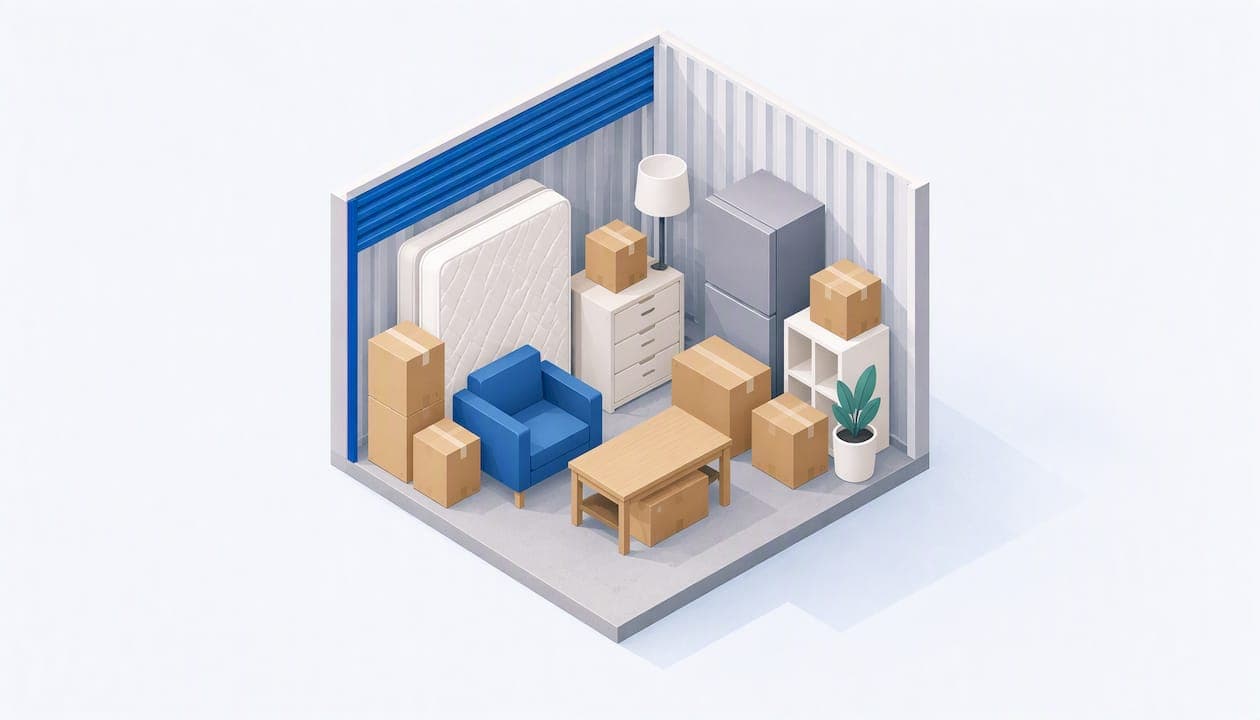
A 10x10 storage unit measures 10 feet wide by 10 feet deep, which gives you 100 square feet of floor space. With the 8-foot ceiling common in drive-up units, that comes to roughly 800 cubic feet of room. In practical terms, it holds the contents of a one-bedroom apartment or a small two-bedroom, if you pack with some care. Below you will find the numbers, what fits, what does not, and how to decide between a 10x10 and its neighbors.
TL;DR
- A 10x10 is 100 sq ft of floor area and about 800 cu ft of volume at an 8-foot ceiling. Ceiling height varies by building, so confirm it before you plan around the cubic figure.
- It typically fits a one-bedroom apartment: a queen bed, a sofa, a dresser, a table with chairs, and 25 to 40 boxes, with a narrow walkway.
- It is a good fit for a move, a renovation, a college student's summer, or a small business's overflow inventory. It gets tight with a full three-bedroom house.
- Pack tall, leave an aisle, and put the things you will need to reach near the door.
- We rent 10x10 units in South San Antonio, and you can reserve one online without visiting the office.
Table of Contents
- The size of a 10x10 in numbers
- How big is 10 feet by 10 feet in real life?
- What fits in a 10x10 storage unit?
- Can a 10x10 hold a one-bedroom apartment?
- Is a 10x10 big enough for your situation?
- When a 10x10 is too small
- 5x10 or 10x10: which one?
- How to pack a 10x10 so it holds more
- What not to put in your unit
- Climate control for a 10x10
- Our view: size for the way you will use it
- Reserve a 10x10 in South San Antonio
- FAQ
- Sources
The size of a 10x10 in numbers
The name is the footprint. Ten feet by ten feet is the floor. Multiply the two and you get 100 square feet. Multiply by the height of the unit and you get volume.
| Measure | 10x10 unit |
|---|---|
| Width | 10 ft |
| Depth | 10 ft |
| Floor area | 100 sq ft |
| Height (common) | 8 ft |
| Volume at 8 ft | 800 cu ft |
| Volume at 9 ft | 900 cu ft |
| Volume at 10 ft | 1,000 cu ft |
That last point matters. Some buildings have a taller ceiling, and the cubic footage rises with it. But the floor does not change, and the floor is what limits what you can set down. Taller ceilings only help if you can stack safely.
Nominal measurements are also slightly generous. Walls, door tracks, support posts and a sprinkler line can take a few inches here and there. A real 10x10 might be a hair under 10 feet in one direction. Treat the published figures as planning numbers, not engineering tolerances. If you have a sofa that is within an inch of a limit, measure the actual unit.
Usable space is less than the number
No one fills 800 cubic feet to the last inch. Boxes do not fill corners, furniture has gaps, and you need a path to reach the back. Plan on using something like 70 to 85 percent of the nominal volume, depending on how disciplined you are about stacking. That still leaves a lot of room, but it explains why two people with the same unit can describe it very differently: one calls it roomy, the other says it was full by the third load.
How big is 10 feet by 10 feet in real life?
Numbers on a page are hard to picture. A few comparisons help:
- A small bedroom. Many secondary bedrooms in American homes are about 10 by 10 feet, so the floor of the unit is roughly what one such room offers.
- Half a one-car garage. A typical single garage is about 12 feet wide and 20 feet deep, which is about 240 square feet, so a 10x10 is a bit less than half. If you think of the unit as a room, it is the size of a room with no windows and a roll-up door.
- About four parking spaces' width? No. A standard parking space is closer to 9 by 18 feet, or around 160 square feet, so a 10x10 is smaller than one parking space. That is a useful reminder that it is a compact unit.
- Ten ten-foot walls. If you lay a 10-foot folding table end to end, you could line up ten across the width of the floor if the table were one foot wide. In other words, a 10-foot floor fits a standard 8-foot sofa with room to spare along one wall.
The usual rule is simple: a 10x10 is where storage stops being "a closet" and becomes "a room".
What fits in a 10x10 storage unit
Here is what a well-packed 10x10 handles, from our experience renting units in South San Antonio and from how these sizes are generally used.
Furniture
- A queen or king mattress and box spring, stored on its side or flat on top of other items
- A three-seat sofa and a loveseat or armchair
- A dresser and one or two nightstands
- A dining table with four to six chairs (take the legs off if the table allows)
- A bookcase, a TV stand, a desk
- A washer and dryer pair, which together take about 6 to 7 square feet in width of floor if side by side
Boxes and smaller items
- Around 25 to 40 medium boxes, stacked three to five high, alongside the furniture
- Or, if you use the unit mostly for boxes, a hundred or more medium boxes with an aisle, though that is a ceiling you rarely hit in practice
- Lamps, rugs, framed art and a mirror stored upright against a wall
- Bikes (hang them or lean them), a few tools, a small grill, patio chairs
A sample load
Here is a layout that works. It is not the only way, but it shows how the space adds up:
- Along the back wall, stand the mattress and box spring on edge, with the sofa in front of it on its end or back.
- Beside them, stack dresser, then boxes on top of the dresser.
- Down one side wall, place the table (legs off) and chairs stacked seat to seat.
- Fill the center with boxes, heavy ones at the bottom, labeled on the side that faces the aisle.
- Leave a walkway of about two feet down the middle or along one side, so you can reach the back without unloading.
The floor will be mostly covered, and the stack will rise to near the ceiling. That is what a full 10x10 looks like.
Can a 10x10 hold a one-bedroom apartment?
Usually, yes. A one-bedroom apartment generally means a bed, a dresser, a sofa, a coffee table, a small dining set, a TV and stand, and a collection of boxes for kitchen, closet and odds and ends. That fits in a 10x10 with a bit of room left over if you pack up and not out.

A two-bedroom is a different call. If the furniture is modest, or you are storing only part of it, a 10x10 can do the job. If you have full-size furniture in both bedrooms plus a living room and a kitchen table, you will probably want a 10x15 or a 10x20. Our guide to the 10x10 versus 10x20 decision for furniture storage walks through it, and the guide to fitting a one-to-two bedroom move lists sizes from 5x5 to 10x30 for renters.
A good rule: if your goods are close to filling a 10x10 on paper, choose the next size up. A unit you can walk into is more convenient than one you have to dig through, and the price difference is often modest.
Is a 10x10 big enough for your situation?
Moving between homes
If you are relocating and have a gap between leases or closings, a 10x10 handles a one-bedroom or part of a bigger home. People who are buying a house and need interim storage often find that a 10x10 holds the big items, while smaller things go in a car or a closet. Plan for the fact that a gap can run longer than you think. Month-to-month terms are helpful because you can leave when you are ready.
Renovating
For a kitchen or living room renovation, you are moving one or two rooms' worth of things out of the way. A 10x10 is usually plenty. You will want drive-up access so you can get furniture in and out without carrying it through hallways.

Summer storage for college students
A dorm room or a shared apartment bedroom fits in far less than 100 square feet. A 10x10 can be more than a student needs alone, but it makes sense when two or three roommates split it. For one student, a 5x5 unit holds 20 to 25 boxes and a nightstand and may be enough.
Business inventory
Small business owners use a 10x10 for stock, display fixtures, files and equipment. Shelving helps a lot here: freestanding steel shelves turn a pile into a stocked room, and the aisle is easier to keep. If your inventory is lighter, look at what a 5x10 can hold for inventory before paying for more space than you need.
Decluttering
Families clearing out a spare room or garage often fill a 10x10 faster than they expect. Seasonal gear, holiday decorations, and furniture waiting to be sold or passed on add up. Sort first, then choose the size.
When a 10x10 is too small
There are clear signs that you need more space:
- You are moving a full three-bedroom house or more.
- You have large appliances plus a full set of living room, dining room and bedroom furniture.
- You want to keep everything accessible, such as a business that needs to pull stock several times a week.
- You store items that cannot be stacked, such as a pool table, a large sectional or a piano along with other furniture.
The next step up is the 10x15, at 150 square feet. It gives you an extra five feet of depth, which is enough for a better aisle. See our 10x15 sizing guide for ceiling height and packing notes, or go directly to our 10x15 units in San Antonio. For a whole house, a 10x20 offers 200 square feet and a 10x30 offers 300. If you have a vehicle, a boat or an RV, none of these will do; those need RV storage or boat storage spaces.
5x10 or 10x10: which one?
The 5x10 is half the floor area: 50 square feet against 100. It suits a studio apartment, a few pieces of furniture and a stack of boxes. The 10x10 is where a full one-bedroom becomes possible. A quick check:
| If you are storing | Likely size |
|---|---|
| A dorm room or a few boxes | 5x5 |
| A studio or a few pieces of furniture | 5x10 |
| A one-bedroom apartment | 10x10 |
| A two-bedroom apartment | 10x15 or 10x20 |
| A three-bedroom home | 10x20 to 10x30 |
These are rules of thumb. Furniture size, how much you pack into boxes, and how many items you can stack all move the answer. A small apartment storage guide covers the 5x5 and 5x10 end of that range if you are on the borderline.
How to pack a 10x10 so it holds more
Good packing can change a 10x10 from "tight" to "comfortable". These steps make the biggest difference.
- Go vertical. Use the height. Stack boxes up to a safe level, with the heaviest at the bottom and lighter ones on top. Do not stack so high that a shifted box could fall on you when you open the door.
- Disassemble furniture. Take legs off tables and unscrew bed frames. Keep the hardware in a labeled bag taped to the piece.
- Stand sofas on end if the manufacturer allows it, and stand mattresses on edge against a wall, wrapped in a mattress cover.
- Use matching boxes. Uniform sizes stack better than a mix. Small boxes for books, medium for kitchen, large for light items like linens.
- Fill furniture. Put linens or small items inside dressers and cabinets, but not fragile ones.
- Keep an aisle. A walkway of two feet or so saves you from unloading half the unit to reach a box at the back.
- Label on the side. Write contents on at least two sides of each box and keep a short list on your phone.
- Raise things off the floor. Pallets or plastic risers protect against dampness, and you should leave a small gap along the walls for air.
Our five-step guide to packing a storage unit goes deeper on moisture, humidity and drive-up loading. It is worth reading if you plan to store for more than a few months, particularly in a humid climate like South Texas.
What not to put in your unit
A 10x10 is for belongings, not hazards. Most facilities, ours included, ask you not to store flammable or explosive materials such as gasoline, propane tanks and fireworks, perishable food, or anything alive. Check your rental agreement for the full list. Do not store anything you cannot afford to lose without insurance, and ask about coverage. Also remember that Texas law gives facility owners a lien right when rent goes unpaid, set out in Chapter 59 of the Texas Property Code, so keep your payments current and your contact details up to date. If something goes wrong with a payment, call the office early.
Climate control for a 10x10
South Texas heat and humidity are hard on some belongings. Wood furniture, leather, electronics, photographs, musical instruments, and papers can warp, crack or grow mildew in a hot, damp unit. If you are storing any of these for months, ask about climate-controlled storage when you reserve. If you are storing tools, outdoor gear and plastic bins for a short time, a standard drive-up unit is often fine. Climate-controlled options are listed on our self-storage solutions page.
Our view: size for the way you will use it
We see the same pattern every week. Someone arrives with a plan to fit everything into the smallest unit, and then spends their first Saturday restacking boxes to reach a lamp. Someone else rents more than they need and pays for empty floor. Neither is a disaster, but both are avoidable.
Here is how we advise people at Inline Storage. Count your big pieces first: bed, sofa, table, dresser, appliances. Those decide the floor. Then count the boxes. Then decide how often you will come back. If you are visiting once a month, you can stack more densely. If you will come weekly, as many small business owners do, pay for the aisle and pick the next size up.
We built our rental process so that the choice is easy to change. Leases are month-to-month, so if a 10x10 turns out too small or too large, you can move to a different size without being locked in. And because you can rent online with our Touchless Rentals™ system, you do not have to schedule an office visit to start. Take a tape measure, walk your largest items, and trust the numbers.
— Ian
Reserve a 10x10 in South San Antonio
If a 10x10 looks right, we can have you set up quickly. Our South San Antonio facility offers drive-up access, gated entry, video surveillance and a 24-hour kiosk, and you can complete your rental online or at the kiosk through Touchless Rentals™. Start with our 10x10 storage units in San Antonio page, or learn how the 24/7 contactless kiosk works.

Not sure whether to pick a 10x10 or a neighbor? Compare the options on our self-storage units page and choose the size that matches your list.
FAQ
How many square feet is a 10x10 storage unit?
A 10x10 storage unit is 100 square feet. At an 8-foot ceiling that is about 800 cubic feet. Some buildings have taller ceilings, so check the height of the unit you rent.
What fits in a 10x10 storage unit?
A typical load is a queen bed, a sofa, a dresser, a small dining set, a TV stand and 25 to 40 boxes, with a walkway. Many people also fit a washer and dryer. If you stack carefully and take furniture apart, you can fit more.
Is a 10x10 storage unit big enough for a one-bedroom apartment?
In most cases, yes. A 10x10 usually holds the furniture and boxes of a one-bedroom apartment. If you have oversize furniture or want to keep a wide aisle, consider a 10x15.
Is a 10x10 the same as a one-car garage?
No. A 10x10 is smaller than half of a typical one-car garage, which runs about 240 square feet. A 10x20 is closer to the floor area of a single garage.
Can I store a car or boat in a 10x10?
No. A car, a boat or an RV needs a vehicle space, not an indoor unit of this size. We offer separate RV and boat storage in South San Antonio for that.