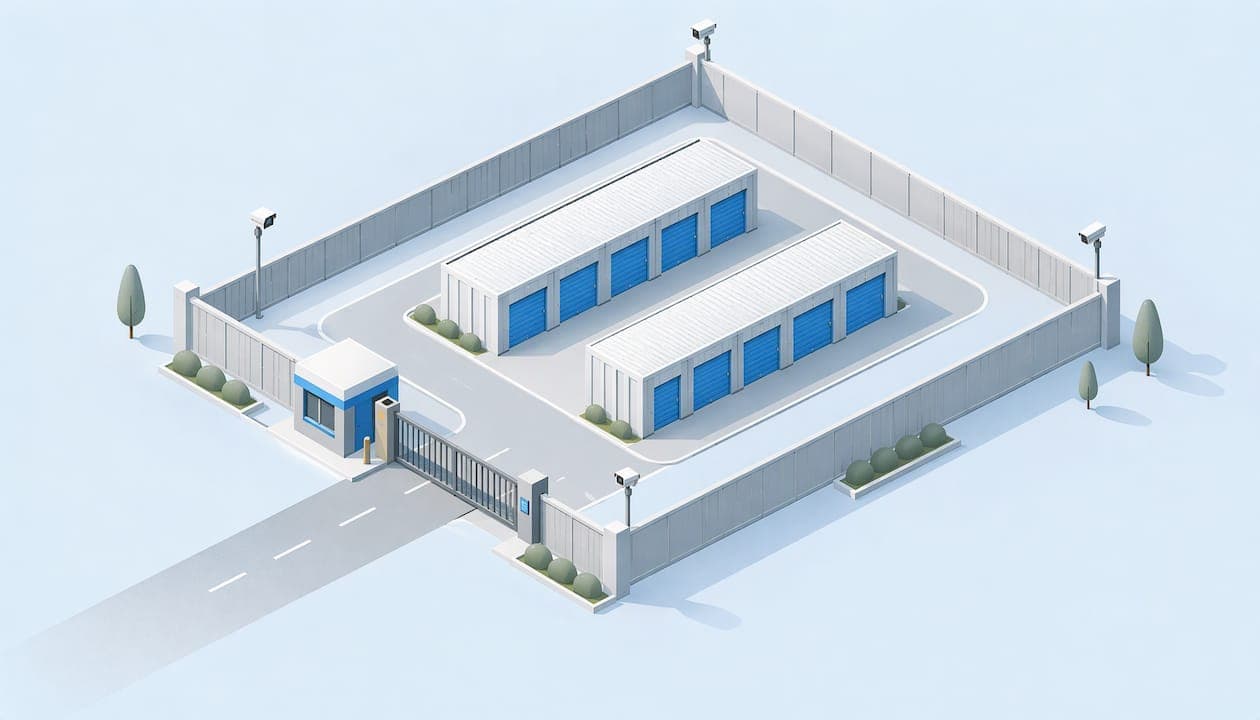
The security features worth looking for in a storage facility work as layers: a fenced perimeter, a gate that needs your personal code, video cameras at entrances and main aisles, good lighting, and a lock you choose yourself. Then ask who actually watches the footage and how your belongings are insured. No single feature does the job alone. Below is what each layer does, where cameras usually go, what "24-hour surveillance" can mean, and a checklist to use on a tour or an online listing.
TL;DR
- Look for layers: fencing, a keypad gate with individual codes, cameras at entrances and aisles, lighting, and unit-level protection.
- Yes, many facilities have cameras, but they cover shared areas such as entrances and aisles, not the inside of your unit.
- "24-hour surveillance" can mean recorded footage or live monitoring. Ask which one the facility means.
- Buy a strong lock, and get your insurance arrangement in writing, because a lease may limit the facility's responsibility for theft.
- At Inline Storage in South San Antonio, we offer video surveillance, gated entry, drive-up access and 24-hour kiosks, plus Touchless Rentals™ for renting online.
Table of Contents
- Why security is a stack, not a single feature
- Perimeter fencing
- Gated entry and personal access codes
- Do storage units have cameras?
- What "24-hour surveillance" really means
- Lighting
- Individual unit alarms and locks
- Staff, kiosks and the human layer
- Security for vehicle storage
- Insurance and the lease: the layer people skip
- Our perspective
- A checklist to use before you rent
- Ready to see it for yourself?
- FAQ
- Sources
Why security is a stack, not a single feature
A camera does not stop someone climbing a fence. A gate does not help if codes are shared. A lock is only as good as the door it sits on. That is why industry guidance describes a well-layered security system built from perimeter fencing, keypad and gate access with individual codes, cameras at entrances and main aisles, motion-activated lighting, and optional alarms on individual doors.
The Better Business Bureau gives similar advice to renters with valuable belongings: look for a good security and monitoring system, consider insurance, and watch for neglected or faulty surveillance equipment. That last point matters. A camera dome on a pole tells you little. A camera that is clean, aimed at the right place and clearly maintained tells you more.
Think of each layer as answering one question:
| Layer | The question it answers |
|---|---|
| Perimeter fencing | Who can get onto the property at all? |
| Gate and keypad | Who is allowed in, and is there a record? |
| Cameras | What happened, and can it be reviewed? |
| Lighting | Can anyone work unseen after dark? |
| Unit alarms or strong locks | What stops access to your specific unit? |
| Staff and kiosk | Who responds when something looks wrong? |
| Insurance | What happens if something is lost anyway? |
Perimeter fencing
The first layer is the edge of the property. Sturdy fencing that encloses the whole site, not only the front, is what turns a gate into a real checkpoint. One trade publication describes a basic perimeter fence as six feet of chain-link topped with razor wire. Facilities vary, so treat that as a reference point rather than a promise from any given site.
On a visit, walk or drive the whole boundary if you can. Look for:
- Fencing on every side, including the back and corners
- No gaps, bent sections or gates propped open
- Clear sightlines from the office or kiosk to the entrance
Burglars can hop fences or tailgate through an open gate to avoid alarms and cameras. This is why the other layers exist. It also means you should never hold the gate open for a stranger, however polite it feels.
Gated entry and personal access codes
A keypad and an automatic gate control who comes in and out. They also create a log: guidance on the topic notes that keypads and gates provide a record of who comes and goes and how long they stay, and recommends assigning an individual code to everyone who accesses the facility.
Individual codes are the detail to ask about. A single shared code for the whole property gives you no record of who entered. A personal code ties each visit to a customer.
For a closer look at what a gate can and cannot do, see our piece on what a gated storage facility actually does. For how codes, kiosks and video fit together on the renter's side, read storage access control with kiosks and video.
Questions to ask about the gate
- Does each renter get a personal code?
- What hours does the gate allow access?
- Is entry logged, and for how long are records kept?
- What happens if a code is lost or a renter moves out?
Do storage units have cameras?
Most modern facilities advertise video surveillance, but it is not guaranteed everywhere. Some operators present cameras as a premium amenity at certain sites rather than something every location includes. So confirm it for the specific facility you are considering. Do not assume it.

Where cameras go matters as much as whether they exist. Recommended placement is at facility entrances and along the main aisles, so that people and vehicles moving around the property are captured. That also answers a question many renters have: are there cameras inside the unit? No. Your unit is private space, and cameras watch the shared areas around it: the gate, the drive aisles, the building entrances and the corridors.
What good camera coverage looks like
- A view of the entry gate, ideally showing vehicles
- Coverage of drive aisles and the approach to your unit
- Views of building entrances and corridors if you rent indoors
- Cameras that look clean, undamaged and aimed where they should be
- Enough lighting that footage is usable at night
Not every property can cover every square foot, and that is normal. What you want to hear is a clear answer about where cameras are and how long footage is kept. We wrote a renter-focused walkthrough on exactly that: how to verify footage before you commit.
What "24-hour surveillance" really means
The phrase sounds simple, but it can describe two different setups.
- Recorded surveillance. Cameras record around the clock, and footage is reviewed after an incident.
- Monitored surveillance. A person, such as a guard or manager, or a monitoring service watches or responds to feeds.
Industry guidance observes that the term implies to renters that someone monitors the feed 24/7. That expectation is worth checking, because recorded and monitored are not the same thing. For a sense of how the phrase is defined in a formal setting, federal rules for hazardous-waste facilities describe a 24-hour surveillance system as television monitoring or surveillance by guards or facility personnel that continuously monitors and controls entry. That regulation does not apply to storage units, but it shows how specific the wording can be.
So ask plainly: "Are the cameras recording 24 hours a day? Is anyone watching live? How long do you keep footage? How do I request a review if something goes missing?"
Lighting
Lighting is the cheapest security feature and one of the most useful. As one industry guide puts it, good lighting is a must because criminals like to work in the shadows. Motion-activated lighting also helps your own safety when you visit after work.
Check lighting in daylight, then ask about evenings. State Farm's renter guidance lists exterior lighting among the things to ask about before choosing a facility. If you plan to visit at night, drive past once after dark. You will learn more in five minutes than in any brochure.

Individual unit alarms and locks
Some facilities add alarms to individual units. These guard against cutting through unit walls or breaking door locks. If a site offers them, ask whether an alarm notifies you, the manager or a monitoring agency. State Farm's guidance makes the same point: ask whether alarms notify owners or a security monitoring agency.
The lock is the part you control. A few practical habits:
- Buy a sturdy disc-style or high-security lock rather than a thin padlock
- Choose a lock whose shackle is hard to reach with cutters when the unit door is closed
- Do not share your lock key or combination casually
- Keep a photo of your lock model and keep spare keys at home
If you store bikes, instruments or other items thieves target, a unit sized to hold everything inside, with the door fully closed, beats leaving items outside the lock. Our guides to storing instruments and bicycles in a small unit cover sizing.
Staff, kiosks and the human layer
Technology records and restricts. People respond. Ask who is on site, when, and how you reach someone after hours. A 24-hour kiosk lets you handle rental tasks without waiting for an office to open, which is useful when a move runs late.
At Inline Storage, our South San Antonio facility has video surveillance, gated entry, drive-up access and 24-hour kiosks. Our Touchless Rentals™ system lets you rent a unit online with minimal physical interaction. If accessibility is part of your decision, we list five checks for easy, touchless renting and offer ADA storage spaces.
Security for vehicle storage
RVs and boats have their own needs. Open parking is visible and often sits near the gate and cameras, so ask which spaces are covered by which cameras and how the lot is lit. Our guide to outdoor vehicle storage lists what to check before you rent. We offer RV storage and boat storage in South San Antonio.
Insurance and the lease: the layer people skip
Security lowers risk. It does not remove it, and your paperwork decides what happens next. In one Michigan appeals case, the lease stated that the facility was not responsible for property damage, including theft. Leases differ, so the lesson is to read yours.
Before you sign:
- Find the clause on liability for loss or theft.
- Ask how stored-property insurance is handled by the facility. State Farm's guidance advises renters to ask how insurance is handled and to check whether the facility or your existing homeowners or renters policy covers stored items.
- If you rely on your own policy, call your insurer and ask about off-premises coverage and limits. Get the answer in writing.
Two of our guides go deeper: getting your off-premises limit in writing and what to check in storage contracts before you sign.
Our perspective
We think of security as something a renter should be able to see, not just read about. When someone chooses a facility, the question we want them to ask is simple: what stands between my things and a stranger, and can I check it myself?
That is why our South San Antonio location combines gated entry, video surveillance and 24-hour kiosks, and why we built Touchless Rentals™ so you can rent online without needing to wait in line. Our own claim is that this mix of access control and convenience makes storage easier to trust and easier to use.
Our advice is to do a short tour. Look at the gate, the cameras, the lighting and the drive aisles. Ask how footage is handled. Then pick a unit size that lets you close the door fully, and choose a good lock. We offer month-to-month leases, so you can start with the space you need now.
Ian
A checklist to use before you rent
Take this on your visit or use it when reading an online listing. It reflects the features recommended by the sources above.
| Check | What a good answer sounds like |
|---|---|
| Fencing | Encloses the whole property, in good repair |
| Gate | Keypad with personal codes and an entry log |
| Cameras | Entrances and main aisles, clean and working |
| Footage | Clear answer on recording, monitoring and retention |
| Lighting | Bright at entrances and aisles, motion-activated where possible |
| Unit protection | Door built to hold a good lock; alarms offered or explained |
| Staff or kiosk | A named way to reach help |
| Insurance | Clear process, in writing |
| Grounds | Tidy and well maintained |
A tidy site is a quiet signal. State Farm's list includes well-maintained grounds for a reason: neglect often travels with broken cameras and burned-out lights. For a broader process, see our nine checks before choosing a storage facility.
Ready to see it for yourself?
If you are comparing facilities in South San Antonio, we make it easy to start. Browse our self-storage units and rent online with Touchless Rentals™, or look through our unit sizes from lockers and 5x5 units up to larger spaces, including climate-controlled storage.

Need room for furniture from a whole home? Our 10x15, 10x20 and 10x30 units give you space to move through and keep items off the floor.
FAQ
Do storage units have cameras?
Many facilities have video surveillance, but it is not universal. Some operators treat it as a premium feature at certain sites. Cameras usually cover shared areas such as gates, entrances and main aisles, not the inside of your unit. Always confirm coverage with the facility you plan to use.
Are there security cameras inside storage units?
No. Your unit is private. Cameras are placed in common areas, with the recommended spots being entrances and main aisles. That placement captures people and vehicles moving around the property without recording what you store.
What does 24-hour surveillance mean at a storage facility?
It can mean cameras that record all day and night, or that someone monitors the feed. Industry guidance notes that renters often assume live monitoring. Ask whether footage is recorded, whether anyone watches live, and how long footage is kept.
How can I make my storage unit more secure?
Choose a facility with cameras, gated fencing, keypad access, exterior lighting and well-kept grounds. Use a high-quality lock and ask whether alarms notify owners or a monitoring agency. Then check whether the facility or your homeowners or renters policy covers stored items, and get that in writing.
How secure are belongings in a storage unit?
Layered security lowers risk but cannot remove it, and leases can limit the facility's responsibility for theft. Read the liability clause, pick a strong lock, and arrange insurance before you move items in.
Sources
- Assembling a Well-Layered Security System for Self-Storage
- BBB Tip: Renting a storage unit
- An Operators' Guide to Self-Storage Security
- Renting and Packing a Storage Unit, State Farm
- Do Storage Units Have Security Cameras
- eCFR, 40 CFR 267.14 Security requirements
- Austin v Track Side Storage LLC, 2024