
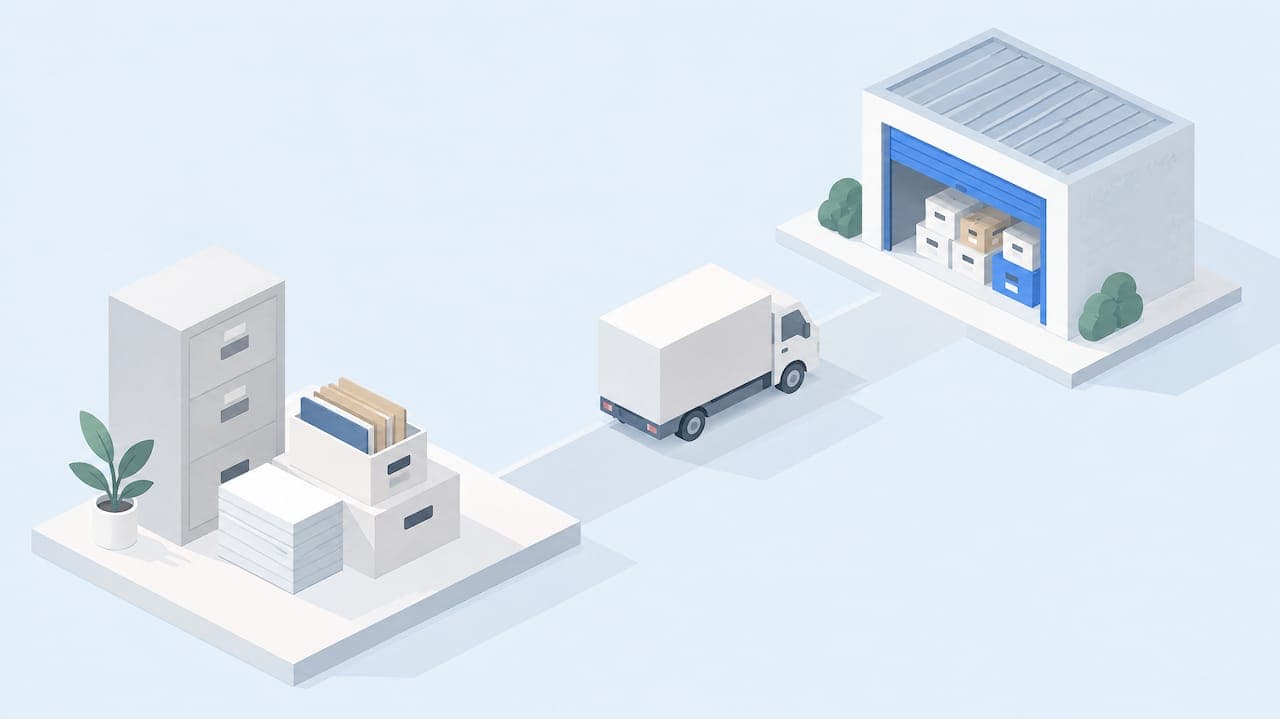
A document storage unit is a rented space, usually a self-storage unit, where you keep paper records away from your office. It works well for a small business when you pick a clean, secure, climate-stable unit, pack the paper in proper enclosures, and keep an index so any file can be found in minutes. This guide shows how to do each step, and how to decide what is worth keeping at all.
TL;DR
- Choose a unit with controlled access, video surveillance and, for long-term paper, climate control. Ask to see how the facility handles humidity.
- Pack records in sturdy boxes with folders that support the paper, and leave a clear aisle so you can reach any box.
- Keep tax records for at least the IRS periods (3 years in general, 6 years in some cases, 4 years for employment tax), then review before you shred.
- Build a simple inventory: box number, contents, date range and destroy-after date.
- Start with a 5x10 or similar size, since a month-to-month rental lets you adjust as your archive grows.
Table of Contents
- What counts as a document storage unit
- When offsite storage makes sense for a business
- How long to keep business records
- What to check before you rent
- Choosing the right size
- How to pack paper records
- Keep it retrievable with a simple index
- Worked example: a small contractor's records room
- Our perspective
- Reserve a unit for your records
- Common mistakes to avoid
- FAQ
- Sources
What counts as a document storage unit
The phrase covers two things. One is office furniture: file cabinets, lateral files and fire-rated safes that sit in your workspace. The other is offsite space: a room or unit where boxes of inactive records live until you need them or are allowed to destroy them. This article is about the second.
Records are broader than loose paper. Archives New Zealand's guidance on physical records lists paper files, volumes and registers, maps, plans and drawings, photographic media such as prints, negatives and x-rays, magnetic media such as tapes and cassettes, and optical media such as CDs and DVDs. For a small business, that usually means:
- Invoices, receipts, ledgers and bank statements
- Payroll and employee files
- Contracts, leases and closed client files
- Blueprints, site plans and job drawings
- Older backup media you are not ready to discard
Each of these reacts differently to heat and moisture. Paper and photographic materials are the most sensitive, which is why the environment matters more than the unit size.
When offsite storage makes sense for a business
Most small businesses reach the same point. The filing cabinets are full, the back office is becoming a records room, and nobody wants to pay for office square footage to hold papers touched once a year. Moving inactive records offsite frees that space for work that earns money.
The New York State Archives describes the inactive phase of a record's life as the point when a record is no longer regularly referred to but must still be kept for legal, administrative or other purposes. That is exactly what belongs in a storage unit. Active files you use weekly stay at the office. Closed jobs, prior-year books and old personnel files go offsite.
It also suits people in transition: a business closing one location, a contractor moving between shops, or an owner renovating an office. If your needs go beyond paper, our business storage units checklist covers inventory, equipment and access planning for small companies.
How long to keep business records
Decide this first, because it determines how much space you need. Do not store everything forever by default.
For federal tax purposes, the IRS says in Publication 583 that you must keep records for as long as they matter to the administration of the tax code. In practice that means until the period of limitations for the return runs out. The publication gives 3 years for general assessments and 6 years if income is underreported by more than 25%. Employment tax records must be kept for at least 4 years after the tax is paid or becomes due.

The same publication explains that a sound recordkeeping system includes a summary of transactions, such as journals and ledgers, plus supporting documents like invoices and receipts. Both halves belong in your archive boxes.
A few practical notes:
- These are federal tax periods. Your state, your industry, your insurer, a lease or a contract may require longer. Ask your accountant or attorney for your own retention schedule before you destroy anything.
- Some records, such as corporate formation papers and long-term contracts, are commonly kept far longer. Your advisor can tell you which apply to you.
- Once a record passes its retention date, destroy it securely instead of paying to store it. Shredding is cheaper than another year of rent.
What to check before you rent
Paper has simple enemies: water, humidity, heat, pests, light and thieves. The New York State Archives' guidance on inactive records says to check the facility's physical structure, fire-suppression and mechanical systems, locks, limited access, alarms, temperature and humidity controls, and water-damage prevention. Turn that into a walk-through list.
Security
- Is entry gated, and is access limited to tenants?
- Are there cameras covering the aisles and entrances, and how long is footage kept?
- Can you use your own lock, and is the unit door solid?
- Is there after-hours access, in case you need a file at night?
Our guide on whether storage units are safe shows how to ask about footage and what to verify on a tour.
Environment
Walk the unit. Look for water stains on the floor or ceiling, damp smells, and gaps under the door. Paper in a hot, humid, or leaky space can warp, grow mold and attract insects. For anything you will keep more than a year or two, climate-controlled space is the safer choice. Before you pay extra, ask what the facility actually does to keep conditions stable. We explain what to request in our climate-controlled storage guide.

Insurance
Your tenant's coverage and your business policy may not treat stored records the same way. Confirm the off-premises limit in writing, and ask whether the cost of reconstructing records is covered. Our article on storage unit insurance lists the questions.
Convenience
A records unit you can't get to is a records unit you will avoid. Drive-up access means you can load boxes from your vehicle without carts and elevators. A location near your office keeps a retrieval trip to a short errand.
Choosing the right size
A standard banker's box holds roughly one cubic foot of paper. Most small businesses with a few years of archives fit in less space than they expect, because the shelving is what takes room. Use these as starting points, then adjust to your own box count.
| Situation | Typical starting point | Why |
|---|---|---|
| A few dozen boxes, occasional access | 5x5 or small locker | Boxes stack, with a short aisle |
| One office's closed files, plus a few supplies | 5x10 | Room for shelves and a walking aisle |
| Archive plus equipment or displays | 10x10 | Space to separate paper from other items |
| Multi-year archive, inventory and furniture | 10x15 or larger | Zones for records, stock and fixtures |
If you are also storing stock, see what a 5x10 can hold for small business inventory. If you are moving an entire office, the 10x10 versus 10x20 comparison helps you size for furniture as well.
How to pack paper records
Good packing does more for your records than any other single step.
Use the right enclosures
The National Archives explains that paper records are typically organized and protected in folders or other enclosures. It notes that kraft and colored papers can be a problem because they are acidic, unstable and contain water-sensitive dyes. For your file folders and dividers, that suggests choosing plain, good-quality stock over bright or brown folders for records you plan to keep a long time.
The same page advises aligning documents neatly so they support one another. Edges or corners that stick out of a folder can bend, break or tear. So do not overstuff folders, and do not let pages hang out.
Pack the box
- Use sturdy, uniform boxes with lids. Matching sizes stack safely.
- Fill each box so papers stand upright without slumping, but do not cram them in.
- Keep the weight manageable. A box you can't lift comfortably is a box that gets dropped.
- Remove metal clips and rubber bands when you can. They rust and degrade paper over time.
- Keep one record category per box where possible. Mixed boxes are hard to search.
- Place photos, film and tapes in their own boxes, away from paper.
Our five-step packing guide for storage units covers humidity and aisle layout in detail.
Set up the unit
- Lift boxes off the floor on pallets or shelving, so a small leak does not reach them.
- Put the most-needed boxes closest to the door.
- Leave an aisle wide enough to pull any box without moving others.
- Keep paper away from tires, paint, fuel and chemicals.
- Avoid plastic wrap around loose paper, since it can trap moisture.
Keep it retrievable with a simple index
The biggest regret with offsite records is not the cost. It is the afternoon spent opening boxes because nothing was labeled. You can fix that with a spreadsheet and a marker.
- Number every box on two sides, such as ACCT-2022-01.
- Label with a category and date range, not with vague words like "misc."
- Create an index with box number, contents, date range, shelf location and a destroy-after date.
- Keep a copy of the index outside the unit, in your accounting system or cloud drive.
- Record every pull: who took which box, and when it returned.
- Review once a year: remove boxes that passed their date and shred them.
Note that the index itself is part of your protection. If records are ever needed for a tax question, an audit or a dispute, a clear index turns a search into a five-minute job. Pair this with a digital copy of the highest-value documents, such as contracts and corporate papers. Scanning does not replace the originals whenever the law or a counterparty requires them, but it gives you a backup if a box is ever damaged.
As the National Archives of New Zealand puts it in its storage plan guidance, a good plan covers identification and control, location, environment, shelving and packaging, maintenance, security and business continuity. That is a useful checklist even though it was written for another country, because paper behaves the same everywhere.
Worked example: a small contractor's records room
Imagine a three-person remodeling company that has six years of closed job files, payroll folders and tax returns in a back office. The files take up two cabinets and a shelf, and the owner wants that room for a desk.
The owner sorts first. Anything past its retention date, confirmed with the accountant, goes to a shredding service. The remaining papers go into about 30 labeled boxes, grouped by year and type: tax and accounting, payroll, job files, insurance. The boxes go onto a shelving unit in a climate-controlled 5x10 with the current year's boxes nearest the door. The index lives in the company's shared drive. Each January, the owner swaps in last year's closed files and removes anything that has aged out.
That routine takes a couple of hours a year and keeps both the office and the unit clean. If the same owner also keeps tools or materials, a separate space is a sensible move. Our contractor storage guide covers that side.
Our perspective
We see the same pattern with business customers in South San Antonio. Records pile up in the office, then in a garage, then in a spare room, and by the time someone needs a file from four years ago nobody knows where it is.
Our view is that paper deserves a proper home, and that home does not need to be complicated. A secure, gated facility with video surveillance, a unit you can drive up to, and the option of climate-controlled space covers the basics. A month-to-month lease lets you start with the size you need now and change later, rather than guess at a multi-year archive.
We built Touchless Rentals™ so you can reserve your unit online without an office visit, and our 24-hour kiosk means the paperwork side stays simple. We design the experience around the customer who is busy running a business and wants the storage part to be handled in one visit.
If you are unsure between sizes or between standard and climate-controlled space, tell us what you are keeping and for how long. We will point you to the option that fits.
Ian
Reserve a unit for your records
If you are ready to move boxes out of the office, you can see our self-storage unit sizes, from storage lockers and 5x5 units up to 10x30. Our facility in South San Antonio offers drive-up access, gated entry, video surveillance and climate-controlled options, and our month-to-month leases mean you can adjust as your archive changes.

You can rent online with our Touchless Rentals™ system, or use the 24-hour contactless kiosk. For current rates and availability, check the Inline Storage homepage.
Common mistakes to avoid
- Storing without a retention plan. You end up paying to keep papers you could legally shred.
- Using damp or crushed boxes. They fail first and take records with them.
- Skipping the index. Retrieval becomes guesswork.
- Putting original-only documents offsite without a copy. Scan key records and keep the scan elsewhere.
- Ignoring the unit between visits. Check for leaks, pests and odors when you drop off or pick up.
- Mixing records with equipment. Chemicals, tires and tools carry dust, odors and moisture.
FAQ
Can I keep business documents in a regular self-storage unit?
Yes. Many small businesses do. Choose a clean, dry unit with controlled access, pack the paper in sturdy boxes on shelves or pallets, and keep an index. For records you will hold for several years, ask about climate-controlled space.
How many years of business records should I keep?
For federal tax purposes, the IRS points to 3 years in general, 6 years when income is underreported by more than 25%, and at least 4 years for employment tax records, as explained in Publication 583. Your state, contracts or industry may require more, so confirm your schedule with your accountant or attorney.
Do I need climate-controlled storage for paper?
It is the safer option for records you plan to keep long term, because paper is sensitive to humidity and heat swings. If you pick a standard unit for short-term storage, raise boxes off the floor and inspect them regularly. Ask the facility how it manages conditions.
How do I find a file quickly once it is in storage?
Number every box, list its contents and date range in a spreadsheet, and keep the most-used boxes near the door. Store a copy of the index outside the unit. With that in place, you can find a file in minutes.
Sources
- Storage of physical records, Archives New Zealand
- Paper-Based Records, National Archives
- Inactive Records, New York State Archives
- Publication 583, Starting a Business and Keeping Records, IRS
- The Records Life Cycle, New York State Archives