
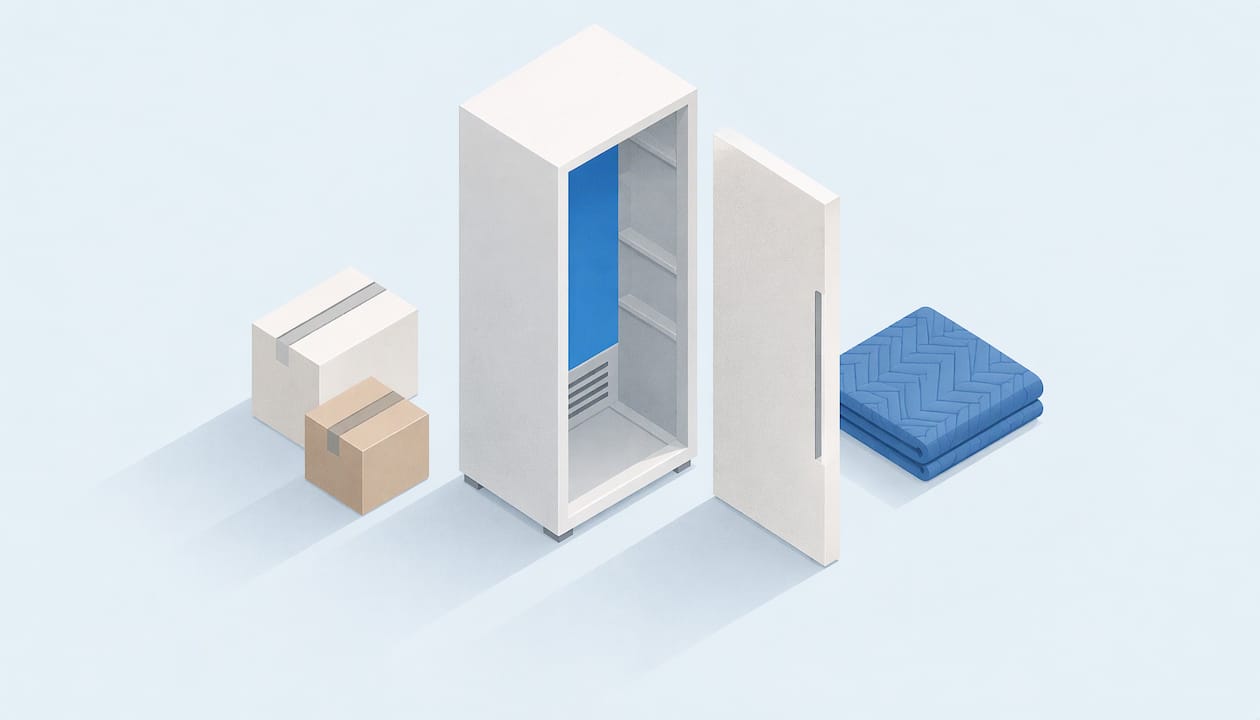
To store a refrigerator, empty it, defrost it fully, clean and dry every surface, unplug it, drain any water line, and keep it upright with the doors propped open so air can move through. Then put it in a clean, dry, ideally climate-controlled space off the floor. Skip any of those steps and you will usually pay for it later in mold, a musty smell or a leak.
This guide walks through each step in order, explains what to do if the fridge has to travel on its side, and covers the TV and other electronics that often go into the same unit.
TL;DR
- Defrost, clean and completely dry the fridge before storage. Leftover moisture is what grows mold.
- Unplug it, shut off and drain the water line and ice maker, and leave the doors propped open.
- Keep it upright. If it was moved on its side, let it stand before you plug it in (manufacturers give different wait times, see below).
- Climate-controlled space protects appliances and electronics better than a hot or damp garage.
- Store TVs upright, in cushioned packaging, with nothing on top.
Table of Contents
- Before you do anything: read your manual
- Step 1: Empty it and turn off the ice maker
- Step 2: Defrost completely
- Step 3: Clean and dry every surface
- Step 4: Handle the water line
- Step 5: Prop the doors open
- Moving it: straps, blankets and a proper dolly
- Can you store a refrigerator on its side?
- Where to store it: garage, spare room or storage unit
- Mini fridges and freezers
- How to store a TV in a storage unit
- Other electronics: game consoles, computers, speakers
- Common mistakes that ruin a stored fridge
- Our perspective
- Ready to store your fridge in South San Antonio
- FAQ
- Sources
Before you do anything: read your manual
Every refrigerator brand publishes its own storage and moving instructions, and the manual for your model outranks general advice, including this article. Look for the Use & Care Guide, or search your model number on the manufacturer's support site. Pay attention to three details: whether your model may ever be tilted or laid down, how to shut off and drain the water line, and how long to wait before plugging it in after a move.
Then plan your timing. Whirlpool's guidance for moving or long absences suggests starting two to three days ahead, because a freezer needs time to thaw and the interior needs time to dry. Moving day is the wrong day to start defrosting.
Step 1: Empty it and turn off the ice maker
Remove all food, ice and drinks. Even a forgotten jar or a few crumbs in a drawer attracts pests and creates odors in a closed, unattended space. Take out shelves, bins and drawers too, so you can clean and dry them separately.
If your fridge has an ice maker, turn it off first. Both Whirlpool and Samsung put this early in their checklists. Samsung says to shut off the household water supply, switch off the ice maker, and dispense water until the line is empty, then remove any remaining ice.
Step 2: Defrost completely
A freezer packed with ice becomes a puddle the moment you unplug it. Unplug the fridge, open the freezer and fridge doors, and lay towels along the bottom to catch meltwater. Whirlpool recommends letting the freezer defrost with the doors open and catching the meltwater with towels before you clean.
Frost-free models still have a defrost pan or drain area that collects water. The University of Florida's extension guidance for closing up a home includes cleaning the defrost pan as part of shutting down a refrigerator. Check your manual for where it sits on your model.
Step 3: Clean and dry every surface
This is the step that decides whether you open a fresh fridge or a moldy one in six months. Wash the walls, shelves, bins, drawers, door gaskets and freezer compartment. Whirlpool recommends warm soapy water and a soft cloth for the bins, drawers, shelves and walls. GE Appliances suggests a solution of 1 tablespoon of baking soda per 1 quart of water, which also helps neutralize odors.

If you want a thorough routine, a fridge cleaning checklist can help you work through the interior in an hour or less, including the spots people skip, like gasket folds and the back of the drawers.
Then dry everything. Samsung warns that residual dampness can produce mold or mildew during storage. Wipe with a clean towel, then leave the doors open for several hours so remaining moisture evaporates. Dry the door seals especially well, since water hides in their folds.
Step 4: Handle the water line
If your refrigerator has a dispenser or ice maker, the water line needs attention. GE Appliances notes that for storage in an unheated location, the dispenser's water reservoir should be drained, and that if temperatures may drop below freezing, draining is essential because frozen water can rupture the tank or tubing and cause a leak later.
Whirlpool also says to disconnect the water line according to the Use & Care Guide and to keep the line and its fittings clean and capped. If you are not comfortable disconnecting a line, ask a qualified appliance technician or plumber. Do not force fittings.
Step 5: Prop the doors open
A sealed, empty fridge traps stale air and moisture. The standard advice across manufacturers is to leave the doors open. GE says to place an open box of baking soda or 2 cups of dry coffee grounds inside and leave the doors open for long-term storage. The University of Florida guidance adds that the doors should be left ajar so they cannot accidentally close.
In practice, use a wedge, a folded towel or a bungee cord looped to hold the door a few inches open. If kids or pets could climb in, secure the doors in a way that prevents anyone getting inside, and never use a latch that locks.

Moving it: straps, blankets and a proper dolly
Most fridge damage happens during loading, not during storage. Whirlpool recommends securing the refrigerator with appliance straps or rope, protecting the exterior with moving blankets and corner guards, and using a properly rated dolly. Measure the doorway, your vehicle ramp and the unit door before the day. Tape or strap the doors shut for the trip only, then open them again once the fridge is in its spot.
A drive-up unit makes this far easier because you can back the truck to the door and roll the fridge in without carrying it through hallways or elevators.
Can you store a refrigerator on its side?
Short answer: keep it upright whenever you can. Laying a fridge down can let compressor oil move into places it should not be, and it needs time to settle back.
Manufacturers differ, so follow your model's manual:
| Brand | Guidance on side transport |
|---|---|
| GE Appliances | Some models must stay upright, while certain top-freezer and side-by-side models can travel on their specified sides. After side transport, stand it upright for the same amount of time, or 24 hours if it was on its side for more than a day. |
| LG | Keep it upright. If it must go on its side briefly, wait at least 2 hours upright before plugging it in, even if it was only tilted for about 10 minutes. |
If you are storing the fridge, it will sit unplugged for a long time anyway, so the wait before restarting matters most on the day you take it out. Stand it upright in its final spot, let it rest per your manual, then plug it in. Plan this when you schedule the move out, not when you are already hauling it into your kitchen.
Two habits cover most of the risk: store it standing, and write the date and the position it traveled in on a piece of tape on the door.
Where to store it: garage, spare room or storage unit
The best place is somewhere dry, shaded and stable in temperature. Garages swing between hot and cold and can be damp. Samsung's guidance suggests considering climate-controlled storage is also part of Whirlpool's approach for appliances kept for a long period, and the reason is simple: steady temperatures mean less condensation inside a closed appliance. Our own guide to preventing mold in storage goes deeper on humidity.
Inside the unit:
- Put it on a pallet or wood blocks if you can, so the base is not sitting directly on the floor.
- Place it near the door, so you do not have to move other boxes to reach it.
- Leave a few inches of space around it for air.
- Do not stack boxes inside it. A fridge is not a shelf, and weight on the shelves can warp them.
- Do not load the top with heavy or breakable items either.
For a standard full-size fridge, a 5x10 or 10x10 unit usually leaves room for other household items. If you are storing a whole household during a renovation, our renovation storage guide and furniture storage guide help you pick a size.
Mini fridges and freezers
The same rules apply to a dorm fridge or chest freezer: empty, defrost, clean, dry, unplug and leave the lid or door open. Mini fridges are the most common summer storage item for students. A small unit can often fit in a locker or 5x5 along with a mattress, boxes and a desk lamp. Chest freezers should have the lid propped open with a wedge, never closed tight.
How to store a TV in a storage unit
A TV is more fragile than a fridge, and a cracked screen is rarely repairable at a reasonable cost. The basics:
- Photograph the back connections before unplugging, so setup later takes minutes.
- Clean and dust the screen with a soft microfiber cloth, and let it dry fully.
- Use the original box and foam inserts if you still have them. If not, use a sturdy box of similar size, padding with foam or a moving blanket and filling empty space so the TV cannot shift. Moving companies commonly give this advice, and one moving company's packing guide says to transport a flat-screen TV upright rather than flat.
- Store it upright and elevated, off the floor, with nothing on top.
- Keep the remote and cables in a labeled bag taped to the box.
Never lay a flat-screen on its face with boxes stacked on it, and do not wrap it in plastic that could trap moisture.
Other electronics: game consoles, computers, speakers
Electronics dislike heat, cold and humidity swings. Engadget reports that climate-controlled storage is the best option for electronics because garages expose devices to these swings. The same article recommends rigid weatherproof bins, desiccant packs, keeping items off concrete and avoiding sealing devices while they are damp.
A simple routine for small electronics:
- Power down fully, remove batteries and wipe surfaces.
- Let everything dry, then pack into a rigid bin with a desiccant packet.
- Label the bin and put it on a shelf or pallet, never directly on the floor.
- Keep chargers and cables in the same bin.
For a full walk-through covering washers, dryers and other large items, see our appliance storage guide.
Common mistakes that ruin a stored fridge
- Closing the doors with a damp interior. This is the number one cause of musty smells.
- Leaving the ice maker line full. Water left in the line can leak or freeze.
- Storing it on its side for convenience. It saves truck space and may cost you a restart delay or worse.
- Putting it in a hot, damp garage. Moisture and temperature swings are hard on any closed appliance.
- Packing it with boxes. You lose the airflow you created by propping the doors.
- Forgetting the unit itself. A dusty, dirty unit invites pests, so clean the storage unit before you move in, and pack with drive-up access in mind.
Our perspective
Most people call us about the fridge last. It is the biggest item, it is awkward, and it is the one thing they are unsure about leaving for months. Our advice is simple: do the prep properly, then give the fridge a spot that is dry and stable.
That is why we offer climate-controlled storage alongside standard units, with gated access, video surveillance and drive-up doors, so you can roll an appliance in without carrying it through halls. Our Touchless Rentals™ system lets you choose a size and rent online, and our 24-hour kiosk means you are not racing a front-office clock on moving day.
We keep month-to-month leases because plans change: a renovation runs long, a semester ends early, a new house closes late. A fridge, a TV and a few boxes of electronics are exactly the sort of load where the right size and a clean unit make a real difference.
Ian
Ready to store your fridge in South San Antonio
If you need a place for a refrigerator, TV and the rest of the household, Inline Storage offers a range of unit sizes, climate-controlled options, drive-up access and Touchless Rentals™ in South San Antonio. You can browse our unit sizes and storage options and rent online, or use the 24-hour contactless kiosk when it suits your schedule.

Not sure how to compare facilities? Our checklist for choosing a storage facility covers what to look for, and the renter safety guide explains how security features work. If you are weighing sizes for a fuller load, start at our main site.
FAQ
Can you leave an empty refrigerator unplugged?
Yes. Empty it, clean and dry the interior completely, shut off the water supply and ice maker, drain the water line, unplug it and leave the doors propped open. Samsung's long-term storage guidance lays out these same steps. Keeping the doors closed on an unplugged fridge is what causes the musty smell.
How long should a refrigerator stand before I plug it in?
It depends on the brand and how it was moved. LG recommends at least 2 hours upright after any time on its side, and GE says to allow 24 hours if it was on its side for more than a day. Check your manual for your model's specific time.
Is it safe to store a fridge in a garage?
It can work if the space is dry and the fridge is clean, dry and propped open, but garages swing in heat, cold and humidity. A climate-controlled unit gives the appliance steadier conditions. If the fridge has a water line and temperatures could fall below freezing, drain it completely first.
How do I store a TV in storage?
Photograph the connections, clean the screen, and pack the TV in its original box or a snug, padded box. Store it upright, off the floor, with nothing on top. Keep it in a climate-controlled space if possible to avoid moisture and temperature swings.
What size storage unit do I need for a refrigerator?
A full-size refrigerator fits comfortably in a 5x10 with room left over, and a 10x10 handles a fridge plus furniture and boxes. For a whole-home load, look at larger sizes. Our 10x15 units and 10x20 units suit bigger moves.
Sources
- Whirlpool: Preparing for Vacation or Moving
- Whirlpool: Winterizing a Refrigerator
- Samsung: Winterize or prepare your fridge for long-term storage
- GE Appliances: Refrigerator winterizing and storage in unheated location
- GE Appliances: Refrigerator vacation and storage recommendations
- GE Appliances: Refrigerator moving instructions
- LG: Can I move my LG refrigerator on its side?
- University of Florida IFAS: Closing Your Seasonal Home
- Engadget: Why you should think twice before storing electronics in a garage
- Coastal Moving Services: Packing tips for moving electronics and appliances
- Fridge cleaning checklist