
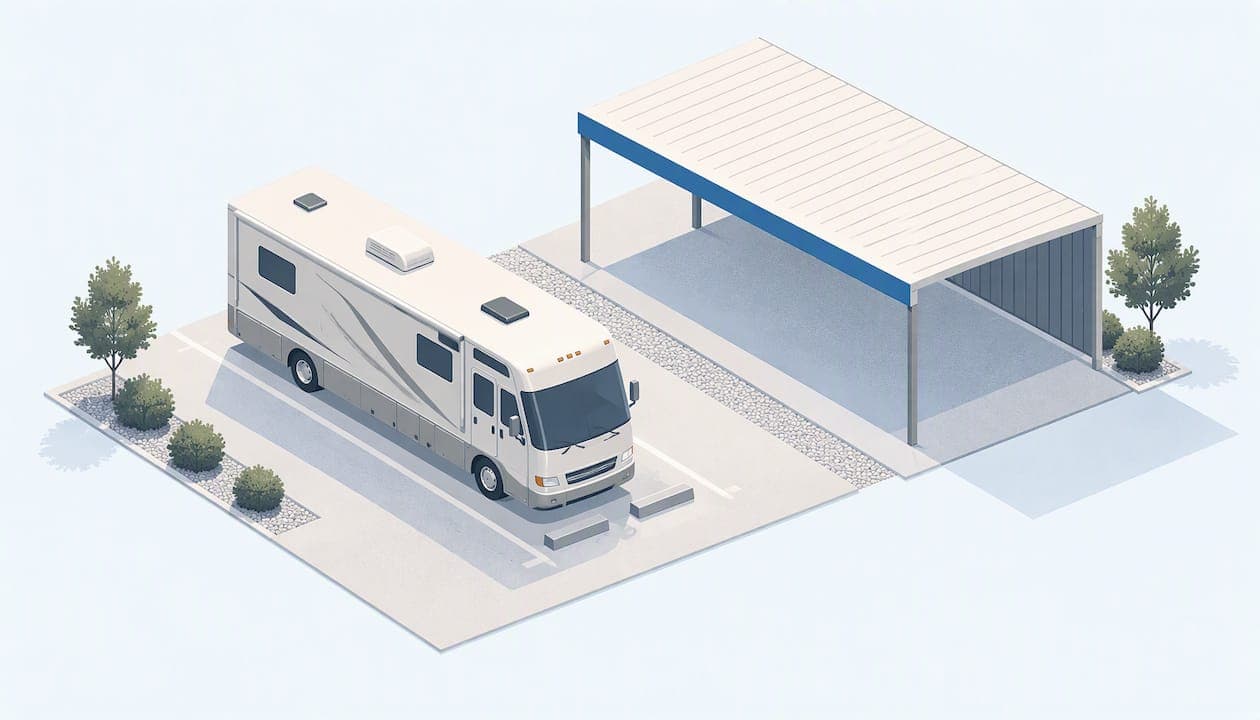
Outdoor RV storage is the most affordable way to keep a motorhome, travel trailer or fifth wheel off your driveway, and it is a sound choice when the lot is gated, lit, paved and watched, and when you prep the rig for the sun. The risk is not the parking itself. It is the sun, the seals and a lot that does not live up to its description. This guide covers what to look for, how uncovered compares with covered, how to prep your RV, and what to confirm with your insurer before you sign.
TL;DR
- Uncovered parking costs the least, but sun is the main enemy. UV wears on roof sealants and tires, so cover the tires and inspect the roof seams on a schedule.
- Judge a lot on gate, lighting, fencing, paving and upkeep, not just price per month.
- Facility insurance generally protects the property, not your RV. Carry your own comprehensive policy and ask your insurer in writing whether the lot counts as a secured location.
- In a hot, sunny climate like South Texas, covered or indoor space can be worth it for a rig you rarely use. For a rig you take out every few weeks, outdoor parking with good prep is usually enough.
- Prep before you park: clean it, check the seals, protect the tires, fix the battery, block the pests.
Table of Contents
- Is it okay to store your RV outside?
- What the sun does to a parked RV
- Uncovered vs. covered RV storage: how to decide
- How to judge an outdoor RV lot
- Insurance: the gap most RV owners miss
- Our perspective: what we tell RV owners who ask
- RV storage checklist: prepping for outdoor parking
- Can you store an RV in a regular storage unit?
- RV and boat storage at Inline Storage
- Where to start looking
- FAQ
- Sources
Is it okay to store your RV outside?
Yes. Millions of owners do it, and many RVs live outside for years. What matters is the quality of the spot and the effort you put into the vehicle.
An RV is built to be outdoors on the road, but a parked RV behaves differently from a moving one. It sits in one position, so the same patch of roof gets the same hours of sun. Tires carry the same load on the same contact patch. Seals never get the airflow and flexing that driving provides. And nobody is inside to notice a leak, a chewed wire or a flat tire.
That is why the useful question is not whether outdoor storage is okay. It is what an uncovered rig needs, and which lot makes that easy.
What the sun does to a parked RV
Sunlight is the biggest cost of an uncovered space, and you can manage it.
Roof and seals. Guidance referencing Lippert technical resources and RVIA best practices says that uncovered outdoor storage accelerates UV degradation of EPDM rubber roofs and sealants, and that seams, vents and edges need regular inspection and re-sealing. In practice, that means getting on the roof (or having someone do it) at the start of storage and again each season, and looking at the sealant around vents, skylights, antennas and edges for cracks or gaps.
Tires. UV can weaken rubber and lead to dry rot. One cover manufacturer notes that tires left uncovered tend to have a shorter life, particularly in high-sun states. Texas qualifies. Fitted tire covers are cheap compared with a set of RV tires, and they are one of the easiest wins for an outdoor spot.

Interior heat. Covering the rig keeps UV off, but it does not make the inside cool. Owners in hot regions commonly say the only meaningful protection from sun is shade or a cover, and that running the air conditioning in an empty RV buys little. So the practical answer is to remove what heat damages: electronics, aerosols, candles, food, medications, and anything that warps or melts.
Windows and upholstery. Reflective window covers and closed blinds reduce fading of fabrics and flooring. They cost little and take ten minutes.
Uncovered vs. covered RV storage: how to decide
The three common tiers are open (uncovered) parking, covered parking under a roof structure, and fully enclosed indoor space. Each trades price against protection.
| Uncovered (outdoor) | Covered | Enclosed or indoor | |
|---|---|---|---|
| Cost | Lowest | Middle | Highest |
| Sun and UV | Full exposure | Roof shielded, sides still open | Fully shielded |
| Hail and wind-blown debris | Exposed | Partly protected | Protected |
| Theft and vandalism | Depends on gate, cameras, lighting | Same as outdoor | Typically strongest, with a locked door |
| Best for | Rigs used often, tight budgets | Rigs stored for months | Long-term storage, high-value rigs |
Is covered storage worth it? It depends on how long the rig sits and how much it is worth. If you use your RV every month or two and you do the prep below, uncovered parking is usually the better value. If the RV sits for four months or more, or it is a high-value motorhome, paying more for a roof can protect the roof, sealants, tires and finish you would otherwise maintain or replace. In a place with strong summer sun and the occasional hailstorm, that argument gets stronger.
If you are weighing all three, our guide to outdoor, covered or indoor vehicle storage goes through the trade-offs in more detail.
How to judge an outdoor RV lot
Price per month is the easiest thing to compare and the least informative. Visit the lot, ideally at two different times of day, and check these things.
Gate, fencing and lighting
A gate stops casual entry, but it is not a guarantee. We wrote about what a gated storage facility does and does not do, and the short version is to ask how gate codes are issued, whether they are tied to each renter, and whether the gate logs entries. Look at the perimeter fence for gaps and at the lighting along the aisles where RVs park, not just at the office.

Cameras
Cameras only help if they cover the places that matter and the footage is kept. Our renter checklist on whether storage units are safe suggests asking to verify how much footage is retained and how you would request it after an incident.
Pavement and upkeep
Surface matters. Gravel and grass lots can shift under weight, hold moisture and make leveling harder, while pavement is cleaner and easier on tires and jacks. Industry guidance says a well-run facility does regular walk-throughs to inspect paving, perimeter fencing and lighting, and that a neglected-looking site is a warning sign. Potholes, broken lights, sagging fence sections and overgrown weeds tell you how the owner will treat your rig.
Space size and turning room
Measure your RV including the ladder, hitch, bike rack and spare tire, then add room to open slides and doors if you want to access it while parked. Ask whether aisles are wide enough for you to back in without a spotter. A space that fits on paper but forces a five-point turn every visit will wear on you.
Access hours and how you rent
If you pull out for weekend trips, you need to know when the gate opens and whether you can get in early on a Friday or late on a Sunday. Our post on storage access hours and weekend access explains the options to ask about. Also ask about the lease: month-to-month terms give you room to change your plans.
Rules on what you can do on site
Many lots do not allow repairs, washing, living in the RV, or storing fuel and propane in certain ways. Read the rules before you move in, not after you are asked to leave. If you plan to keep gear in the RV, ask about limits there too.
Insurance: the gap most RV owners miss
A common assumption is that the storage facility's insurance covers whatever sits on its lot. In general, facility policies protect the building, fencing and equipment, not the customer's RV. You need your own comprehensive coverage.
There is a second catch. The same source explains that insurers may deny theft or vandalism claims if the RV was left in a location that did not meet the policy's definition of a secured premises, such as an open driveway or an unfenced gravel lot. So before you sign a rental agreement:
- Call your insurance agent and tell them where the RV will be stored.
- Ask whether a gated, fenced, camera-monitored lot meets your policy's secured-location requirement.
- Get the answer in writing, by email at minimum.
- Ask whether your coverage changes when the RV is in storage, and whether you can adjust it for months it does not move.
Our guide on getting your off-premises limit in writing walks through the same habit for stored belongings. If you keep items inside the RV while it is stored, find out whether they are covered under your RV policy, your homeowners or renters policy, or neither.
Our perspective: what we tell RV owners who ask
We run a self-storage facility in South San Antonio, and RV owners ask us the same questions again and again. Here is what we say.
First, we tell people not to buy more protection than they will use. If your rig goes out every few weeks, a gated outdoor space with a good prep routine is a reasonable choice. If it sits all summer, ask yourself what the sun will cost you in seals and tires, and consider a covered or enclosed option.
Second, we tell people to look at the lot, not just the listing. Gated entry, video surveillance, open parking you can actually maneuver in, and clear access rules matter more than a few dollars a month. These are the things we build our facility around, along with month-to-month leases so you are not locked in when your plans change.
Third, we tell people to talk to their insurer before the move-in, not after a loss. The facility is responsible for the property. Your RV is your responsibility, and your policy has its own wording.
Finally, we want renting to be easy. Our Touchless Rentals™ system lets you reserve online, and our 24-hour kiosk is there if you prefer to finish in person with no waiting for the office to open.
— Ian
RV storage checklist: prepping for outdoor parking
Run through this before you drive in. If you will be gone more than a month or two, follow a full guide such as this long-term RV prep walkthrough for your specific rig type, and always follow your owner's manual first.
Exterior
- Wash and dry the RV. Dirt, bird droppings and tree sap are harder to remove after weeks in the sun.
- Inspect the roof and seams. Look for cracks, lifted edges and dried sealant. Reseal before storage, not after the first rain.
- Cover the tires. Use fitted covers and, if possible, park on a clean, firm surface. Check pressure to the manufacturer's recommendation.
- Retract awnings and close slides according to your manual. Secure ladders and rack accessories.
- Consider a breathable RV cover if the lot allows it. Avoid plastic tarps, which trap moisture and can scuff the finish.
Systems
- Water. Drain fresh, gray and black tanks, and the water heater. Follow your manual for winterizing if freezing is possible, which in San Antonio is occasional rather than routine.
- Battery. Disconnect it, or use a maintainer if the lot permits one. A dead battery is the most common problem when owners return.
- Propane. Turn off the valves. Check lot rules on propane.
- Appliances. Empty and prop open the refrigerator to prevent mildew, and clean the stove and oven.
Interior
- Remove food, toiletries, medications, aerosols and anything heat-sensitive.
- Block pests. Seal gaps around pipes and vents with steel wool or the product your manual recommends, and set traps rather than loose poison.
- Crack a vent or use moisture absorbers to limit mildew in humid weeks.
- Cover windows to reduce fading.
Paperwork and security
- Photograph the RV on move-in day, all sides and the roof if you can. Date-stamped photos help with any later claim.
- Keep registration, insurance card and lot agreement in your tow vehicle or phone, not in the stored RV.
- Use a hitch lock, wheel chock or tongue lock on trailers and consider a wheel lock for added deterrence.
- Visit every few weeks. Start the engine and generator if your manual calls for it, check tire pressure, look for leaks and pests, and make sure nothing has changed on the roof.
Can you store an RV in a regular storage unit?
Only if it fits and the facility allows it, which is rarely the case for full-size RVs. Even a small camper is usually better in a space made for vehicles, with room to maneuver. Smaller things are another matter. Your RV's gear, such as camp chairs, leveling blocks, hoses, outdoor mats and bikes, often fits well in a unit. That frees space in the RV and keeps it out of the heat. Our guide to drive-up storage sizes from 5x5 to 10x30 can help you choose one.
RV and boat storage at Inline Storage
If you are in the San Antonio area, we offer RV storage in South San Antonio with gated entry, video surveillance and open parking. We also offer boat storage, climate-controlled units and standard units from our full range of unit sizes, so you can store gear in a unit and park the RV on the lot. Our 24/7 contactless kiosk lets you rent without waiting for office hours. For current availability and rates, check the RV storage page or start with Touchless Rentals™ on our home page.
Where to start looking
If you do not yet know where to park, make a short list of three lots within a reasonable drive of your home. Fuel costs and time add up when you take the rig out often, and a lot that is too far gets visited less. Then do this:
- Check the size requirements against your RV's real length and height.
- Visit, and walk the lot as described above.
- Ask about gate hours, camera retention and lease terms.
- Confirm with your insurer.
- Reserve, photograph the rig on move-in, and put a seasonal inspection reminder in your calendar.
Searching by state-wide lists can help you find options, and there are directories of storage facilities listed by state, but treat any listing as a starting point and verify every detail on site.
FAQ
How much does it cost to store an RV outdoors?
It varies by city, space length and facility features, and uncovered parking is the cheapest tier. Rates are set by each lot, so compare spaces of the same size with the same security features. For our current availability and rates, check our RV storage page.
Is covered RV storage worth it?
It is worth it when the RV sits for months at a time, when it is high in value, or when you want protection from sun and hail without paying for enclosed space. For a rig you use frequently, uncovered parking with tire covers and seasonal roof checks usually offers better value.
Will my insurance cover an RV stored outside?
Only if your own policy says so. Facility insurance generally covers the property, not your RV, and some insurers deny theft or vandalism claims at locations that do not meet their definition of secured. Call your agent before move-in and get the answer in writing.
Should I cover my RV in an outdoor lot?
A fitted tire cover is a simple, low-cost step, and a breathable RV cover can help if the lot allows it. Avoid non-breathable tarps, which can trap moisture. Ask the facility about its rules first.
Sources
- RV storage lots vs home storage | PickRV Wiki
- Site-Maintenance Tips for Keeping Your Boat/RV-Storage Facility Shipshape | Inside Self-Storage
- Are RV Tire Covers Necessary? | The Cover Blog
- Summer storage in extremely hot climates | Forest River Forums
- RV DIY Channel with Mark Polk