
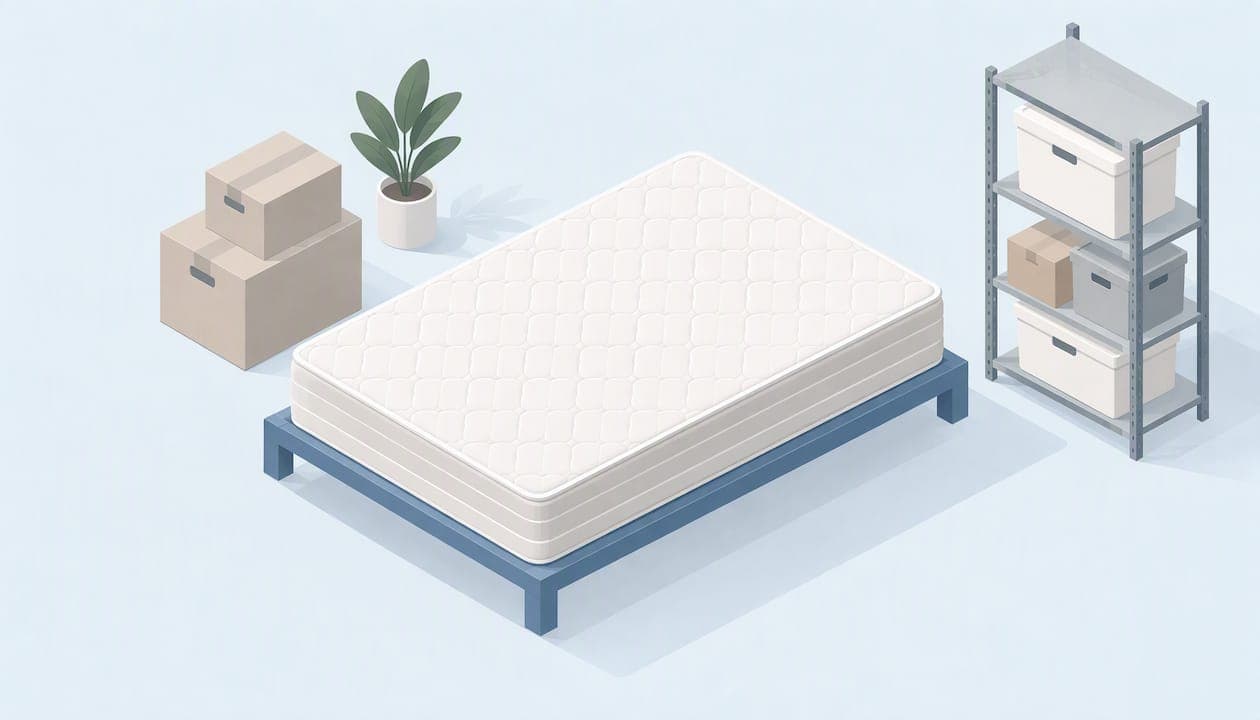
To store a mattress well, clean it, dry it completely, cover it with a protective bag, and lay it flat on a raised surface in a cool, dry space. Do all that and it will come out of storage in the shape it went in. Skip a step and you risk mold, lumpy layers or a warranty claim that gets denied. This guide covers each step, the mistakes that cause most damage, and how to choose the right storage space in San Antonio.
TL;DR
- Vacuum, spot-clean and let the mattress dry fully before it goes into any bag.
- Use a heavy-duty, sealable cover, but do not seal it airtight in a space that is not climate controlled.
- Store it flat and off the floor. Standing it on its side is a short-term fix only.
- For long stays, climate-controlled storage in the 68 to 72°F range is the safest choice.
- Check your warranty first. Storing a mattress the wrong way can void it.
Table of Contents
- Why mattresses need more care than other furniture
- Step 1: Clean the mattress and let it dry completely
- Step 2: Choose a cover that protects without trapping moisture
- Step 3: Move it flat, with help
- Step 4: Store it flat, off the floor, with nothing on top
- Step 5: Pick the right kind of space
- Storing a memory foam or mattress-in-a-box product
- Check your warranty before you store
- How to check on a stored mattress
- What unit size do you need for a mattress?
- Our perspective: what we see in a mattress storage unit
- Store your mattress with Inline Storage
- Common mattress storage mistakes
- Frequently asked questions
- Sources
Why mattresses need more care than other furniture
A mattress is soft, porous and expensive. It absorbs moisture and odors, and its internal layers (springs, foam, latex, wool) can shift if the mattress is held in the wrong position for months. HGTV's storage guide warns that a mattress stored badly can lose its shape, its layers can separate, and the material can get moldy.
That is why a mattress needs a plan, not just a corner of the unit. The good news is that the plan is simple and costs very little.
Step 1: Clean the mattress and let it dry completely
Strip all the bedding and wash it separately. Then vacuum every side and the edges with an upholstery attachment to lift dust, skin cells and debris. Spot-clean stains with a mild detergent and water solution, and avoid saturating the core. Harsh disinfectants are not needed and can harm the materials.
The drying step is the one people rush. Moisture trapped in a mattress is what grows mold in storage, so let it air-dry until there are no damp spots at all. Stand it in a well-ventilated room, or leave it flat in the sun-free air of a spare room, for as long as that takes. A fan helps.
If you want to freshen it, sprinkle baking soda on the surface, leave it for a few hours, then vacuum it off.
Check for pests before you wrap anything
Sealing a mattress in plastic does not kill anything that is already inside it. Look along the seams, piping and tufts for dark spotting or live insects. If you see signs of bed bugs, read this guide on what to do and what not to do with bed bugs on a mattress before the mattress goes anywhere. The page comes from a Singapore pest control company, so treat the treatment details as general background. For an infestation at home in Texas, call a licensed local pest professional.
Step 2: Choose a cover that protects without trapping moisture
A cover keeps out dust, dirt and moisture, and it protects the mattress during the truck ride and the trip down the unit hallway.
Bag thickness
Mattress bags are usually polyethylene plastic. Thin ones are around 2 mil and are basically single-use. A heavy-duty bag such as this 6 mil mattress bag resists tears and punctures, and you can reuse it. A 4 mil sealable bag is a middle option. If you will move the mattress more than once, or keep it for many months, the thicker bag is worth the few extra dollars.
Use a bag sized for your mattress: twin, full, queen, king or extra-long. A bag that is too small tears at the seams. Box springs need their own bag.
Do not seal it airtight
This is the most common mistake. Sealy's storage advice points out that over-sealing or vacuum-sealing can trap leftover moisture, which feeds mold, especially in spaces that are not climate controlled. If your unit is not climate controlled, choose a breathable cover or leave the closure slightly open so air can move.
If you do use a fully sealed bag, make sure the mattress is bone dry first and store it in a climate-controlled space.
Skip the old sheet and the tarp
A bedsheet gives almost no protection against moisture. A tarp wrapped tightly is effectively a sealed bag with none of the convenience. A proper mattress bag is cheap and made for the job.
Step 3: Move it flat, with help
A mattress should not fold, bend or sag while you carry it. Stearns & Foster recommends two or three people moving it horizontally with the top facing up, because bending can damage the innerspring unit. Do not tie it to a truck roof, and do not let it fold in a pickup bed.
If you are renting a unit with drive-up access, you can back the vehicle up to the door and slide the mattress straight in, with no elevators or long carries. That cuts the risk of kinks and corner damage.
Step 4: Store it flat, off the floor, with nothing on top
Flat beats upright
The best position is flat, on a raised surface. HGTV recommends a pallet or platform, which keeps internal layers from migrating. This matters most for pocket-sprung and natural-fiber mattresses, which can lump if they stay on their sides or edges.
Many people think they can stand a mattress up indefinitely to save floor space. Per the Sleep Foundation, vertical storage is acceptable for a very short time, ideally under a month. Longer than that, latex, wool or memory foam can shift and cause sagging and uneven support. If you have to stand it up, support it fully so the comfort layers do not bunch.
Raise it
A concrete floor can wick moisture, and the floor is where any water will show up first. Put the mattress on pallets, a platform or a clean bed frame. Leave a little space around it for air.

Do not stack things on it
Boxes, tools and furniture create permanent dents and compress the layers. If you need to use the unit's height, place the mattress on the bottom and build shelving around it, not on it. Our guide to packing a storage unit shows how to lay out a unit so nothing presses on soft items and air can still move.
Step 5: Pick the right kind of space
| Space | Best for | Watch out for |
|---|---|---|
| Climate-controlled unit | Long-term storage, memory foam, latex, natural-fiber mattresses | Ask how humidity is managed |
| Standard drive-up unit | Short stays, mattresses that are bagged and dry | Heat and humidity swings; check in more often |
| Garage or attic at home | Very short term only | Heat, pests, leaks |
| Basement | Rarely a good choice | Humidity and flooding |
The usual guidance, cited by the Sleep Foundation, is to keep a mattress in a climate-controlled environment between 68 and 72°F, so heat and humidity do not degrade the materials or cause mold. South Texas summers are hot and humid, so this matters more here than in a dry climate.
If climate control is not an option, ventilation is the next best defense. HGTV notes that a non-climate-controlled space must be dry, well ventilated and away from water, and that it needs more frequent check-ins for moisture, mold and pests.
What to ask before you pay for climate control
Not every "climate-controlled" label means the same thing. We wrote a short checklist on asking for humidity logs before paying extra. Ask how the temperature range is held and whether the facility can show you readings.
Storing a memory foam or mattress-in-a-box product
A bed-in-a-box mattress is compressed and rolled for shipping, and it should not stay that way. According to the Sleep Foundation, most manufacturers limit rolled-up time to 1 to 2 months. Past that, the foam's structure can be permanently damaged, and the warranty may be voided.
If you have a new boxed mattress you cannot use yet, unroll it and store it flat, or follow the maker's instructions exactly. Memory foam in general likes a stable temperature and a flat surface. It should never carry weight on top.
Check your warranty before you store
Many owners void their warranty without knowing it. The Sleep Foundation notes that many manufacturers state that storing a mattress on its side, on the floor, or rolled up beyond a short period can void coverage. Read your own warranty, or search the maker's support page, before you decide how to store it. Take photos of the mattress and its tags when you wrap it, so you have a record of its condition on the day it went into storage.
How to check on a stored mattress
If the stay is longer than a couple of months, plan a visit. Open the bag, look and smell for mustiness, check for pests and dampness, then close it again. Check more often in a unit without climate control, especially after a stretch of wet weather or the peak of summer. When you take the mattress out, let it air for a few hours before you put sheets on it.
What unit size do you need for a mattress?
A mattress lying flat takes up less space than most people expect, but it also blocks the floor area you may want for boxes. Our rule of thumb:
- Just a mattress and a few boxes: a small unit may do. See our guide to small apartment storage for when a 5x5 or 5x10 makes sense.
- A bedroom's worth of furniture: a 10x10 unit gives you room to lay a mattress flat on a platform and still store a dresser, a frame and boxes.
- A one- or two-bedroom move: look at drive-up unit sizes and compare 10x10 against 10x20 in our furniture storage guide.
These are our practical suggestions, not a fixed formula. Measure your biggest pieces before you choose.
Our perspective: what we see in a mattress storage unit
We run a self-storage facility in South San Antonio, and mattresses are among the most common things people bring to us. The damage we hear about is rarely dramatic. It is a musty smell, a mattress that was stood on end for months, or one that went in slightly damp inside a sealed bag.
So our advice is plain. Dry it, bag it, lay it flat on a pallet, and keep nothing on top. If the mattress is a good one and it will be stored for more than a few weeks, we suggest a climate-controlled unit, because South Texas humidity is the main thing you are protecting it from. If it is a short stay and the mattress is dry and covered, a standard drive-up unit can work, but plan to check in.
We also built our rentals around convenience for people in the middle of a move: flexible month-to-month leases, Touchless Rentals™ you can complete online, and a 24-hour kiosk. You should not have to schedule your life around an office's hours just to put a bed away.
— Ian
Store your mattress with Inline Storage
If you are ready to store a mattress, we offer climate-controlled storage and a range of unit sizes in South San Antonio, with drive-up access, gated entry and video surveillance. You can rent online with Touchless Rentals™ or use our 24-hour kiosk, and our leases are month to month, which suits short moves and renovations. For the full picture of what we offer, see our self-storage units page. If you are unsure about security, our renter checklist on whether storage units are safe tells you what to verify at any facility.
Common mattress storage mistakes
- Storing it damp. Even a small damp spot can lead to mold. Dry it fully.
- Sealing it airtight in a hot unit. Trapped moisture is the risk. Use a breathable cover, or leave the seal slightly open.
- Leaving it on its side for months. Layers shift and sag.
- Putting it on the floor. It can wick moisture and void some warranties.
- Stacking items on top. This leaves permanent dents.
- Leaving a boxed mattress rolled up. Stay within the 1 to 2 month window the maker gives.
- Forgetting to check in. A quick visit catches problems early.
Frequently asked questions
What is the best way to store a memory foam mattress?
Clean it, let it dry completely, put it in a protective bag, and lay it flat on a raised surface. Keep it in a stable, cool, dry space, ideally climate controlled, and put nothing on top. If it came compressed in a box, do not leave it rolled for more than the 1 to 2 months most makers allow.
Can I store a mattress on its side?
Only for a short period, ideally under a month. Over longer periods, the internal layers can shift, causing sagging and uneven support. If you have no choice, support the mattress fully so the comfort layers do not bunch up, and check your warranty.
What kind of mattress bag should I use for storage?
Choose a heavy-duty polyethylene bag made for your mattress size. Thicker bags, around 4 to 6 mil, resist tears and can be reused. In a space without climate control, avoid sealing it airtight, so moisture can escape.
Do I need a climate-controlled unit to store a mattress?
Not always, but it is the safest option for long stays and for foam, latex or natural-fiber mattresses. Guidance points to 68 to 72°F. If you use a standard unit, make sure the mattress is dry and covered, and check on it regularly for moisture, mold and pests.
Sources
- How to Store a Mattress: 5 Simple Steps, Sleep Foundation
- How to Store a Mattress and a Mattress Topper, HGTV
- How to Store Your Mattress, Sealy
- How do I transport or store my mattress? Stearns & Foster
- UltraBlock 6 mil mattress bag
- TRU Lite 4 mil mattress storage bag