
Most RV owners pay somewhere between $65 and $150 a month to park a rig at a storage facility, but the real number depends on three things: how well the space protects your RV, how long your rig is, and which city you're in. Outdoor parking sits at the bottom of the range. Covered, enclosed and climate-controlled spaces cost progressively more. This guide breaks down each tier, shows how to estimate your own number, and lists the fees that catch owners off guard.
TL;DR
- The national median is $65 to $150 a month across 1,631 verified RV facility prices, but local demand and land costs move that figure a lot.
- You are mostly paying for protection: outdoor uncovered is cheapest, then covered, enclosed and climate-controlled.
- Length matters. Many facilities tier by length, and some add $1 to $3 per foot per month when a rig runs past standard dimensions.
- Ask for an all-in monthly price, including access, power and any admin fees, not the "starting at" rate.
- In San Antonio, call us for current RV rates. We don't publish a price list here, and we won't guess at one.
Table of Contents
- What RV storage costs on average
- Cost by type of storage
- How your RV's length changes the price
- Fees that sit outside the base rate
- Insurance: a cost people forget
- Storing at home versus at a facility
- Our perspective on RV storage pricing
- Prepare the RV before it goes into storage
- How to get a reliable quote
- RV and boat storage at Inline Storage
- FAQ
- Sources
What RV storage costs on average
National figures are a useful starting line, nothing more. One published index puts the median RV storage rate at $65 to $150 per month, based on verified prices from facilities that accept RVs. Another guide, updated in June 2026, reports a much wider spread of $35 to $582 a month across all storage types.

That gap isn't an error. It reflects what you're buying. A gravel space on the edge of a small town and a heated, enclosed bay near a big metro belong to different products that happen to share a name.
The bigger lesson is that averages mislead. According to RV Storage HQ, pricing is hyper-local, and rates follow local demand and land costs more than any national figure. Its advice is to get written quotes from at least three facilities in your own area. We agree, and we'd add one thing: compare the same rig length and the same type of space each time, or the quotes tell you nothing.
Cost by type of storage
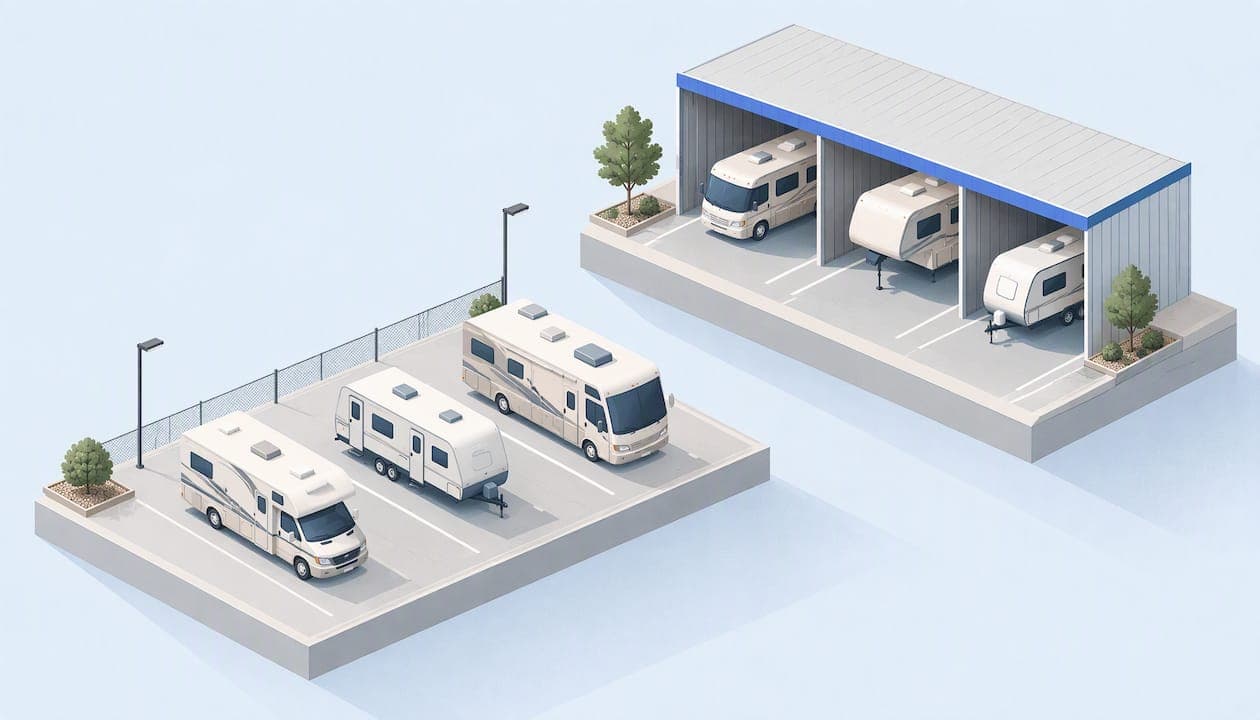
Think of RV storage as four tiers. The same four tiers show up in what enthusiasts call the 444 rule, which lists uncovered, covered, enclosed and climate-controlled as the four storage levels to choose between. Price rises with each step because protection from sun, rain, hail and theft rises with it.
| Storage type | What you get | Cost position |
|---|---|---|
| Outdoor uncovered | A marked space on gravel, asphalt or concrete, usually fenced | Lowest |
| Covered | A roof or canopy over the space, open on the sides | Mid-range |
| Enclosed | A garage-style bay with walls and a door | Higher |
| Climate-controlled | Enclosed, with temperature and humidity managed | Highest |
We deliberately don't attach dollar figures to every row. Published ranges vary a lot by region and by source. One national guide lists outdoor uncovered RV storage as the entry point, and a 20-foot trailer typically sits at the base rate, roughly $30 to $150 a month outdoors depending on whether the facility charges a flat rate or a length tier. Anything beyond that is local.
Outdoor uncovered parking
This is the budget choice and the right one for many owners. A secured, fenced lot with gated entry and cameras protects against theft and keeps the rig off your street. What it doesn't protect against is UV and weather. If you park outdoors, a quality cover for the roof and tires and a little more attention to seals pays for itself over time.
Covered parking
A roof takes the worst of the sun and hail off the RV. For owners in hot, sunny climates, that's often the best value step up, because UV is what cracks sealants, fades decals and ages rubber. Covered spaces are less common than open lots, so availability can matter more than the price difference.
Enclosed and climate-controlled storage
Fully enclosed storage suits high-value motorhomes, owners who store for many months at a stretch, and anyone who wants the rig out of sight. Climate control adds a further layer, mainly useful for protecting interiors, electronics and wood from extreme humidity and temperature swings. If you're deciding whether it's worth the premium, our guide to climate-controlled storage explains why you should ask for humidity logs before paying extra. For a broader look at the tradeoffs, see our walkthrough of outdoor, covered and indoor vehicle storage.
How your RV's length changes the price
Length is the second big driver. Many facilities price in tiers, for example under 20 feet, 20 to 30 feet and 30 to 40 feet. Others charge per linear foot. PickRV's cost guide notes that large spaces tend to have a lower rate per square foot but a higher monthly total because of their footprint.
Here is how that plays out for common rigs.
A 20-foot trailer
A trailer around 20 feet often fits a standard parking space, which is the entry-level product at most facilities. The same guide gives a typical outdoor range of $30 to $150 a month, depending on flat versus tiered pricing.
A 30-foot travel trailer or fifth wheel
This is where tiers start to bite. Many lots treat 30 feet as the top of the standard space. If you sit right at that line, measure carefully before you commit.
A 40-foot motorhome
A 40-foot rig lands at the top tier of local pricing. These rigs often exceed standard parking dimensions, so facilities may require an oversized slot or add the $1 to $3 per foot overage fee mentioned above. Pull-through spaces can also carry a different price than back-in ones.
Measure the whole rig
Measure bumper to bumper, including the rear rack, spare tire, ladder and hitch. A trailer sold as 28 feet can be 33 feet once the tongue is included, and that can push you into the next tier. Write the full length on your rental application so there's no dispute later.
Fees that sit outside the base rate
Most owners are surprised by what the advertised price leaves out. RV Storage HQ points out that base monthly rates often exclude add-ons such as 24/7 access, electricity or wash bays, and recommends asking for an all-in price rather than a "starting at" figure.
Before you sign, ask about each of these:
- Administrative or setup fee. Is there a one-time charge when you open the account?
- Access hours. Is gate access 24 hours, or limited? Our post on storage access hours covers what to ask.
- Power. Is a hookup available, and is it metered or included?
- Length surcharges. Which tier does your measured length fall into?
- Space type. Is a pull-through space a different price from back-in?
- Insurance. Does the facility require proof of coverage for the RV?
- Rate changes. When and how are rates adjusted after the first months?
- Lease terms. Is it month to month, or is there a minimum commitment?
Insurance: a cost people forget
Storing an RV doesn't automatically cancel the need to cover it. The Texas Department of Insurance advises checking your coverage before you take an RV out, and the same logic applies to when you park it: confirm what your policy covers for a stored vehicle, including theft, weather damage and contents. Rules differ by state. Lenders often require RV insurance even where the state doesn't, and a few states let you suspend coverage seasonally with the right paperwork. If you're considering that, talk to your insurance agent first, since a lapse can leave you uncovered or in breach of a loan agreement.
Storing at home versus at a facility
Storing at home looks free, but it often isn't. RV storage isn't federally regulated, but states and municipalities set their own requirements, and owners should check local zoning before parking at a residence. Some cities require permits: Miami Gardens, Florida, for example, charges $149.50 a year for an RV permit and caps allowed RV length.
San Antonio has its own rules. An older city ordinance amending Chapter 19 of the City Code restricts parking of watercraft, campers and certain trailers in front and side yards in residential districts unless they sit on permanent surfaces such as concrete, asphalt, brick or curbed gravel. That document is an archived ordinance, and city codes get amended, so check the current text with the City of San Antonio or your HOA before you rely on it. Many neighborhood associations are stricter than the city.
If home storage is restricted, or you'd rather not leave a rig in view, a facility is the simpler route. For many owners, the monthly fee also buys gated entry, cameras and a clear place to put the vehicle.

Our perspective on RV storage pricing
We run a self-storage facility in South San Antonio, and the same conversation repeats. An owner calls with a number from a national article and wonders why the local quote differs. The answer is almost always that the article is an average of very different products in very different places.
Here is how we'd approach it, based on what we offer:
- Start with protection, not price. Decide whether your rig needs open parking, or a more protected option, and only then compare rates.
- Measure first. Length decides the tier. Knowing your exact number makes any quote comparable.
- Look at the facility, not just the rate. Gated entry, video surveillance, 24-hour kiosk and drive-up access all affect how easy and safe your storage is day to day.
- Keep the lease flexible. We offer month-to-month leases, so you aren't locked in if you sell the rig or travel for a season.
We also rent online through Touchless Rentals™, so you can reserve a space without a counter visit. It suits owners who are on the road or want the process done in a few minutes.
— Ian
Prepare the RV before it goes into storage
Whatever you pay, storage only protects the vehicle if you prepare it. The owner's manual for a Thor-built RV distributed by Cruise America covers the essentials, and the main points are these:
- Tires. Keep pressure correct to avoid flat spots. Tires age even when the RV doesn't move, so inspect them regularly.
- Battery. Switch off the battery disconnect or use a trickle charger so the battery doesn't discharge.
- Seals. Check roof and window seals for leaks before you leave and when you return.
- Fluids and water system. Winterize where freezing is possible. Freeze damage can be extensive.
The 444 rule mentioned earlier also frames this as four months of planning, four maintenance checks and four storage tiers. It's an enthusiast shorthand rather than an official standard, but the checklist behind it is sensible.
How to get a reliable quote
- Measure the full length, width and height of your RV, including attachments.
- Decide on your storage tier: outdoor, covered, enclosed or climate-controlled.
- Contact at least three facilities near you. Ask each for the all-in monthly price for your exact length.
- Ask about fees, access hours, power, insurance requirements and lease terms.
- Visit if you can. Look at gate security, lighting, cameras, surface condition and turning room.
- Get the quote in writing, then compare monthly totals over a year, including one-time fees.
If you need to fit other gear too, say tools, camping equipment or seasonal items, a nearby unit can keep it all in one place. Our guide to drive-up storage sizes helps you pick a size, and the 10x20 unit is a common choice for gear that doesn't fit in the rig.
RV and boat storage at Inline Storage
We offer RV storage in South San Antonio with gated entry, video surveillance and a 24-hour kiosk, plus boat storage if you have a second vehicle. Contact us for current rates for your rig length, and you can start a rental online without visiting an office. If you'd like to see how the kiosk works first, read about our 24/7 contactless self storage kiosk.
FAQ
How much does it cost to store a 40-foot RV?
Expect the top tier of local pricing. These rigs often exceed standard parking dimensions, so facilities may require an oversized space or charge $1 to $3 per foot per month in overage fees. Ask for an all-in monthly figure for your exact length.
Why is RV storage so expensive?
Because an RV needs far more land than a storage unit, and land costs vary a lot by metro area. Protection also adds cost: roofs, walls and climate control are more expensive to build and maintain than open lots. Local demand and land costs drive rates more than the national average does.
What is the 444 rule for RV?
It's an enthusiast term, not a regulation. It stresses preparation: four months of planning, four maintenance checks and four storage tiers. Those tiers are uncovered, covered, enclosed and climate-controlled.
How much does it cost to store a 20-foot trailer?
Usually the base rate at a facility. Outdoor storage for a trailer that size typically runs $30 to $150 a month, depending on flat or tiered pricing. Covered and enclosed options cost more.
Can I park my RV at home in San Antonio?
Often only with limits. City code restricts parking certain trailers, campers and watercraft in front and side yards unless they're on permanent surfaces, and HOAs may be stricter. Confirm the current rules with the city or your association before you decide.
Sources
- RV Storage Cost by State: 2026 Rate Index, FindBoatStorage
- RV storage lots vs home storage, PickRV Wiki
- RV & Boat Storage Rate Report, RV Storage HQ
- Insurance for RVs: Know your coverages, Texas Department of Insurance
- West Virginia Division of Motor Vehicles
- Vehicle permit requirements, City of Miami Gardens
- Ordinance amending Chapter 19, City of San Antonio (archived)
- Owner's manual, Thor via Cruise America