
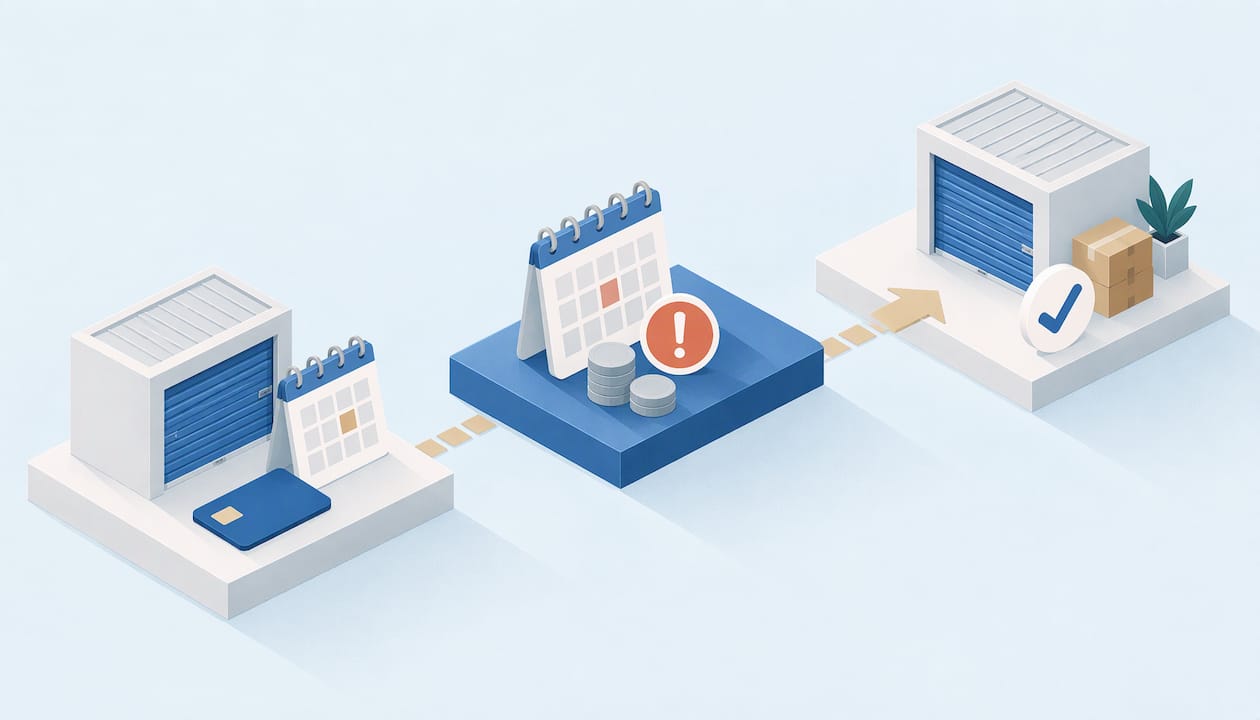
A storage unit late fee is a charge added to your rent when you miss the due date, usually after a short grace period. The amount and the timing come from two places: your state's self-storage law, if it has one, and the rental agreement you signed. Many states set a floor for the grace period or a ceiling on the fee. The agreement tells you what your facility actually charges. Read that document first, because it beats any general rule you find online.
This guide explains how late fees work, shows what several states allow, walks through what happens if rent stays unpaid, and gives you practical ways to keep a unit current. We are a self-storage facility in South San Antonio, so we write from the renter's side of the counter too.
TL;DR
- A late fee is normally allowed only if your rental agreement provides for it, and many states add a waiting period before it can be charged.
- State rules differ a lot. Some states give a 3-day or 5-day grace period, and some cap the fee at a flat amount or a percentage of rent.
- An unpaid balance can lead to a lockout, a lien notice and eventually a sale. In most states you can stop the process by paying what you owe before the sale.
- Autopay, a due date that matches your payday and an early call to the office prevent nearly all late-fee problems.
- Your lease controls the details. Check the late fee, the grace period and the notice method before you sign.
Table of Contents
- What a storage late fee is
- How much late fees can be
- What the lease must say
- Grace periods in practice
- What happens if rent stays unpaid
- You can usually stop a sale by paying
- How to dispute a fee that looks wrong
- How to avoid late fees
- Our perspective on late fees
- Rent a unit you can manage with confidence
- Quick checklist before you sign any storage lease
- FAQ
- Sources
What a storage late fee is
A late fee is a charge for paying rent after the date your agreement says it was due. Some state laws describe it in specific terms. Washington's statute treats it as an estimate of the loss caused by late payment, not as a penalty or interest on a debt. Arizona's statute defines it as a "reasonable fee or charge" for failing to pay rent when due.
The word "reasonable" matters. Where a state names a number, that number is the line between reasonable and not. Where a state does not, the fee still has to be tied to your agreement.
A late fee is also different from the cost of collecting a debt. Washington, for example, separates late fees from the reasonable expenses of collecting unpaid rent or enforcing a lien. On a delinquent account you may see both on the same statement, so ask for an itemized breakdown.

How much late fees can be
There is no single national number. Here is what several states put in writing.
| State | Fee limit | When it can be charged |
|---|---|---|
| California | $10 if rent is $60 or less; $15 if rent is over $60 and under $100; $20 or 15% of monthly rent, whichever is greater, at $100 or more. One fee per late payment. | Only after at least 10 days of nonpayment past the date in the agreement (BPC 21713.5) |
| Illinois | $20 or 20% of the rental fee per unpaid month, whichever is greater, is deemed reasonable | Only if rent stays unpaid at least 5 days after the due date (Illinois statutes) |
| North Carolina | No more than $15 or 15% of the rental payment, whichever is greater | Not until the payment is five days or more late (Chapter 66, Article 39) |
| Wisconsin | $20 or 20% of the rent, whichever is greater, as a monthly fee | When payment is 5 days late (Wisconsin DATCP) |
| New Hampshire | Fee barred if you pay everything in full by the fifth day after the due date | After day five (RSA 451-C:7) |
| Maine | Fee barred if you pay in full by the third day after the due date | After day three (Pine Tree Legal Assistance) |
The pattern is clear. Fees are usually small, a flat amount or a slice of one month's rent. The waiting period before a fee applies ranges from three to ten days where a state sets one.
Worked example
Say your unit rents for $120 a month in a state with a rule like Illinois. The fee deemed reasonable is the greater of $20 or 20% of $120, which is $24. So $24 would be on the reasonable side of that line, and only if rent was still unpaid five days after the date in your agreement. On a $60 unit the same rule gives $20, because the flat amount is greater than 20% of $60.
That is an illustration of how the rule works, not a statement of any facility's fee. Your own lease has the figure that applies to you.
What the lease must say
The agreement is where a fee becomes enforceable. In Washington, a late fee must be provided for in the rental agreement or an addendum, or it cannot be collected. California requires the fee amount to be specified in the rental agreement.
Arizona takes a lighter approach. The lease there must state the date rent is due and the date the late fee accrues, but not the fee amount. In that kind of state, the dates in your lease matter as much as any posted price.
Before you sign anywhere, find these five items:
- The due date, and whether it is the same day every month or tied to your move-in date.
- The grace period, if any, and whether weekends and holidays count.
- The late fee amount or the formula for it.
- How the facility sends notices: mail, email or both, and which address it uses.
- The date a missed payment can lead to a lockout or a lien notice.
Texas is where most of our customers live. We do not state a Texas fee cap here, because the research we relied on covers Texas notice and sale rules but not a statutory fee ceiling. Use your signed lease as the guide, and ask our office if a line is unclear. A good facility will explain every charge before you commit.
Grace periods in practice
A grace period is the time after the due date when you can still pay without a fee. Some states require one and some leave it to the facility. As the table shows, Maine's is three days, while Illinois, New Hampshire, North Carolina and Wisconsin use five.
Two cautions on grace periods:
- A grace period for the fee is not always a grace period for access. A facility may handle gate access, locks or default status on a different schedule from the fee. Wisconsin, for instance, says renters may be considered in default five days after payment is due.
- Counting days. Check whether the days run from the due date or from the date a notice was sent, and whether the count is calendar days.
Paying inside the grace period is the cheapest fix there is. If you know a payment will be a day or two late, pay inside the window and skip the fee.
What happens if rent stays unpaid
A late fee is the first and smallest consequence. If the balance keeps growing, the steps tend to escalate. Consumer guidance from Legal Aid Center of Southern Nevada describes a path of lockout or denied access, then a lien notice, then a sale, unless the renter cures the delinquency before the sale.
States set different clocks:
- Montana: the facility has a lien right away and may sell if rent is more than 60 days past due, after notice at least 30 days before a sale.
- Minnesota: a sale may happen no sooner than 45 days after default, or 60 days for motor vehicles and watercraft.
- Massachusetts: notice of a pending sale may go out no sooner than 14 days after default, and it must demand payment within a period not less than 14 days after receipt.
- Maine: if you are more than 45 days late, the owner may throw out or sell the property.
The Texas process
If you rent in San Antonio, Texas rules apply. Texas Law Help explains that written notice must come before a sale, and the notice must warn that unpaid amounts not paid before the 15th day after you receive it can lead to a public auction. After 15 days from the notice date, the facility may publish a newspaper notice once in each of two consecutive weeks, or post notice at the facility and at least five other locations, with a sale as soon as ten days after posting.

The practical lesson: notices are your signal. Open every letter and email from your facility. The earlier you respond, the more options you have.
You can usually stop a sale by paying
In most states the door stays open until the sale happens:
- Montana lets you pay the full amount necessary to satisfy the lien at any time before the sale and take your property.
- Minnesota lets an occupant redeem before any sale by paying the lien amount and the reasonable expenses of complying with the section.
- Wisconsin says renters can get property back any time before the sale if overdue charges are paid.
- Maine lets you get your property back by paying what is due before it is sold or thrown out.
If you cannot pay in full, call the office before the notice deadline and ask what the facility can do. We cannot promise a result, because every facility sets its own policy, but a conversation before the deadline is always better than silence after it.
How to dispute a fee that looks wrong
Start with the paper trail:
- Pull your rental agreement and find the late fee clause and the grace period.
- Compare the date your payment posted with the due date. Payment confirmations and bank records help.
- Ask the office for an itemized statement that separates the late fee from other charges.
- If the fee exceeds a limit set by your state's self-storage law, point to that statute in writing.
- For legal questions about liens, notices or a pending sale, a legal aid office or an attorney in your state is the right person to see.
Keep your tone factual. Most disputes resolve at the office once both sides look at the same dates.
How to avoid late fees
Most late fees come from small logistics, not from money trouble. These habits solve most of them.
Automate the payment
Autopay on a card or bank account removes the monthly decision. Our guide to storage payment options covers the ways to pay rent and keep from missing a bill.
Match the due date to your paycheck
If your rent date falls just before payday, ask whether the billing date can move. Even a few days of alignment can save a fee every few months.
Update your contact details
Notices go to the address or email on file. After a move, update both. A notice you never see is the most common reason a small balance becomes a big one.
Right-size the unit
A smaller unit costs less every month. Decluttering before a renovation, or clearing a home before a move, can mean less to store. If you are furnishing a temporary home, flexible furniture rental can also keep your storage needs lower, since you do not need to store what you never bought.
Watch promotions and plan your exit
Move-in specials lower early costs, but plan for the regular rate after they end. See how to find storage discounts and move-in specials. When you are done with the unit, give notice according to your lease so you are not billed for another month. Our explainer on storage unit deposits and move-out rules shows what to expect at the end.
Our perspective on late fees
Most late fees are avoidable, and most of them happen to people who were not trying to be late. A date gets missed during a move, a card expires, or an email goes to an old address.
That is why we think about the rental experience as a whole. Our Touchless Rentals™ system lets you rent online with minimal physical interaction, and our 24-hour kiosk means you are not working around office hours. We offer flexible month-to-month leases, so you can match storage to the time you actually need it instead of locking into more than you want.
We would also tell any renter the same thing we would tell a neighbor: choose the right size, know your due date, keep your contact information current, and call early if something changes. Our range of unit sizes, from lockers and 5x5 units up to 10x30, is designed to make that right-sizing easier. Climate-controlled options, gated access and video surveillance are there so that the thing you pay for each month is something you can rely on.
Ian
Rent a unit you can manage with confidence
If you are comparing storage in South San Antonio, we offer self-storage units in a range of sizes, plus climate-controlled storage, drive-up access, RV and boat parking, and ADA storage spaces. You can rent online with Touchless Rentals™ or at our 24/7 contactless kiosk.

Not sure what size you need? Browse our unit sizes from lockers to 10x30, or look at 10x15 and 10x20 layouts if you are storing a full household. Our rental agreement is yours to read before you commit, and our team can walk you through the payment terms.
Quick checklist before you sign any storage lease
- Is the late fee stated, and is the grace period clear?
- Can you set up autopay, and which payment methods are accepted?
- How will notices reach you?
- What does the facility charge if you leave without notice?
- Does the unit insurance requirement match your coverage? Our post on off-premises limits for storage insurance explains what to confirm in writing.
- Are access hours convenient? See our guide to storage access hours.
A short call or a few minutes with the lease answers all of these before you pay anything.
FAQ
Is there a standard storage unit late fee?
No. Amounts differ by state and by facility. Where states set limits, they often use a flat dollar amount or a percentage of one month's rent, such as $20 or 20% in Illinois and Wisconsin. Your signed rental agreement lists the fee that applies to you.
Can a facility charge a late fee the day after rent is due?
In some states, yes, and in others, no. Maine bars a fee if you pay in full by day three, and Illinois, New Hampshire and North Carolina use five days. California requires at least 10 days of nonpayment. Check both your state's law and your lease.
What happens to my belongings if I pay late?
A single late payment usually means a fee. Continued nonpayment can lead to denied access, a lien notice and, after the legal waiting period, a sale. In Texas, the notice must give you 15 days after you receive it to pay before a public auction can proceed. Paying what you owe before the sale generally stops it.
Can I get a late fee waived?
Sometimes. Waivers are up to each facility, and we cannot speak for any other business. If you had a real problem, such as a bank error or a missed email, call the office, explain, and have your payment records ready.
How do I avoid late fees on a month-to-month unit?
Set up autopay, keep your contact information current and know your due date. Our overview of month-to-month storage explains how flexible terms work.
Sources
- California Business and Professions Code 21713.5
- Chapter 19.150 RCW, Washington
- Arizona self-storage FAQ on late fees
- Illinois Compiled Statutes, self-service storage
- North Carolina General Statutes, Chapter 66, Article 39
- Wisconsin DATCP, Self-Service Storage
- New Hampshire RSA 451-C:7
- Pine Tree Legal Assistance, Self-Storage Units in Maine FAQ
- Legal Aid Center of Southern Nevada, Self-Storage Units
- Montana Law Help, Law on Storage Units in Montana
- Minnesota Statutes 2025, Section 514.973
- Massachusetts General Laws, Chapter 105A, Section 4
- Texas Law Help, Self-Storage Facilities