
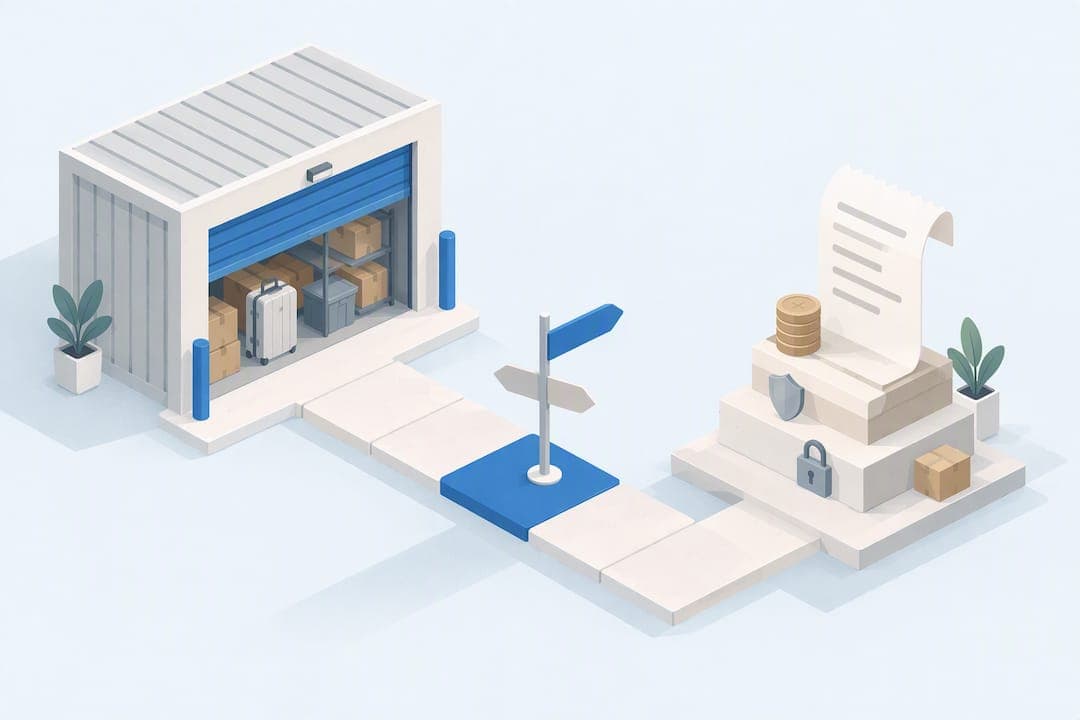
The three practical short term storage options are self-storage units, portable or curbside containers, and full-service mover storage. Match the choice to your situation: moving between homes favors containers or mover storage, short-term decluttering or renovation favors self-storage units, and vehicles like RVs or boats need dedicated vehicle storage. From there, cost, access, and flexibility decide the winner.
TL;DR:
- Choose self storage when you need repeated access; after a portable container leaves for a warehouse, you generally cannot reach belongings until delivery.
- Budget beyond rent: administrative fees can run $20 to $75, while required locks may cost $10 to $20, before container delivery or mileage charges.
- For electronics, photographs, or wood furniture, verify that climate control regulates both temperature and humidity; some facilities provide heat without humidity control.
- For a 30 to 90 day stay, compare total costs, including prorated rent, setup fees, locks, and delivery or pickup, instead of monthly rates alone.
- Do not pay by wire transfer, gift card, or cryptocurrency, and avoid providers who refuse written estimates or demand deposits before you inspect the unit.
Table of Contents
- Three main types of short-term storage explained
- How the main storage options compare on cost and access
- What short-term storage really costs once fees are added
- A simple checklist for choosing a short-term storage provider
- Packing and loading tips that protect your belongings
- How to avoid storage and moving scams
- What most renters get wrong about short-term storage
- Why Inline Storage works for short-term needs
- FAQ
- Sources
Three main types of short-term storage explained
Each storage format solves a different problem, and knowing the differences up front saves you from paying for features you won't use.
Self-storage units are the most common option for short stays. You rent a space at a facility and drive your own belongings there, choosing from drive-up units, indoor units, or climate-controlled rooms depending on what you're storing. They work well for renovation projects, staging a home for sale, or bridging a gap between move-out and move-in dates.
Portable or curbside containers get delivered to your driveway, you load them at your own pace, and the company either picks them up and stores them at a warehouse or leaves them on-site for do-it-yourself access. This format suits people who want to pack without a rental truck and don't need daily access once the container is sealed.
Full-service mover storage bundles storage into a moving package: movers pack and load your items, then hold them in a warehouse until your new place is ready. It's the least hands-on option, which also makes it the most expensive per month in many cases, but it removes nearly all physical labor from the process.
- Self-storage units: best for frequent access, renovation gaps, or short-term decluttering.
- Portable containers: best for a single move with no rental truck and minimal daily access needs.
- Full-service mover storage: best when you want someone else to pack, load, and store everything.
- Vehicle storage (RV or boat): a related short-term need, usually requiring open parking or covered spots rather than a standard unit.
How the main storage options compare on cost and access
Once you know which category fits your situation, the real decision comes down to four practical factors: who it's for, how you get your stuff, what you'll pay, and how secure it is.
- Best for: self-storage suits ongoing or intermittent access during a renovation or a slow move; containers suit a single packed-once move; mover storage suits people relocating long distance who want a hands-off experience.
- Access and convenience: self-storage units typically offer drive-up access and extended or 24-hour gate hours; containers sit in your driveway until pickup, then you lose access until delivery to the new address; mover storage usually means scheduling an appointment to retrieve anything mid-move.
- Cost drivers: self-storage charges a flat monthly rate plus occasional add-ons; containers charge for the unit, plus delivery and pickup fees, often with mileage-based charges that climb the longer you keep the container; mover storage folds everything into the moving quote, which tends to run higher overall.
- Security and climate control: self-storage facilities commonly offer gated entry, video surveillance, and climate-controlled rooms for sensitive items like electronics or wood furniture; container companies vary widely in whether their warehouse offers climate control; ask directly rather than assuming.
A short example helps make this concrete. Say you're renovating a kitchen for six weeks and need to clear out a dining room and some appliances. A self-storage unit with drive-up access lets you move items in and out as the project progresses, and a 10x10 unit typically handles a few rooms' worth of furniture. Compare that to a cross-country move where you won't need anything until you arrive: a portable container or mover storage removes the packing-and-driving burden, even though it usually costs more per month.
When comparing providers, ask about climate control explicitly. A storage room that claims "climate controlled" sometimes only means heated, not humidity-regulated, which matters for electronics, photos, or wood furniture during humid summer months. Ask whether the unit maintains both temperature and humidity ranges, and get the answer in writing if it affects your decision.

What short-term storage really costs once fees are added
The advertised monthly rate rarely tells the whole story, especially for stays under three months. Short-term renters often pay more per month than long-term renters because many providers price month-to-month leases higher than multi-month contracts, and short stays don't benefit from promotional discounts that reward longer commitments.
Common hidden fees to watch for:
- Administrative or setup fees, often charged once at signup.
- Required lock purchases if you don't bring your own.
- Delivery and pickup charges for portable containers, frequently paired with mileage fees.
- Insurance or protection plan premiums, sometimes bundled into the lease by default.
One sourced figure worth budgeting around: some commonly hidden self-storage fees include administrative charges of roughly $20 to $75 one-time and required lock purchases around $10 to $20, on top of the advertised monthly rent.
The simplest way to avoid sticker shock is to calculate your true 30 to 90 day cost before committing: add the first month's rent, any prorated days, delivery or pickup charges, the lock cost, and one-time administrative fees into a single number, then compare that total across providers rather than comparing headline monthly rates alone. This full-cost approach catches the add-ons that a bare monthly price hides.
Timing matters too. Summer months typically bring higher demand for storage and moving services, which can push prices up and create urgency that scammers exploit. If your schedule allows it, booking outside peak season or locking in a rate early can help you avoid both the price bump and the rushed decision-making that comes with it.
A simple checklist for choosing a short-term storage provider
Before you sign anything, run through a short set of questions that separate a solid provider from a problem waiting to happen.
- What's the minimum rental term, and is there a penalty for leaving early?
- What does access look like: drive-up, 24-hour gate, or appointment-only?
- What fees come on top of rent: administrative charges, locks, insurance, delivery?
- Is climate control included or an upgrade, and does it cover humidity as well as temperature?
- What security features are in place: gated entry, video surveillance, individual unit alarms?
- What's the cancellation and refund policy if your plans change mid-month?
Work through the decision in order: figure out your timeline first, then how often you'll need access, then your budget ceiling, then the actual volume of belongings. Settling volume last keeps you from renting a unit sized for "just in case" rather than what you actually have. A timeline-then-access-then-budget-then-volume approach helps renters avoid overpaying for space or features they don't end up using.
Red flags that should stop you from signing:
- A provider that only accepts payment by wire transfer, gift card, or cryptocurrency.
- A blank or incomplete contract you're asked to sign "now, details later."
- A demand for a large upfront deposit before you've seen the unit or container in person.
Documents to keep before you pay anything:
- A written estimate listing every fee, not just the base rent.
- An itemized breakdown of one-time versus recurring charges.
- The provider's direct contact information and physical address, not just a phone number.
Pro Tip: Ask for the itemized fee list in writing before you tour the unit. If a provider hesitates to put fees in writing, treat that as your answer.
Packing and loading tips that protect your belongings
A little preparation during loading prevents most of the damage that happens in short-term storage, and it makes retrieval far less frustrating if you need something mid-stay.
- Wrap furniture and electronics in moving blankets or bubble wrap, and use moisture-resistant covers for anything sensitive to humidity swings.
- Keep frequently needed items near the front of the unit or container, and label every box by room and contents rather than a vague "misc."
- Photograph your inventory before sealing boxes, which creates a record if anything is damaged or misplaced.
- Load heavy, sturdy items first and stack light, fragile items last to avoid crush damage from boxes shifting in transit.
- For RVs and boats, disconnect or trickle-charge the battery, use breathable covers rather than plastic tarps to prevent condensation, and check tire pressure before and after a storage period longer than a few weeks.
Leaving a narrow walking path down the center of a unit, rather than stacking wall to wall, makes it much easier to grab one box without unloading the entire space.
How to avoid storage and moving scams
Scams tend to follow a predictable pattern: a deal that looks too good, a provider that won't put anything in writing, and pressure to pay immediately. Rental scams commonly involve demands for payment by wire transfer, gift card, or cryptocurrency, along with fake listings or stolen photos; legitimate providers accept standard payment methods and let you see the actual unit or container before you commit.
If you're hiring movers as part of a storage plan, interstate moving companies must be registered with the U.S. Department of Transportation, and a written estimate detailing all fees should be provided before you sign anything.
Verification steps worth the ten minutes they take:
- Get a written estimate and confirm it lists every fee, not just the base rate.
- Ask directly what insurance or protection plan covers your belongings, and what it excludes.
- Check the provider's DOT registration if interstate movers are involved.
- Read recent reviews and look for a pattern of unresolved complaints.
A provider with visible trust signals, a facility with video surveillance, digital rental options, and a transparent starting price, makes verification easier because there's less guesswork about what you're agreeing to. If something feels off, report it: the FTC accepts fraud reports at ReportFraud.ftc.gov.
What most renters get wrong about short-term storage
The biggest mistake I see isn't picking the wrong storage type. It's skipping the written estimate because the phone quote sounded fine. Fees that seemed minor on a call add up fast once you tally delivery charges, a lock, and an administrative fee you never heard mentioned until the invoice arrived.
My one piece of advice: get an itemized, written estimate and photograph your inventory before you load anything. It costs you five minutes and saves you a dispute later.
— Ian
Why Inline Storage works for short-term needs
If a self-storage unit is the right fit for your timeline, we built Inline Storage around the exact checklist above: no guesswork about fees, no waiting around for office hours, and no long-term commitment required.

We offer month-to-month leases, so a six-week renovation project or a two-month move gap doesn't lock you into a year you don't need. Our unit sizes range from compact lockers and 5x5 spaces up to 10x20 and 10x30 units, and climate-controlled options are available for anything sensitive to temperature or humidity. Our facility includes drive-up access, gated entry, and video surveillance, and our Touchless Rentals™ system lets you rent a unit online through our 24/7 contactless kiosk without ever waiting in a leasing office.
- Month-to-month leases with no long-term contract required.
- Unit sizes from 5x5 lockers to 10x30 spaces, plus climate-controlled rooms.
- Drive-up access, gated entry, and video surveillance on-site.
- RV and boat storage available for vehicles that don't fit a standard unit.
Before booking, confirm your exact unit size, whether climate control is included, and your move-in date. Check availability and rent your unit online at Inline Storage to get started.
FAQ
Can you rent a storage unit for 1 month?
Most self-storage facilities offer month-to-month leases with no requirement to commit beyond 30 days, though the per-month rate is often higher than longer-term contracts. Confirm the minimum term and any early-termination fees before signing, since policies vary by provider.
Is it cheaper to rent a pod or a storage unit?
It depends on how long you need storage and how much you move. Portable container rentals often add delivery, pickup, and mileage-based fees that climb the longer you keep the container, while a local self-storage unit with month-to-month billing tends to be cheaper for short stays under about 60 days when you need frequent access.
How much does it cost to rent PODS at Home Depot?
Pricing for portable container services varies by location, unit size, and rental length, and container companies typically list rates on their own sites rather than through retail partners. Request a written, itemized quote directly from the provider so you can see delivery, pickup, and mileage fees before committing.
Is there another company like PODS?
Several portable container companies and full-service movers offer comparable door-to-door storage logistics, and self-storage facilities offer a drive-up alternative for anyone who wants more frequent access. The right fit depends on whether you need door-to-door convenience or hands-on access during your storage period.
Sources
- Storable resource on storage pricing transparency
- Moving this summer? Watch for rental scams | Consumer Advice (FTC)